This section examines the financial consequences of prolonged housing problem. The evidence presented here shows how uncertainty over repair bills, damaged possessions, rising household costs, and the prospect of further losses resulted in acute financial stress and anxiety across tenures. These pressures were then compounded as residents increasingly found themselves expected to absorb the expense, labour, and responsibility of addressing defects they had neither created nor controlled. Taken together, the accounts that follow reveal how unresolved housing problems generated both immediate financial insecurity and a wider transfer of costs onto residents.
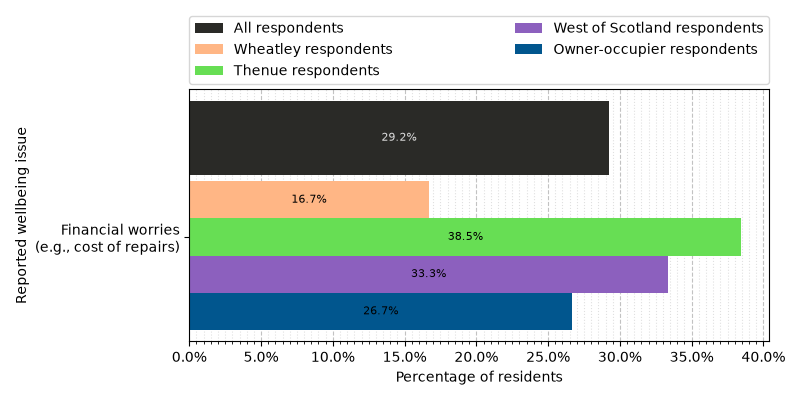
- Almost a third of survey respondents (29.2 per cent) reported experiencing financial worries as a result of their housing conditions.
Financial Stress and Anxiety
Housing problems created a persistent sense of financial insecurity. Residents described living with large and often unpredictable costs that they felt powerless to avoid. The stress arose not simply from cost alone, but from the uncertainty surrounding what further expenditure might yet be required and how it would be paid for.
Unlike tenants, owner-occupiers were personally responsible for meeting the cost of major repairs, placing them at risk of substantial and unexpected financial costs. Susan Robertson faced the prospect of replacing severely deteriorated windows and doors throughout her home. Reflecting on the quotes she had received, she described the significant financial anxiety this had created:
It’s incredibly stressful, and replacing all the doors and windows in the property is also going to be really expensive… all of these uncontrollable things that are going on around me, it’s incredibly stressful… I’m going to be using up a huge bulk of savings… simply to make my house properly watertight and airtight again… The quotes that I’m getting for the windows, it’s almost £40,000… That’s a lot of money to find… and then the awareness that when they start actually working, if they find anything else, I’ve got a major problem. It’s incredibly stressful.
Interview with Susan Robertson (Owner-Occupier) by Isla Wallace and Bohdan Starosta (26.03.2026)
Similar concerns were expressed by Elizabeth Rutherford, who repeatedly returned to what she described as ‘a forty grand bill hanging over my head’.1 Reflecting on the financial burden and anxiety this created, she explained:
I still need to pay my mortgage every month, I still need to pay my bills every month. Forty grand to me is not touchable. Forty grand to me is half my mortgage right now.
I can weep. I honestly could. See the more this conversation goes on, I can’t take this anymore. It’s just too fucking stressful. I’m going to have to find forty grand in the next fucking six months and it’s not going to be pleasant. It’s not, again it’s not, I mean we’re joking about it, but it’s not, I can’t fucking sleep.
Interview with Elizabeth and Will Rutherford (Owner-Occupiers) by James Ferns and Gary Wong (11.03.2026)
Whilst owner-occupiers worried about substantial repair bills, tenants often described the financial consequences of repeatedly replacing possessions damaged by unresolved housing problems. For Kirsty Sinclair, flooding and water damage had resulted in carpets and flooring being replaced multiple times, with the costs ultimately falling on her. Reflecting on the financial burden this created, she explained:
It’s cost me an absolute fortune and now I’m at the stage that I’ve maxed out all the credit I can possibly get. So I can’t afford to keep replacing, keep replacing, because it’s now affecting obviously me and getting me into debt.
Interview with Kirsty Sinclair (Thenue Housing Association Tenant) by James Ferns and Frances Galt (27.11.2025)
Elsewhere in the interview, Kirsty described how the repeated replacement of damaged flooring had pushed her into debt, creating what she described as a ‘vicious circle’:
It’s just constant stress, constantly doing your house up, money worries trying to replace all the furniture that gets damaged, all the flooring that gets damaged. So you’re constantly chasing your own tail because you’re getting maybe loans – like I’m on UC – so like, you’re getting loans to cover whatever or pay up weekly on carpets and then they’re getting damaged and that’s three carpets and three floorings I’ve replaced… So then I’m paying that back, which is leaving me short every month… So it’s just a vicious circle.
Interview with Kirsty Sinclair (Thenue Housing Association Tenant) by James Ferns and Frances Galt (27.11.2025)
These financial pressures were experienced against the backdrop of the cost-of-living crisis. At a time when many households were already struggling to pay for essentials, residents found themselves confronted with additional costs arising from housing problems they had not created. The anger evident in many accounts stemmed not simply from the expense itself, but from the belief that they were being forced to bear costs that should never have fallen upon them in the first place. Both Kirsty Sinclair and Claire Sullivan situated their experiences within this broader financial reality:
It’s all expenses that you just really can’t afford. Especially these days, like with the cost of living and everything else, you know what I mean? It’s just… It’s deflating.
Interview with Kirsty Sinclair (Thenue Housing Association Tenant) by James Ferns and Frances Galt (27.11.2025)
We’re then put in financial difficulty because, you know, we’re in a cost-of-living crisis as it is. We’re not only trying make ends meet, whether that be with food, bills. But now you’ve got financial added pressures with what’s going on with the housing, and you’ve got to ask yourself: is the housing actually aware of this?
Interview with Claire Sullivan (West of Scotland Housing Association Tenant) by James Ferns and Frances Galt (30.01.2026)
For some residents, these pressures were compounded by rising energy bills – heat escaping through defective windows and poorly sealed homes comes at a financial cost. Reflecting on her own experience, Susan Robertson explained:
I’ve had to boost up the heating, my heating bill was a lot more this year than it was even like a year ago… I’ve been in a fortunate position that I can do that, but it’s not a long-term fix and it shouldn’t have to happen.
Interview with Susan Robertson (Owner-Occupier) by Isla Wallace and Bohdan Starosta (26.03.2026)
The financial burden did not end with repair bills, damaged possessions, or higher energy costs. Residents also described spending money simply to cope with the consequences of housing problems on a day-to-day basis. Money was spent attempting to manage dampness, mould, odours, cold, and other conditions that residents believed should never have required such expenditure in the first place. As Helen Taylor explained:
I constantly bleach, disinfectant, air fresheners – you name it… it’s cost me a fortune because nothing seems to take the smell away.
Interview with Helen Taylor (Thenue Housing Association Tenant) by James Ferns and Isla Wallace (03.02.2026)
For some residents, these costs accumulated over months and even years. Reflecting on a compensation offer she regarded as more an insult than a solution, Maria Rossi explained that it would not even cover the money she had spent attempting to manage the effects of dampness and mould within her home:
I’m not asking for hundreds of pounds in compensation, do you know what I mean? But just to be compensated on things I’ve lost and the stress and anxiety. And they just say, “Here, there you go, there’s £500”. That doesn’t even cover for my cleaning supplies that I’ve had to spend in the last fifteen months… I’ve had to throw out everything… my OCD wouldn’t let me keep them in the house. If I find something with damp and mould on it, that’s it: it’s ripped up and it’s out. There and then, it’s straight out the door.
Interview with Maria Rossi (Wheatley Homes Glasgow Tenant) by James Ferns and Frances Galt (26.02.2026)
Elsewhere, residents described spending money not simply to manage housing defects, but to protect family members from their consequences. Having previously described his fears about the impact of cold conditions upon his elderly mother’s health, James Stewart reflected on the cost of trying to keep her warm:
I’ve had to get electric blankets for her chair there, I’ve got one for her bed, halogen heaters, and you know yourself – the price of electricity, all this stuff just adds up… we got told when we moved here our electricity prices would be halved from what they were, and I think they’re more now.
Interview with James Stewart (Thenue Housing Association Tenant) by James Ferns and Isla Wallace (02.03.2026)
The accounts presented here reveal that the financial consequences of housing problems extended far beyond isolated repair bills or one-off expenses. Residents described living with uncertainty, debt, and the constant fear of further costs yet to come. What emerged is a picture of households forced to absorb financial burdens arising from housing problems they neither created nor controlled. The anxiety described throughout this section was rooted not simply in the money itself, but in the knowledge that the next bill, the next replacement, or the next expense could be just around the corner.
Residents Filling the Gap
Transfer of Responsibility
Faced with repeated delays, inadequate repairs, and unresolved defects, many residents found themselves carrying out work that they believed should have been undertaken by their housing provider. Residents described sealing windows, treating mould, undertaking repairs, and purchasing materials after losing confidence that reported problems would be addressed. What emerges is not simply a picture of residents maintaining their homes, but of residents stepping in where housing providers had failed.
After a year of being passed between organisations and receiving a repair that resulted in even more water entering the property, Eileen Gallagher ultimately opted to resolve the problem herself:
When we first moved in… the window was letting in water. It damaged wardrobes, carpets, furniture… [the] housing association basically told me to contact [the builders] because there hadn’t been a proper handover done yet. [The builders] ignored us for the best part of a year. Ended up with Wheatley Homes coming out and they said that they couldn’t find an issue. They drilled holes in the window to drain it, which made no sense because it ended up letting more water in… so I just ended up taking a couple of tubes of sealant and sealed the windows to stop anything from going in.
Interview with Eileen Gallagher (Wheatley Homes Glasgow Tenant) by James Ferns and Bohdan Starosta (10.03.2026)
Eileen’s testimony also illustrates how responsibility for dealing with mould was effectively transferred onto residents. Having concluded that Wheatley Homes Glasgow were not going to address the problem, she described taking it upon herself to manage mould within the property, despite only having access to its visible symptoms:
The mould… I’ve tried to be as proactive as possible because I know [Wheatley] aren’t going to fix it. So, my idea was treat what I can see, get it out the way, and hopefully it doesn’t damage anybody’s health. Obviously, I’m only treating what I see, so I don’t have access to everything else underneath.
Interview with Eileen Gallagher (Wheatley Homes Glasgow Tenant) by James Ferns and Bohdan Starosta (10.03.2026)
Repeated experiences of delay, ineffective repairs, and unresolved defects led some residents to stop seeking assistance altogether and instead assume responsibility for problems that they believed should have been addressed by their housing provider:
I’ve got to the stage now I don’t even like phoning them, I’m doing the repairs myself.
Interview with James Stewart (Thenue Housing Association Tenant) by James Ferns and Isla Wallace (02.03.2026)
Cupboard doors in the kitchen keep falling off. My husband usually fixes them cause he’s a joiner. But there’s only so much you can do, you know what I mean?
Interview with Charlotte Wilson and Claire Wilson (Wheatley Homes Glasgow Tenant) by Bohdan Starosta and Alan Sproull (03.02.2026) [Charlotte Wilson]
I need my middle toilet fixed and I don’t want to phone them. I’ll wait until I get paid on Monday and I’ll buy the full valve for my toilet myself to fix it. Because I don’t even want to let them to fix it.
Interview with Maria Rossi (Wheatley Homes Glasgow Tenant) by James Ferns and Frances Galt (26.02.2026)
Bathroom’s needed resealed multiple times, but they do not do any significant repairs that will fix the core issue. There have been leaks into other rooms that’s bringing in lots of dampness that I have to treat with bleach by myself.
Survey Participant 78 (Wheatley Homes Glasgow Tenant)
These accounts point to something more troubling than residents simply undertaking repairs themselves. They suggest a collapse in confidence that reported problems would be resolved at all.
The consequences extended beyond isolated repairs. Residents also described using their own time, skills, and money to prevent defects from worsening, protect their homes from further damage, and address problems that they believed should have been resolved by their housing provider. James Stewart explained how he treated his own windows:
If you look out the window there you can see those, like all the wood’s rotten… we’ve had ours painted, to protect the wood, but I’ve had to paint it all myself as well, multiple times, just to stop it from all rotting away… They just don’t come out and fix anything.
Interview with James Stewart (Thenue Housing Association Tenant) by James Ferns and Isla Wallace (02.03.2026)
The transfer of responsibility was reflected in survey responses. One tenant described moving into a property that they regarded as ‘unliveable’, and being left to fund the necessary repairs themselves:
When we moved in the house was unliveable, we had to repair it on our own purse with no help from Wheatley.
Survey Participant 91 (Wheatley Homes Glasgow Tenant)
What emerges from these accounts is a striking loss of faith in formal repair processes. Residents described abandoning requests for assistance and instead carrying out repairs themselves, often purchasing materials and replacement parts at their own expense. The significance of these accounts lies not in the repairs themselves, but in what they reveal: the labour, responsibility, and cost of maintaining homes were increasingly transferred onto residents after repairs were delayed, mishandled, or failed to materialise altogether. When tenants conclude that sealing windows, treating mould, purchasing parts, and carrying out repairs themselves is more effective than seeking assistance through official channels, confidence in the repair system has collapsed.
Priced Out of Repairs
Housing providers benefit from a system that shifts the consequences of housing failures onto residents. Flooring is damaged by flooding, residents pay to replace it, flooding occurs again, and residents are expected to pay once more. Over time, many become unable or unwilling to continue absorbing these losses. Yet when residents refuse to lift flooring they cannot afford to replace, decline works that would leave them financially worse off, or disengage from repair processes they no longer trust, these outcomes can be recorded as some variant of ‘customer choice’. What follows raises serious questions about the fairness of such processes and the extent to which residents are being presented with meaningful choices at all.
After repeated water damage and months of inaction, Maria Rossi delayed installing replacement flooring because she expected it would simply be destroyed again. Reflecting on the position she had been placed in, she explained:
It was just like bare floor. And I’ve got grandkids about… I had to go buy big rugs… I had the floor in to put down, but I wasn’t putting it down because it’d just get ruined… I ended up having to put it down, because they just weren’t coming out to do nothing. Fourteen months of me reporting it to them… I had to put something down in the living room. So, I put my amazing floor down and then that got ruined.
Interview with Maria Rossi (Wheatley Homes Glasgow Tenant) by James Ferns and Frances Galt (26.02.2026)
Eileen Gallagher described repeated pipe failures that caused extensive damage throughout her home, destroying flooring, furniture, mattresses, and other possessions. Explaining the scale of the losses involved, she stated:
Each time, when they burst, it caused massive damage – you’re talking about at least £5,000 each time worth of damage. Everything had to be replaced… everything, everything, carpets, laminate. I’ve had to replace beds… there’s been big patches of water coming right through the ceiling – went through mattresses, beds… there’s been loads and loads of damage. It’s being ignored.
Interview with Eileen Gallagher (Wheatley Homes Glasgow Tenant) by James Ferns and Bohdan Starosta (10.03.2026)
Elsewhere in the interview, Eileen explained that many of the damaged items could not be replaced at all. Despite losses running into thousands of pounds, she stated that the only compensation ever offered by Wheatley Homes Glasgow was a £50 voucher towards the cost of running dehumidifiers:
There’s been loads and loads of things that have just been ruined by it and can’t be replaced. And not once has Wheatley ever compensated us, [except] a £50 voucher once to run dehumidifiers.
Interview with Eileen Gallagher (Wheatley Homes Glasgow Tenant) by James Ferns and Bohdan Starosta (10.03.2026)
In instances where replacement was eventually offered, residents often described being left worse off. After repeated damage to flooring caused by unresolved housing problems, Kirsty Sinclair explained that any replacement provided would not reflect what had actually been lost:
I had a bit of back and forth last week because [they’re] like “I’m not here for compensation, I’m just here for repairs”. I’ve said, “you’ve got to understand how frustrated I am living in this”. Like that’s another mattress, another set of drawers, another carpet, my flooring. And don’t get me wrong, I’ve argued with them this time to the point they’ve said they’ll replace the kitchen floor. But what kitchen floor will I be getting? It’ll not be the one that I paid £500 to put down.
Interview with Kirsty Sinclair (Thenue Housing Association Tenant) by James Ferns and Frances Galt (27.11.2025)
Eileen Gallagher described being told that flooring would need to be lifted to investigate water damage beneath her property, whilst simultaneously being informed that any replacement flooring would be her responsibility. She explained how circumstances such as these could later be recorded as ‘customer choice’:
When they came out to check the bottom bathroom and possibly talk about removing the shower, they said to me that the water had been going under the subfloor in the bathroom and they thought it had spread out to the rest of the house… they said to me,
Interview with Eileen Gallagher (Wheatley Homes Glasgow Tenant) by James Ferns and Bohdan Starosta (10.03.2026)When are you lifting your floor?And I said:Well I’m not lifting my floor, it’s not long down. If you replace it, you can lift it. And he said:No, we don’t do that… we don’t replace anything… I’ve had that for years and they’ve, they’ve kind of always done that to us. But they’ve never tried to replace anything that they’ve damaged or took away or lifted, it’s always been at a cost to me… A lot of it gets put down to being the choice of the customer… So nine times out of ten, there’s no point in phoning them because they’re not really interested anyway… they don’t want to replace anything, they don’t want to fix anything, and they don’t want to put anything back the way it was. You are very much left in a worse situation nine times out of ten than you previously were.
Eileen’s testimony exposes a fundamental problem with concepts such as ‘customer choice’ within housing repairs. A resident who cannot afford to replace flooring that has already been damaged through no fault of their own is not being presented with a meaningful choice. Yet decisions taken under these circumstances can nevertheless be recorded as ‘customer choice’, obscuring the financial pressures and repeated losses that shaped them. Elsewhere in the interview, Eileen again challenged the principle underpinning this approach:
It’s taken me a long time to replace a lot of things… and it’s bit by bit I’m doing it. But I can’t afford to take full floors up, full carpets up and replace every single bit… I can’t afford to do this all at the one time, whereas it should be Wheatley’s responsibility – any housing association’s responsibility. If something happens in the house and it’s not your fault, they should be replacing it. I don’t feel as if that’s an unreasonable request to ask any of them to do. But because nine times out of ten, it’s their shoddy handywork that causes it.
Interview with Eileen Gallagher (Wheatley Homes Glasgow Tenant) by James Ferns and Bohdan Starosta (10.03.2026)
Claire Sullivan similarly described the dread of being told that flooring would need to be removed yet again, knowing that the financial consequences would ultimately fall upon her household:
They said,
Interview with Claire Sullivan (West of Scotland Housing Association Tenant) by James Ferns and Frances Galt (30.01.2026)Oh, we need to take up the flooring in this property. And my first question was like,Oh my god, not again. I don’t have this money to fix these things.
When she sought compensation for damaged belongings, she explained that no payment was forthcoming:
They were totally refusing me any payout whatsoever. Now I mean, I lost my flooring, my rug, all my toilet things, towels.
Interview with Claire Sullivan (West of Scotland Housing Association Tenant) by James Ferns and Frances Galt (30.01.2026)
One of the clearest illustrations of this process came from a survey respondent who had already paid several times to replace flooring damaged by flooding. Having lost confidence that the underlying problem would ever be resolved, they described becoming unwilling to invest further money in flooring that they feared would simply be ruined again:
My bathroom has flooded three times which ruined my flooring which I paid for each time. I’m now scared to refloor my bathroom because I feel another flood is just a matter of time and West of Scotland Housing Association will not fix the root of the problem.
Survey Participant 85 (West of Scotland Housing Association Tenant)
Meaningful choice becomes difficult to identify within a system that repeatedly leaves residents worse off. A resident who cannot afford to replace flooring is not making a free choice. Nor is a resident who refuses to replace flooring because they expect it to be ruined again, or rejects an inferior replacement that leaves them financially worse off. What emerges instead is a system in which the financial consequences of housing failures are repeatedly transferred onto residents. Faced with repeated losses, inadequate compensation, and unresolved defects, many residents eventually reached the point where they could no longer continue absorbing the costs of problems they had not created. Under such circumstances, disengagement from repairs and complaints processes becomes a predictable outcome. Yet when residents withdraw in this way, the repeated losses, financial pressures, and unresolved defects that drove that decision risk disappearing from the record altogether, leaving what appears on paper to be a matter of choice rather than the predictable consequence of repeated housing failure.
Limits of Contents Insurance
Housing associations frequently directed residents towards contents insurance when they sought compensation for damaged possessions, but there was a fundamental flaw in this approach. Multiple residents were expected to rely upon insurance that they could not afford, could not obtain, or believed had been denied through processes shaped by the actions of their housing provider. Rather than providing a route to compensation, contents insurance often became another mechanism through which responsibility for housing-related losses could be displaced.
After being told that damaged possessions would need to be replaced through contents insurance rather than by Wheatley Homes Glasgow, Eileen Gallagher found herself effectively uninsurable because of the very housing problems that had caused the damage:
When I had tried to ask them to replace some stuff after previous floods, they told me that it was only covered by contents insurance, home contents insurance, and I had to get that. But when I tried to get home contents insurance, they wouldn’t insure me!
I’ve tried this as recently as two months ago, again to get home contents insurance and when I tried to get it, I had a message on my phone, saying,
We can’t offer you it at this point in time, somebody will be in contact with you to see if we can give you home contents insurance through Wheatley. And when they called me, they saidSo what happened?, and you’ve got to list everything within five years that has happened to your house, and when I listed all the stuff that had happened, they said,You probably shouldn’t have told us that, because we didn’t pay for it. And I said,But youse would have found out anyway because I had to report all the issues to the housing, and they said:Aye, but now you’ve just made yourself basically uninsurable.So, I’m kind of left with no insurance and no way to replace anything either, because I can’t afford to keep replacing all the things… you’re told if you get caught lying, it’s null and void [then] they’re telling me on the phone I shouldn’t have said anything because I replaced the stuff myself… I’m telling you because you already know this, you’ve already got it on record, so what do you want me to do?
Interview with Eileen Gallagher (Wheatley Homes Glasgow Tenant) by James Ferns and Bohdan Starosta (10.03.2026)
Eileen’s testimony exposes a profound contradiction. She was told that contents insurance was the appropriate route for recovering losses arising from repeated flooding and damage. Yet when she attempted to obtain insurance, the history of flooding and damage within the property became a barrier to obtaining cover. The housing failures that caused the losses had also undermined her ability to insure against them.
Kirsty Sinclair questioned why residents should be expected to claim on insurance for losses arising from repairs that had not been completed properly in the first place:
And the housing obviously. They don’t want to replace anything, they just tell you to claim your insurance, which – why should we keep having to do that for problems that their workers are fixing and then they’re still not fixed properly?
Interview with Kirsty Sinclair (Thenue Housing Association Tenant) by James Ferns and Frances Galt (27.11.2025)
Elsewhere in the interview, Kirsty explained that contents insurance was simply unaffordable at the time the damage occurred:
I’ve not got insurance to be honest obviously, it’s just a thing that I couldn’t afford. Like I split up with my partner a few years ago, I was just trying to get back to my feet. So, I didn’t have any insurance to even claim.
Interview with Kirsty Sinclair (Thenue Housing Association Tenant) by James Ferns and Frances Galt (27.11.2025)
The assumption that residents could rely upon insurance bears little resemblance to the realities described here. Insurance cannot function as a safety net for households who cannot afford to purchase it in the first place. But the problem was not confined to access to insurance alone. One survey respondent stated that their claim had been rejected because of poor maintenance and the landlord’s failure to deal properly with repairs:
Due to poor maintenance and negligence of landlord to properly deal with repairs, my contents insurance claim was rejected.
Survey Participant 34 (West of Scotland Housing Association Tenant)
Claire Sullivan’s testimony provides a more detailed account of how residents could find themselves blamed within compensation and insurance processes following housing failures. After flooding within her home, dehumidifiers were provided to assist with drying. Claire, who worked permanent night shifts, explained that housing staff arrived unannounced during her sleeping hours and found the dehumidifiers switched off. Although she explained that they had been turned off for safety reasons while she slept, and later provided evidence of her working pattern, she believed this incident was subsequently used against her when her claim was considered:
They provided dehumidifiers to the property… I work a Friday, a Saturday, and a Sunday… I was night shift. I get off work five o’clock in the morning. By the time I get home, [and] by the time I go to sleep, you’re looking about 7am… The door’s getting banged, and I’ve then went to the front door: it’s two guys from housing… They’re then like,
Interview with Claire Sullivan (West of Scotland Housing Association Tenant) by James Ferns and Frances Galt (30.01.2026)We need to come in and have a look at the humidifiers… And he’s like,Why are they off?I said,Oh, I’m in my bed. I’m night shift… I tried to explain this to him… They basically then put in a later report, and tried to accuse me that the floors weren’t drying up quickly enough because I was actually causing them not to, because I didn’t have them on that time they came… I had to go log into my worksheet, to my work, which I sent them proof of. They totally ignored it, and I’m positive… when it had gone to the insurance team, this was used on one of the reasons why I wasn’t given any money back for the insurance… they wrote to the insurance they use, and they gave them a breakdown of all – basically everything in it you could imagine was negative about me. Basically, almost like they were pointing the finger… I couldn’t keep it on. It’s like you go to bed, you go to turn the lights out, or you take a plug out, or you turn the plug off for safety reasons. That was my reasoning for doing that. I wouldn’t have it on… I wouldn’t have a dehumidifier on while I was in my bed in case something were to happen, a fire were to erupt, and I couldn’t protect my children.
Claire’s testimony describes a process in which scrutiny became focused upon the actions of the resident rather than the flood that had caused the damage in the first place. After explaining why the dehumidifiers had been switched off and providing evidence of her working pattern, Claire believed this information was ignored and later used against her when compensation was considered. The central issue was flooding within the property. Yet responsibility for the consequences of that flooding came to rest upon the resident herself. Rather than receiving compensation for losses arising from housing failures, Claire described being placed in the position of having to justify her behaviour and prove that she was not responsible for the damage.
The accounts presented in this section challenge the assumption that contents insurance provides an adequate remedy for losses arising from housing failures. Insurance cannot compensate residents if it is unaffordable, unavailable, or ineffective. Nor can it absolve housing providers of responsibility for losses arising from unresolved defects. What emerges instead is a system in which residents can be directed elsewhere for compensation while remaining burdened by the consequences of housing failures.
Full Rent, Limited Use
Paying More for Less
Housing providers continued to charge full rent for homes that residents could not fully use. Bathrooms, showers, and toilets were repeatedly rendered unusable by leaks, flooding, mould, and unresolved repairs. In some cases, facilities remained out of use for months or even years. Residents were therefore not simply living with housing problems; they were paying for parts of their homes that had effectively been taken out of service.
Claire Sullivan described how persistent leaks reduced a four-bathroom home to one in which only half of those facilities could be used:
The other toilet kept leaking and my ceiling nearly came through, so we now don’t use those toilets either. So, we only had access to two of the toilets even though we had four toilets within the household, because they weren’t getting fixed.
Interview with Claire Sullivan (West of Scotland Housing Association Tenant) by James Ferns and Frances Galt (30.01.2026)
The loss of facilities was often long-term rather than temporary. Eileen Gallagher explained that one bathroom in her home was effectively removed from use for almost two years:
My younger son’s bathroom was the first to flood in the house and his sink was the first to burst. They told me not to use that bathroom, couldn’t be used at all. So that bathroom was not usable for the best part of two years.
Interview with Eileen Gallagher (Wheatley Homes Glasgow Tenant) by James Ferns and Bohdan Starosta (10.03.2026)
Nor was this an isolated problem. Residents repeatedly described bathrooms and toilets that could no longer be used:
[For] nearly two months, my top [bathroom’s] been turned off of water… we can’t use it and the shower’s still growing mould.
Interview with Kirsty Sinclair (Thenue Housing Association Tenant) by James Ferns and Frances Galt (27.11.2025)
My lower bathrooms are unusable because of extreme mould.
Survey Participant 21 (Thenue Housing Association Tenant)
Unable to use downstairs toilet due to mould.
Survey Participant 47 (Thenue Housing Association Tenant)
The bottom floor bathroom is unusable with a very strong damp smell, there’s also a persistent mice infestation, and nothing has been done about it. One of us has a heart condition and we can’t use that bathroom.
Survey Participant 91 (Wheatley Homes Glasgow Tenant)
In many cases, repair works themselves resulted in facilities being removed without the underlying problem ever being resolved. Maria Rossi explained:
They come out and ripped my bottom toilet out three times, to the extent I’ve not got a shower in my bottom toilet at all. It was just a toilet pan and a wee sink – that still doesn’t work right.
Interview with Maria Rossi (Wheatley Homes Glasgow Tenant) by James Ferns and Frances Galt (26.02.2026)
Claire Sullivan described a similar experience. After repeated attempts to repair a leaking shower, her family eventually abandoned it altogether:
The full entire shower… the only part that was left in was the base. And then they would fix everything round it, but it would never be fixed because give or take a couple of weeks it would then be broke again. So, we just took it upon ourselves to not use that shower.
Interview with Claire Sullivan (West of Scotland Housing Association Tenant) by James Ferns and Frances Galt (30.01.2026)
The impact extended beyond facilities that had already been lost. Tesfay Kiros described being advised to restrict how his children used the bath because of concerns about ongoing water ingress:
One of [the repairs team], he said
Interview with Tesfay Kiros (Wheatley Homes Glasgow Tenant) by James Ferns and Isla Wallace (25.02.2026)maybe [the issues are] because of the bath… so every time when [my kids] bathe I should tell them,Oh be careful guys, water is there don’t splash up there. They are kids, you know… the roof may collapse… I told them don’t fill the bath… [but] they want to fill it, especially my small son. So, I say to them,no, don’t do this.
What emerges is a picture of homes becoming progressively less usable whilst rents remained unchanged. Bathrooms, showers, and toilets were lost, restricted, or abandoned altogether. Residents adapted, avoided rooms, altered routines, and learned to live around defects that should have been repaired. Eileen Gallagher captured the unfairness of this situation in a single sentence:
You’re two bathrooms down when you’re paying for four.
Interview with Eileen Gallagher (Wheatley Homes Glasgow Tenant) by James Ferns and Bohdan Starosta (10.03.2026)
That statement captures a wider problem identified throughout this research. Residents continued to pay full rent despite losing access to essential parts of their homes for months and, in some cases, years at a time. Housing costs remained unchanged even as the usability of the home steadily diminished.
One-Way Obligation
Residents repeatedly described a growing disconnect between the rent they were paying and the homes they were receiving in return. Juxtaposed to this, housing providers continued to collect rent in full irrespective of extensive and long-lasting disrepair. For many residents, the issue was not simply poor housing conditions. It was the expectation that they should continue paying for a standard of housing that they were no longer receiving.
Claire Sullivan identified what many residents regarded as a fundamental unfairness:
You are both working, you’re paying for a property. And you know, you’re expected to take care of this property, yet the people that are giving you this property aren’t even interested in taking care of this property to a high standard. But you are expected to pay the high levels of rent. You know? You are expected to pay service charges. You’re expected to be blamed.
Interview with Claire Sullivan (West of Scotland Housing Association Tenant) by James Ferns and Frances Galt (30.01.2026)
Once rent is understood as payment for a safe, functional, and properly maintained home, many residents struggled to understand how increasing rent could be justified alongside persistent housing failures. Eileen Gallagher expressed that frustration directly:
They’re raising the rent. So how can they justify raising the rent when they don’t want to do the repairs properly?
Interview with Eileen Gallagher (Wheatley Homes Glasgow Tenant) by James Ferns and Bohdan Starosta (10.03.2026)
Few quotations better capture the disparity between rent and housing quality than Kirsty Sinclair’s description of her home:
£500 odd pound a month to live in basically a pig sty.
Interview with Kirsty Sinclair (Thenue Housing Association Tenant) by James Ferns and Frances Galt (27.11.2025)
Maria Rossi’s testimony reveals the depth of frustration and cynicism that prolonged housing problems produce. After years of living within a state of disorder, she no longer viewed repairs as a genuine concern of her housing provider. What remained was her perception that rent would always be collected, whilst residents themselves were left to live with the consequences:
As long as they’re getting rent from that property, they couldn’t care about the repairs that get carried out… You just want a nice house when you’re putting money into it.
Interview with Maria Rossi (Wheatley Homes Glasgow Tenant) by James Ferns and Frances Galt (26.02.2026)
Maria’s testimony reflects a profound breakdown of trust. Yet the expectations that preceded that breakdown were remarkably modest. Residents were not demanding exceptional standards. They were asking for homes that were comfortable, functional, and pleasant to live in. As Kirsty Sinclair put it:
All I want is a house… you’re paying rent, so you should have a house that’s nice to stay in… just a home that I’m comfortable in and can live in and I’m happy to go home to.
Interview with Kirsty Sinclair (Thenue Housing Association Tenant) by James Ferns and Frances Galt (27.11.2025)
The anger evident throughout these testimonies was often rooted in a simple reality: residents continued to pay hundreds of pounds each month for homes they believed had been allowed to deteriorate around them. Rent remained non-negotiable even where parts of the home had become unusable, possessions had been damaged, and repairs remained unresolved. Many residents came to believe that whilst they were expected to fulfil every obligation placed upon them as tenants, housing providers were not being held to the same standard.
Footnotes
- Interview with Elizabeth and Will Rutherford (Owner-Occupiers) by James Ferns and Gary Wong (11.03.2026) ↩︎