This section turns from the consequences of poor housing conditions to the institutions responsible for preventing and resolving them. The evidence presented here raises fundamental questions about the competence, accountability, and culture of organisations entrusted with people’s homes. Rather than revealing isolated lapses in judgement or individual mistakes, the accounts that follow describe repeated institutional failures that allowed known problems to persist, undermined residents’ confidence, and fundamentally eroded trust in the very organisations responsible for providing safe and secure housing.
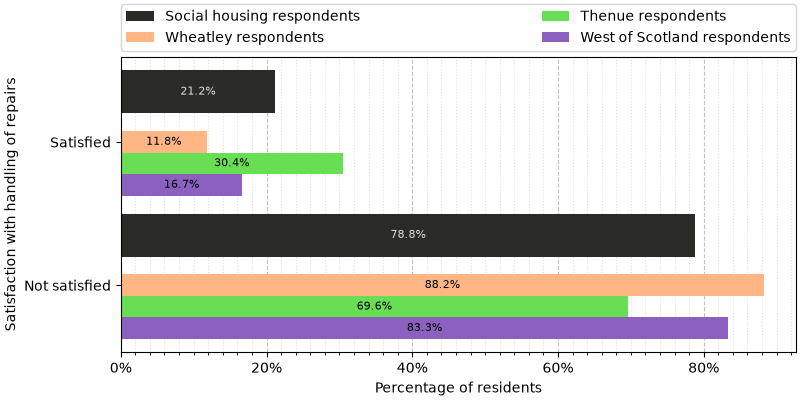
- Levels of satisfaction with housing providers were correspondingly low. Across all housing associations, only 21.2 per cent of respondents reported being satisfied with the outcome of their attempts to resolve housing problems.
- Thenue Housing Association tenants reported the highest level of satisfaction at 30.4 per cent, followed by West of Scotland Housing Association tenants at 16.7 per cent and Wheatley Homes Glasgow tenants at just 11.8 per cent.
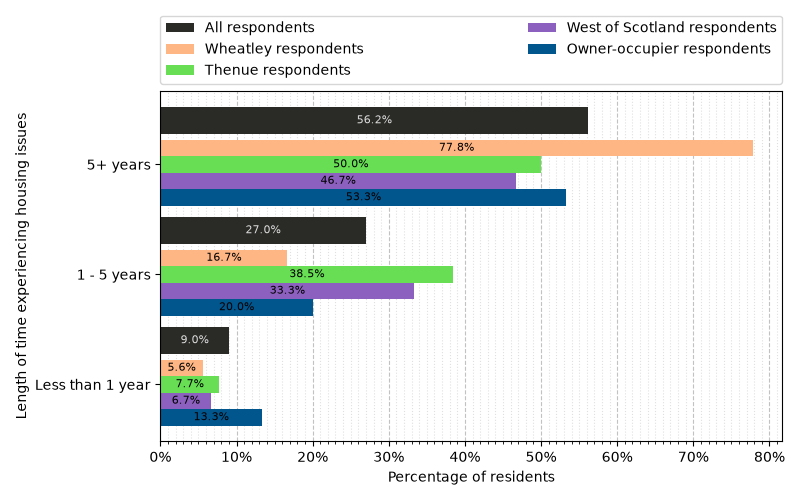
- The overwhelming majority of social housing tenants had reported housing problems to their landlord (94.4 per cent of Wheatley Homes Glasgow tenants; 88.5 per cent of Thenue Housing Association tenants; and 80 per cent of West of Scotland Housing Association tenants).
- Despite this, many social housing tenants reported living with housing problems for extraordinary lengths of time. This figure was notably higher among Wheatley Homes Glasgow respondents, with 77.8% reporting housing issues lasting more than five years (50 per cent of Thenue Housing Association tenants, and 46.7 per cent of West of Scotland Housing Association tenants, also reported dealing with housing problems for five years or more).
Incompetent and Unresolved Repairs
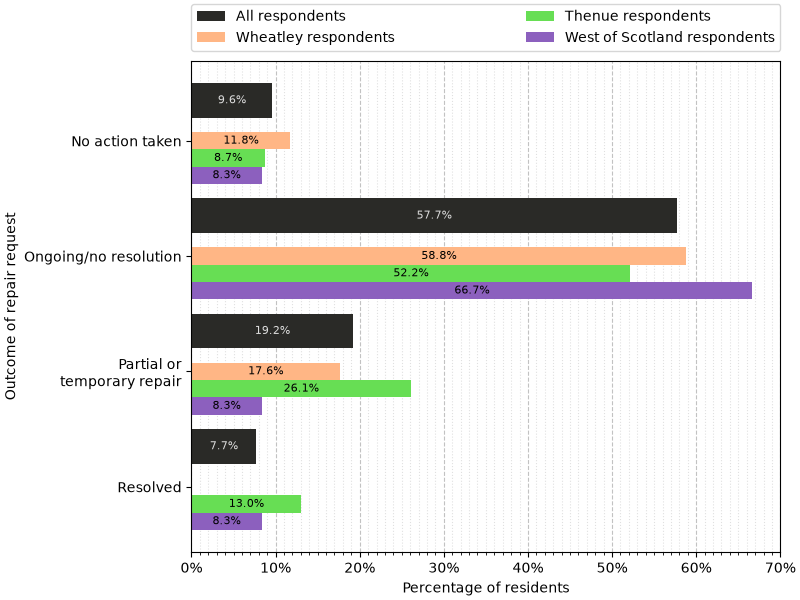
- Survey responses point towards an overwhelming lack of resolution once housing problems had been reported.
- Among tenants who had contacted their housing provider, 19.2 per cent reported that their housing problems received a partial or temporary repair (17.6 per cent of Wheatley Homes Glasgow tenants, 26.1 per cent of Thenue Housing Association tenants, and 8.3 per cent of West of Scotland Housing Association tenants).
- Among tenants who had contacted their housing provider, 57.7 per cent reported that their housing problems were ongoing or had no resolution (58.8 per cent of Wheatley Homes Glasgow tenants, 52.2 per cent of Thenue Housing Association tenants, and 66.7 per cent of West of Scotland Housing Association tenants).
- A further 9.6 per cent of tenants reported that no action had been taken in response to the problems they had raised.
- Across the entire cohort, only 7.7 per cent reported that their housing issue had been resolved. Even within this small group, the issues most commonly reported as resolved related to plumbing defects. Only one respondent reported a mould-related problem that they believed had been resolved quickly.
Failure as Standard Practice
The evidence presented here raises serious questions about the competence of housing providers’ repair processes. Years of failed repairs, recurring defects, and botched workmanship wrecked residents’ confidence in the repair process altogether. The testimonies that follow describe more than delay or poor communication. What emerges is a picture of a repair system that often appeared to be operating through trial and error. Residents were repeatedly assured that problems had been fixed. Yet leaks returned, ceilings collapsed again, replacement installations failed, and homes remained in disrepair.
After years of recurring failure, residents had little reason to believe that repairs would hold up any better than the ceilings they were supposed to fix. Kirsty Sinclair’s experience captures a pattern that appeared throughout the testimonies: the same defects returning after they had supposedly been repaired. Reflecting on the collapse of the same ceiling on two separate occasions within a matter of months, she explained:
Twice. Twice for the same issue. The washer and the toilet pan up in the top toilet. Same ceiling, same issue… wasn’t that long, I think it was last year it collapsed and it collapsed there in September.
Interview with Kirsty Sinclair (Thenue Housing Association Tenant) by James Ferns and Frances Galt (27.11.2025)
For Kirsty, the problem was not that repairs were absent. It was that they appeared incapable of delivering a lasting solution:
They come out, patch it up as best they can and leave you until it bursts again and then again… and then it’s just a repeat. They’ll patch it up, do the same.
Interview with Kirsty Sinclair (Thenue Housing Association Tenant) by James Ferns and Frances Galt (27.11.2025)
Others described the same cycle. Claire Sullivan explained that even the complete removal and replacement of a shower failed to resolve a longstanding leak:
They would fix everything round it, but it would never be fixed because give or take a couple of weeks it would then be broke again.
Interview with Claire Sullivan (West of Scotland Housing Association Tenant) by James Ferns and Frances Galt (30.01.2026)
Elsewhere, James Stewart described how a replacement shower installed after the collapse of flooring in a disabled bathroom began leaking almost immediately:
That took me about a month of fighting as well, just to get them to come out for that… it wasn’t fitted properly in the first place… they’ve replaced it [now], saying it’s top of the range and all that stuff. The first shower my mother went to have after that, it’s leaking again… I can switch it on right now, and you’ll see the water’s just going to come right on the floor… she can barely move – she’s got a Zimmer frame – and it’s very, very dangerous for her to get in and out the shower.
Interview with James Stewart (Thenue Housing Association Tenant) by James Ferns and Isla Wallace (02.03.2026)
Repeatedly, repairs appeared to function less as solutions and more as temporary interruptions before the same problem inevitably returned. At other points, the accounts move beyond failed repairs and into the realm of the absurd. Eileen Gallagher described a bathroom that remained unusable after repair teams repeatedly lost replacement sinks:
My younger son’s bathroom was the first to flood in the house and his sink was the first to burst… They lost two sinks – how you lose a sink is beyond me. But they lost two of them and every time somebody came out, they kept telling me they need to send somebody else out, somebody else needs to come out, somebody else needs to come out. And eventually – they never replaced the sinks; they taped it up with plumber tape and they kind of hoped for the best. Nothing’s happened because that bathroom’s not been usable, and my son doesn’t get full use of that bathroom.
Interview with Eileen Gallagher (Wheatley Homes Glasgow Tenant) by James Ferns and Bohdan Starosta (10.03.2026)
Claire Sullivan described reporting a floor that had effectively disintegrated beneath her feet, only for the eventual repair to consist of a sheet of cheap plywood screwed over the hole:
[In the utility cupboard] the floor had turned to mush and it completely disappeared, so there was now this big hole… they were aware of the hole, they didn’t do anything about it until I had contacted the CEO again and I was like, “Listen, we’re falling through this hole”… eventually they had come out to fix the flooring, they sent out three big works vans. And I mean these were huge, big vans. And I think there must have been about three or four workmen coming just to put a board of wood over it… they screwed four holes into it and left.
Interview with Claire Sullivan (West of Scotland Housing Association Tenant) by James Ferns and Frances Galt (30.01.2026)
Experiences of this kind eventually destroyed confidence in the repair process altogether. After almost five years of recurring defects, Maria Rossi reached a stark conclusion:
I mean, I had my bottom toilet ripped out so there was nothing in it. Just pipes sticking up the wall right down to nothing. They come out and they said they repaired it. Literally three weeks later? Same thing. I let them back in to rip it out again! Over the period of a week…
Interview with Maria Rossi (Wheatley Homes Glasgow Tenant) by James Ferns and Frances Galt (26.02.2026)fixed itthey said. Literally two months later? The same thing. Then my kitchen, they fixed it. Literally a month later? They had to come back out… nearly five years. It’s got to the stage now I won’t even let them in… they know what’s wrong, they just don’t know how to fix it.
Maria no longer wanted promises that problems had been resolved. She wanted honesty:
If you can’t fix it, then tell me that. Do you know what I mean? Just tell me that you can’t fix it, that’s fine, we’ll try and see what can do from that. But don’t stand there and lie to me and say you know what the problem is when they don’t know what the problem is… I think that’s why they’re just fobbing tenants like that – because they don’t know how to fix it.
Interview with Maria Rossi (Wheatley Homes Glasgow Tenant) by James Ferns and Frances Galt (26.02.2026)
Her testimony also raises a wider question about oversight. After years of repair work carried out within her home, she could not recall a single occasion where completed work appeared to be independently checked:
I’m not saying they’re not qualified, but it was a lot of like apprentices. And nobody came and checked the work at the start of it, halfway through it, and then at the end of it to make sure it was done to a decent standard.
Interview with Maria Rossi (Wheatley Homes Glasgow Tenant) by James Ferns and Frances Galt (26.02.2026)
The same concerns surfaced elsewhere:
No accountability from housing association… poor service when it comes to repairs… people sent out by Wheatley don’t know to resolve the issue.
Survey Participant 86 (Wheatley Homes Glasgow Tenant)
The full experience I have had with West of Scotland’s outside agencies doing work is nothing but a disgrace, I ended up in rental arrears having to move out my home to stay with family during it being fixed, my ceiling in my kitchen is still the same still.
Survey Participant 12 (West of Scotland Housing Association Tenant)
The failures documented throughout this section cannot be reduced to the actions of individual workers or contractors. Frontline operatives carried out the repairs residents encountered, and in many cases the work described was plainly incompetent. Yet the recurrence of the same failures across different homes, repair teams, and housing providers points towards deeper organisational problems: inadequate diagnosis, poor transfer of information, fragmented responsibility, insufficient supervision, weak quality control, and repair systems that appeared to measure whether a job had been completed rather than whether the underlying defect had been resolved. Individual failures therefore matter not as isolated exceptions, but as evidence of repair systems that repeatedly permitted, reproduced, and failed to correct them. Under such circumstances, the loss of confidence described throughout these accounts should not be viewed as surprising. The more difficult question is why residents should have been expected to retain confidence in the repair process at all.
Turning Up Clueless
Perhaps the clearest illustration of the dysfunction residents encountered was the frequency with which repair crews arrived at properties without even a basic understanding of the issue they had been sent to resolve. Helen Taylor’s assessment was blunt:
When they’re sending anybody out, they don’t know what they’re doing.
Interview with Helen Taylor (Thenue Housing Association Tenant) by James Ferns and Isla Wallace (03.02.2026)
Eileen Gallagher recalled a contractor arriving at her home apparently unsure of what he was supposed to do. Concerned by his demeanour, she asked him directly:
The boy that come out, and – no harm, but – he was a wee boy, and he just kind of looked lost when he walked in the house, and I said,
Interview with Eileen Gallagher (Wheatley Homes Glasgow Tenant) by James Ferns and Bohdan Starosta (10.03.2026)Do you even know what you are doing?And he saidNo. And I was likeRight.
Kirsty Sinclair described a similarly chaotic experience. Her floor had become saturated with water to the point that she feared it would collapse. After waiting for a dehumidifier, two separate workers arrived at her property. Neither appeared to know why they had been sent:
So my floor’s soaking through right to the point it’s going collapse. I’ve not had a dehumidifier. So they phoned me the other day, and somebody will be there between 12.30pm and 2.30pm, that’s fine. Gets there, the guy doesn’t know what he’s in the house for… then my front door goes and it’s another worker. He doesn’t know what he’s in my house for. And I’m like,
Interview with Kirsty Sinclair (Thenue Housing Association Tenant) by James Ferns and Frances Galt (27.11.2025)Where’s the dehumidifier?We’ve not got one, we’re bringing it on the day.
Maria Rossi suggested that these experiences were not exceptional. Rather, they reflected a wider breakdown in communication between housing providers, contractors, and residents:
They don’t know how to fix it… the repair people. But they need to know what they’re dealing with and they’ve told me… when they turn up for work in the morning, they get handed a sheet… but it’s sometimes not what the tenants maybe said, and they just come out and you go,
Interview with Maria Rossi (Wheatley Homes Glasgow Tenant) by James Ferns and Frances Galt (26.02.2026)Alright, what you out for?And they go,Oh, I don’t know, you tell me. The housing officer, she always says,Right, I’ll go back and tell them. So, when you’re expecting them to come out,Right, what are you here to do?Oh, I don’t know…Were you not told that?No.
Residents were often expected to explain problems to the very people who had been sent to fix them. Rather than arriving informed and prepared, workers frequently appeared reliant on residents themselves to explain the defect, the repair history, and the purpose of the visit. A repair service cannot function effectively when residents know more about the job than the workers carrying it out. These testimonies raise serious questions not only about communication and coordination, but about the competence of a repair system that repeatedly dispatched workers to residents’ homes without the knowledge required to do the job.
Ignoring the Cause
Housing providers seemed unwilling or unable to identify the root cause of housing defects. Instead, residents described a succession of superficial interventions that dealt with what was visible whilst leaving the underlying problem unresolved. The result was a repair process in which symptoms were repeatedly treated whilst causes were left untouched.
Maria Rossi’s testimony strikes at the heart of the issue. After years of failed repairs, she no longer believed that housing providers were attempting to identify the source of the defects they were supposedly repairing. In her assessment, the problem was not a lack of visits, contractors, or repair orders; the problem was ‘they’re not investigating it’.2 And without investigation, there could be no meaningful solution:
They don’t fix the problems. Personally, I think they make it worse because they don’t investigate. I don’t know how many times I had all these home repair teams out… like the top of the top… [and] I never got anywhere…. I never got anywhere, never got anything I was promised… Why should I let you back in? Because you have not fixed the problem. Because this is the third time you’ve come out to fix our problem.
Interview with Maria Rossi (Wheatley Homes Glasgow Tenant) by James Ferns and Frances Galt (26.02.2026)
Eileen Gallagher’s testimony supports Maria’s assessment. In her experience, repairs rarely addressed the underlying cause. Instead, workers dealt with whatever was immediately visible and left the root of the problem unresolved:
The issue that I’ve had with this is every single time you report something, they basically put a plaster on a bigger problem. And it never ends up being what it’s supposed to be, it never tends to be fixed properly. You tend to find that nine times out of ten, what they’re doing is surface level stuff. So, anything underneath you’re left to deal with on your own and it causes issues down the road with other things. To be honest with you the response has been shocking, it’s been terrible.
Interview with Eileen Gallagher (Wheatley Homes Glasgow Tenant) by James Ferns and Bohdan Starosta (10.03.2026)
Eileen Gallagher’s description of ‘putting a plaster on a bigger problem’ is vividly illustrated by Kirsty Sinclair’s experience. Faced with a leak, workers did not trace its source or repair the defect. Instead, they sealed it behind tiles:
The Thenue Housing workers had came out and they had sealed the leak in, so it was behind the tiles. So, obviously, they must have thought they were fixing it. They sealed it in and to the point that the tiles started popping off the walls because it was that damp in the background.
Interview with Kirsty Sinclair (Thenue Housing Association Tenant) by James Ferns and Frances Galt (27.11.2025)
It is difficult to understand the rationale behind a repair that appears to have trapped a leak behind a wall rather than address its cause. Leaks, of course, possess object permanence; hiding them from view does not make them disappear.
The logic underpinning Kirsty’s experience surfaced elsewhere. Rather than identifying why defects persisted, workers repeatedly returned to apply another temporary measure and leave the underlying problem untouched. James Stewart described an almost farcical cycle of repairs around his kitchen sink:
They’ve taken the kitchen sink out like three times now… and there’s several holes – which, the first guy that came out [he] just filled underneath my sink with expanding foam which was coming out of everywhere for about a week – and, they’ve been out several times, and they just keep filling it, expanding foam, expanding foam. They’re not actually dealing with the problem.
Interview with James Stewart (Thenue Housing Association Tenant) by James Ferns and Isla Wallace (02.03.2026)
Tesfay Kiros had been living with the same leak for ‘more than three years’. During that period, repair teams attended the property multiple times and carried out various works. Yet the leak remained unresolved. The persistence of a defect over such an extended period is difficult to reconcile with the claim that meaningful repairs were taking place. As Tesfay explained:
They come to the toilet, and they have done something but it’s not sorting it out… I know that they are not fixing it… two or three times they came. They came to fix it, but it’s not fixed… the people who come, I don’t know whether they are not identifying the problem, or they are fixing something else. For example, the last time he came he changed the bath, but it’s not sorting it out… they’re not fixing the real problem… the only problem is, if they fix it, it’s not fixed.
Interview with Tesfay Kiros (Wheatley Homes Glasgow Tenant) by James Ferns and Isla Wallace (25.02.2026)
Criticism from residents was often remarkably straightforward. As Kirsty Sinclair put it:
They know it’s an issue. They should be fixing the issue.
Interview with Kirsty Sinclair (Thenue Housing Association Tenant) by James Ferns and Frances Galt (27.11.2025)
One survey respondent distilled the problem to its essence. Repairs were repeated, interventions were carried out, yet the underlying defect remained untouched:
Bathroom’s needed resealed multiple times, but they do not do any significant repairs that will fix the core issue.
Survey Participant 78 (Wheatley Homes Glasgow Tenant)
The issue identified throughout these testimonies was not simply that repairs failed, but that the cause of defects often appeared secondary to the management of their symptoms. Leaks were sealed rather than traced. Defects were patched or covered whilst the underlying problem remained untouched. Under such circumstances, recurring failures should not be viewed as unexpected, rather, they were the predictable outcome of a repair process that repeatedly mistook the symptom for the cause.
Concealment as Treatment
The treatment of mould provides some of the strongest examples of the incompetent repairs residents encountered. Workers repeatedly applied superficial fixes to problems that clearly required something more substantial. Mould was painted over, sealed behind wet wall panels, and treated in ways that residents themselves understood would never address the source of the issue. Charlotte Wilson described an apparently endless cycle in which mould was repeatedly ‘sprayed with something’, but always returned:
My bathroom gets mould in it, and they come out and they spray it with something… then it just comes back again. It’s just swings and roundabouts.
Interview with Charlotte Wilson and Claire Wilson (Wheatley Homes Glasgow Tenant) by Bohdan Starosta and Alan Sproull (03.02.2026)
Maria Rossi described much the same pattern after nearly eight years of damp and mould complaints. In her view, the cycle persisted because the underlying dampness had never been properly addressed:
They’ve still not fixed the problem nearly, what, eight years later? Do you know what I mean? They’ve just replaced a bit of floor, they’re not interested in the mould and the damp… If you don’t treat a damp problem, it’s going to come back. If you put paint on it, it’s still going to come back.
Interview with Maria Rossi (Wheatley Homes Glasgow Tenant) by James Ferns and Frances Galt (26.02.2026)
Neither resident expressed surprise that the mould returned. Both understood that unless the dampness causing it was addressed, the outcome would remain the same. Eileen Gallagher repeatedly challenged the methods used to address damp and mould in her home. When workers proposed treating mould with oil-based paint, she immediately questioned the rationale:
I told them I wasn’t happy because there were wet patches everywhere and they told me they would paint it. But they’re talking about using an oil-based paint. But an oil-based paint only covers it, it doesn’t actually treat the mould itself and then eventually you started to see mould spores coming through.
Interview with Eileen Gallagher (Wheatley Homes Glasgow Tenant) by James Ferns and Bohdan Starosta (10.03.2026)
Eileen Gallagher described another encounter that left her questioning the competence of repair experts. After discovering a substantial patch of mould behind a picture frame in her son’s bedroom, she contacted the supervisor of the external contractor dealing with the issue, expecting practical assistance. Instead, she received a recommendation that she immediately recognised as fundamentally flawed:
One day, I went into my son’s room… and I was wiping one of the pictures and I saw mould spores coming out of the picture. So when I lifted the picture off the wall, there was a massive patch of mould on the wall. So that day, I phoned [the contractor], because I was given the number for the supervisor of it, and he told me to bleach it. He said:
Interview with Eileen Gallagher (Wheatley Homes Glasgow Tenant) by James Ferns and Bohdan Starosta (10.03.2026)What to do is just bleach it. Let me know if it comes back. And I said:You’re telling me to bleach mould, you’re not supposed to bleach mould. And he said:No, we just tell you to bleach it and let us know if it keeps happening. So obviously, I know the process: you don’t bleach mould. So I cleaned it and then I treated it myself and thankfully it’s not come back.
Like Eileen Gallagher, Claire Wilson recognised the shortcomings of the repairs being carried out in her home. Faced with extensive mould in her bathroom, workers responded by covering it with wet wall:
[Mould] was all round the silicone and up the back of the silicone… parts of it was on the tiles. They came out and they put wet wall on top of it, they didn’t even wash it, or clean it, or disinfect it, or anything like that. They just stuck it right back on top of it, put big squirts of silicone on, and just shoved it on, and then that was it, that’s the job done… I would probably say, two to three weeks after, it started kind of coming through.
Interview with Charlotte Wilson and Claire Wilson (Wheatley Homes Glasgow Tenant) by Bohdan Starosta and Alan Sproull (03.02.2026)
It is difficult to understand how this was ever supposed to solve the problem. The mould remained. The dampness causing it remained. The only thing that changed was that both were now hidden behind a new surface. Shockingly, Maria Rossi described the same experience:
All that stuff was still mouldy… I’ve got pictures of that still being mouldy and then they put wet wall on top of that… and I’m like,
Interview with Maria Rossi (Wheatley Homes Glasgow Tenant) by James Ferns and Frances Galt (26.02.2026)but you’ve not treated it. It’s going to come back.
These accounts describe a startling level of incompetence. Two residents recalled workers covering mould with wet wall while leaving the underlying problem untouched. Both immediately recognised that the repair would fail. They understood, before the work had even been completed, that covering mould is not the same thing as treating it.
Among the clearest explanations for why residents lost faith in the repair process is the response Claire Wilson received when she raised concerns about the work being carried out:
[They] spray disinfectant on it and then put new silicone on it, or scrape the old silicone off, and put new silicone on… I asked them if they could take the tiles off and they says,
Interview with Charlotte Wilson and Claire Wilson (Wheatley Homes Glasgow Tenant) by Bohdan Starosta and Alan Sproull (03.02.2026)oh that would take us longer, we can’t do that. And then I said,you can’t put it on top of mouldy tiles, because it’s just going to end up all mouldy, and he went:we’re just here to do a job.
The indifference described in this exchange is astounding. Claire identified the flaw in the repair before it had even been completed. Rather than disputing her concerns, the workers reportedly explained that dealing with the problem properly would take ‘longer’ and that they were ‘just here to do a job’. The obvious question is what that job was exactly? It does not appear to be treating mould effectively. Claire’s account describes a repair process that appears more concerned with completing tasks than solving problems. It is difficult to imagine a clearer expression of a repair process that had become indifferent to its own failures.
The failures described here were not the result of unforeseeable circumstances or technical difficulty. Residents repeatedly identified flaws in the repairs being carried out and warned they would fail. The accounts presented in this section suggest not only incompetence, but a repair culture marked by an alarming degree of indifference towards the outcomes residents were forced to live with. Yet the existence of incompetent workmanship alone cannot explain these accounts. The more fundamental failure is that work residents immediately recognised as inadequate was nevertheless commissioned, completed, accepted, and, in many cases, repeated. A repair system in which such obvious failures can repeatedly pass through diagnosis, supervision, quality assurance, and management without correction is itself profoundly incompetent. Such systemic complacency has no place in any repair service entrusted with maintaining people’s homes.
Damage Disguised as Repair
Residents did not merely describe repairs that failed. They described repairs that made things worse. Again and again, residents recounted the same experience: defects were reported, contractors arrived, work was undertaken, and households were left facing fresh damage, new defects, and additional disruption. Problems that should have been resolved instead multiplied. In some cases, the repair itself became the source of the next complaint. This was not a story of isolated mistakes. It was a story of residents losing faith in a repair system that repeatedly appeared incapable of carrying out even basic work without creating further problems.
Eileen Gallagher described reporting water ingress from a window. Their solution, she recalled, was to drill holes into the frame:
When we first moved in… the window was letting in water. It damaged wardrobes, carpets, furniture… They drilled holes in the window to drain it, which made no sense because it ended up letting more water in.
Interview with Eileen Gallagher (Wheatley Homes Glasgow Tenant) by James Ferns and Bohdan Starosta (10.03.2026)
Helen Taylor had been reporting drainage and sewage problems for ‘ten years’.3 That such issues could remain unresolved after a decade is remarkable in itself. Yet Helen also described how works to improve a toilet flush system allegedly resulted in flooding:
They’ve taken the wall away and put the cistern higher, saying that the higher the flush, the better… So, they dismantled all that wall, everything else, and you’re left to deal with everything that’s getting left – they’re no really interested. Then the guy that put the cistern in, whatever he done… something wasn’t right anyway, so the next thing was, when they opened the back wall again, the place was flooded – the thing had been leaking from how it was put in.
Interview with Helen Taylor (Thenue Housing Association Tenant) by James Ferns and Isla Wallace (03.02.2026)
The same pattern emerged in survey responses. One resident described how a contractor attending a routine toilet repair knocked off a waste pipe, causing sewage and wastewater to flood through the property:
[A] plumber who came to fix a simple toilet pan issue knock[ed] off my waste pipe and the waste then flood[ed] my bathroom and hall downstairs.
Survey Participant 34 (West of Scotland Housing Association Tenant)
These are not accounts of repairs failing to solve complex structural defects. They are accounts of repair work causing avoidable damage. In some cases, the consequences extended beyond the original repair itself, leaving residents responsible for rectifying the damage contractors left behind. Kirsty Sinclair explained:
I’ve obviously done the two kid’s bedrooms last Christmas. My boy obviously just moved out there in September, but his bedroom paints ruined again because they’ve plastered the ceiling, they’ve not cared what they’re doing. So that’ll all need repainted.
Interview with Kirsty Sinclair (Thenue Housing Association Tenant) by James Ferns and Frances Galt (27.11.2025)
Elsewhere, a request to repair failing kitchen units produced what appeared to be little more than an exercise in improvisation:
My doors and all that were falling off in my kitchen. Last year, I phoned them out and asked them to replace it and what they done was put the hinges on the other side, turned the doors upside down, put them up to the point all the paintwork and everything was coming off.
Interview with Kirsty Sinclair (Thenue Housing Association Tenant) by James Ferns and Frances Galt (27.11.2025)
Charlotte Wilson described a replacement back door that introduced draughts and was never properly completed:
They came out and fitted a new back door… if you put your hand down the bottom, you can feel the draft coming in. They put screws in it; there should be no screws. You’re not supposed to see any screws in that door at all. But screws are in it in the inside and screws are in it in the outside… they never put any draft excluders or anything on it… just put the frame in and that was it… they said somebody would be back out, [but] nothing.
Interview with Charlotte Wilson and Claire Wilson (Wheatley Homes Glasgow Tenant) by Bohdan Starosta and Alan Sproull (03.02.2026)
Maria Rossi similarly recalled a repair to her front door that left her with what she regarded as an obvious fire safety risk:
They had tried to replace the doors and locks on my door, they couldn’t. They put two big bits of wood to hold my door shut. Now if I had a fire, there was no way of me getting out… that’s against safety regulations to do that.
Interview with Maria Rossi (Wheatley Homes Glasgow Tenant) by James Ferns and Frances Galt (26.02.2026)
The common thread running through these accounts is not simply poor workmanship – it is the absence of care. Eileen Gallagher summarised the experience bluntly:
They don’t want to replace anything, they don’t want to fix anything, and they don’t want to put anything back the way it was. You are very much left in a worse situation nine times out of ten than you previously were.
Interview with Eileen Gallagher (Wheatley Homes Glasgow Tenant) by James Ferns and Bohdan Starosta (10.03.2026)
The inevitable consequence was a collapse in trust, as outlined by Maria Rossi’s loss of confidence in the repair process altogether:
I told them I wasn’t willing to let them in anymore… until they came with the solution and I wanted to see the solution. Until that they weren’t getting in, because they were making it worse.
They just leave them in a worse state than what they walked in to be honest.
Interview with Maria Rossi (Wheatley Homes Glasgow Tenant) by James Ferns and Frances Galt (26.02.2026)
What residents experienced was a repair system that too often compounded the very problems it was supposed to solve. Residents were left with damaged homes, unfinished works, and new defects created through repair interventions. The issue was not simply that repairs failed. It was that the repair process itself became part of the problem. The accounts indicate that the priority was closing jobs rather than resolving defects. Instead of solving housing problems, the repair process frequently reproduced them.
Ignored and Dismissed
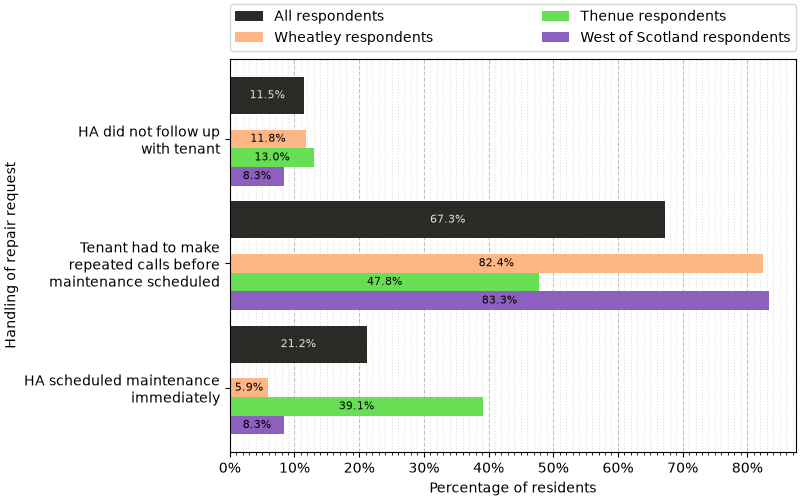
- Only 21.2 per cent of social housing tenants reported that maintenance work was scheduled immediately after raising an issue.
- More than two thirds (67.3 per cent) reported having to make repeated calls before maintenance was scheduled.
- A further 11.5 per cent reported that no maintenance work had been scheduled at all despite their requests.
A Pattern of Disregard
Residents frequently felt ignored and dismissed as communication often broke down, complaints lingered unresolved, and repeated attempts to secure engagement produced little meaningful response. Maria Rossi described a system in which reporting problems was an ordeal in its own right:
You get passed from Peter to Paul to John, and then you just get all these wee people outside your house who don’t even know what they’re doing… you get told that a housing officer will phone you back. Never phones you back. You keep phoning them, or you text them and ask them if there’s any update… you get no response… they don’t get back to you when they should get back to you and tell you what’s going on. So, then you phone back up… I’m sick, I’m sick of phoning.
Interview with Maria Rossi (Wheatley Homes Glasgow Tenant) by James Ferns and Frances Galt (26.02.2026)
For many residents, obtaining even basic communication required relentless persistence. The burden of pursuing updates often fell entirely on residents themselves, trapping them in an exhausting cycle of unanswered calls and continual follow-up:
I kept phoning them and phoning them and phoning them… it’s just constant.
Interview with Charlotte Wilson and Claire Wilson (Wheatley Homes Glasgow Tenant) by Bohdan Starosta and Alan Sproull (03.02.2026)
I’ve tried to phone them up, I tried to phone. You don’t get anywhere, they don’t answer you.
Interview with Maria Rossi (Wheatley Homes Glasgow Tenant) by James Ferns and Frances Galt (26.02.2026)
It’s been a nightmare. I’ve phoned the contact centre repeatedly about loads of things and I’ve ended up putting in complaints because nobody contacts you back; nobody will even respond to you… Every time you try and get any decent response off them, they ignore you. They just ignore it, and they leave you for months.
Interview with Eileen Gallagher (Wheatley Homes Glasgow Tenant) by James Ferns and Bohdan Starosta (10.03.2026)
The expectation that residents should have to advocate continually for themselves was a recurring source of frustration:
The housing association will not come out to do repairs unless you keep calling them up and advocating for yourself near endlessly.
Survey Participant 91 (Wheatley Homes Glasgow Tenant)
I’ve had to fight with them… everybody’s got to fight for it.
Interview with Helen Taylor (Thenue Housing Association Tenant) by James Ferns and Isla Wallace (03.02.2026)
People were getting told one thing, and then I was maybe getting told another thing… it all comes down to what an individual will accept. What you as a person will accept, and how much you would push for information.
Interview with Claire Sullivan (West of Scotland Housing Association Tenant) by James Ferns and Frances Galt (30.01.2026)
James Stewart described a process that appeared more effective at reallocating responsibility than resolving defects. Rather than identifying who would address the problem, he found himself repeatedly passed between Thenue Housing Association and [their contractor], each insisting that responsibility lay elsewhere:
I go through the public line and then I’ll constantly have to phone back because they never get back to you. And then, you’re in an argument – well, you’re getting sent between Thenue and [the contractor]. [The contractor] are saying it’s Thenue’s problem and Thenue are saying it’s [the contractor’s] problem, and then you’re stuck there and it’s about a month and a half until you get anything done. So, it’s just, it’s constant with them. I’ve got to the stage now I don’t even like phoning them, I’m doing the repairs myself.
Interview with James Stewart (Thenue Housing Association Tenant) by James Ferns and Isla Wallace (02.03.2026)
For some residents, the issue was not simply that complaints went unanswered, it was that warnings were disregarded. Following an initial flood, Eileen Gallagher repeatedly requested preventative action, but her housing provider chose not to act; it took a second flood before the problem began to receive any meaningful attention:
A couple of times we’ve had the floods… I asked and I asked repeatedly after the first flood: “could you replace all the mesh integration systems with copper pipes to ensure this doesn’t happen”. They refused to do it, and it was only after the second flood that they started doing things, so they were trying to cover their own back.
Interview with Eileen Gallagher (Wheatley Homes Glasgow Tenant) by James Ferns and Bohdan Starosta (10.03.2026)
Particularly striking was the consistency with which Wheatley Homes Glasgow tenants described housing officers who were notable primarily by their absence. Residents repeatedly described attempting to contact their housing officer only to be met with silence. Calls went unanswered, promised responses failed to materialise, and months or even years could pass without meaningful engagement:
[I] tried to get a hold of my housing officer… She’s never got back to me. Two years now, nearly two years I’ve not seen her.
Interview with Charlotte Wilson and Claire Wilson (Wheatley Homes Glasgow Tenant) by Bohdan Starosta and Alan Sproull (03.02.2026)
Got told that a housing officer will phone you back. Never phones you back. You keep phoning them, or you text them and ask them if there’s any update… you get no response.
Interview with Maria Rossi (Wheatley Homes Glasgow Tenant) by James Ferns and Frances Galt (26.02.2026)
I struggle to get a hold of my Wheatley housing officer about repairs.
Survey Participant 75 (Wheatley Homes Glasgow Tenant)
Not been able to get a response from the housing officer, been waiting for two years for her to take us seriously.
Survey Participant 63 (Wheatley Homes Glasgow Tenant)
Struggle to get in touch with the housing officer, no contact since last year, feeling left out and abandoned.
Survey Participant 35 (Wheatley Homes Glasgow Tenant)
Eileen Gallagher’s assessment was damning. In her experience, the issue was not simply a lack of response but the repeated failure to act upon serious concerns that had already been raised:
[My housing officer] tells you she’s going to do something, and then she says she never said that… She ignores major issues. She came out to tenancy visits, and she took a list that size away of repairs that were still to be done, and I never heard from her again. And I never had anybody turn up. To be honest with you, it’s been a nightmare.
Interview with Eileen Gallagher (Wheatley Homes Glasgow Tenant) by James Ferns and Bohdan Starosta (10.03.2026)
The consistency of these accounts amongst Wheatley Homes Glasgow tenants suggests something more serious than poor communication. Residents repeatedly described being left without meaningful support, whilst serious housing problems remained unresolved. A housing officer is supposed to provide residents with a clear route towards support and resolution. But for many Wheatley Homes Glasgow tenants, that route appeared effectively closed, leaving residents to navigate serious housing problems largely on their own.
The experiences of owner-occupiers reveal remarkably similar patterns of delay, dismissal, and disputed responsibility as those reported by social housing tenants. Elizabeth and Will Rutherford described more than a decade spent pursuing action from [the builders]– ‘this is historic… this has been from 2015’ – navigating repeated delays and continual attempts to avoid responsibility for defects within their home.4 Elizabeth felt that their complaints were not only being dismissed, but that they themselves had been written off as ‘serial complainers’:
Constant badgering, phone calls, more phone calls. Emails fell on deaf ears. It didn’t matter where you sent [them]… they never got back to you. They just didn’t, they: “Oh we’ll get back to you with an answer”. And it went to the bottom of the pile. As I say, I think they classed us as serial complainers. We weren’t, we just wanted stuff fixed.
Interview with Elizabeth and Will Rutherford (Owner-Occupiers) by James Ferns and Gary Wong (11.03.2026)
Elizabeth and Will felt repeatedly redirected between [the builders] and the National House-Building Council, with neither organisation willing to provide a clear route to resolution. The consequence was not merely frustration. Valuable time continued to pass whilst the defects remained unresolved and warranty protections steadily expired:
Because it’s under their warranty and they said: “No, no, no, no, you go back because you’re before the ten years. You go back to them”. So we went back to them… “No, no, no, it’s definitely not”… I said… who do I speak to about the windows? Who do I make a claim for about the windows? Somebody has to come and see these windows because some of them need replaced”. After three years arguing, you’re now telling [me] that they are out of warranty? So I now need to go and speak to these people who said: “No, no, when you’re under ten years warranty, and it’s the build, it’s the person who put the house together. It’s not our job”. At that point, I was for smashing every window.
Interview with Elizabeth and Will Rutherford (Owner-Occupiers) by James Ferns and Gary Wong (11.03.2026)
This experience left Elizabeth with a profound sense of betrayal:
Nobody wanted to listen; nobody wanted to take responsibility.
Interview with Elizabeth and Will Rutherford (Owner-Occupiers) by James Ferns and Gary Wong (11.03.2026)
Everything they said was a lie: From selling us the house, to the upkeep of the house.
Interview with Elizabeth and Will Rutherford (Owner-Occupiers) by James Ferns and Gary Wong (11.03.2026)
The years spent being redirected between organisations had not simply delayed resolution, but had fundamentally weakened their position with regards to warranty protections. Both had come to believe that the process itself functioned as a mechanism for delaying action and avoiding responsibility:
[Elizabeth Rutherford:] [The builders]… were just trying to waste time and that’s exactly what they did. [Will Rutherford:] That seems to be their MO. See if they can push you and hold you long enough, you’ll hit a certain time of you can’t do anything anymore. That seems to be the MO with them.
Interview with Elizabeth and Will Rutherford (Owner-Occupiers) by James Ferns and Gary Wong (11.03.2026)
Survey responses from owner-occupiers echoed these concerns:
A few years ago, when we noticed issues with decaying window frames… The outcome was we were never registered by [the builders]! I therefore have been at a loss as to how we deal with these issues as there has been no cover for our new build property for its initial ten years. As a home owner with a mortgage the factors and housing agencies won’t deal with our concerns.
Survey Participant 61 (Owner-Occupier)
Another described being instructed to commission investigations at their own expense before later being told the advice had never been given:
NHBC refused to deal with concerns of noisy flooring. I was eventually advised by one of their staff to get an independent joiner in to open up one of the floor panels and do some checks and most importantly get photos to show the structure at my expense! NHBC then denied this happened.
Survey Participant 60 (Owner-Occupier)
Owner-occupiers differed from social housing tenants in their legal and contractual context, but the underlying pattern was strikingly familiar. Responsibility was disputed, redirected, and delayed. Problems remained unresolved whilst organisations debated whose responsibility they were. For many residents, the central struggle was not simply securing repairs. It was persuading someone to accept responsibility for the defects in the first place.
No Consideration Given
Housing providers did not merely delay repairs. They frequently transferred the practical consequences of those delays onto residents themselves. Appointments were missed, cancelled, or rearranged with little apparent regard for residents’ working lives, caring responsibilities, or personal commitments. Kirsty Sinclair described repeatedly taking time off work for a repair appointment that never materialised. A straightforward repair instead became four separate days of wasted leave:
So the ceilings were fixed, then my toilet pan down in the bottom toilet started running water constantly, see just constantly running, the flapper or something had went. It’s a simple fix, well so everybody’s told me. That appointment was cancelled four times… Just didn’t turn up. So four times off work. Four times, whatever. They were too busy, basically… I’m taking days off working and they’re not turning up.
Interview with Kirsty Sinclair (Thenue Housing Association Tenant) by James Ferns and Frances Galt (27.11.2025)
Similarly, Claire Sullivan reflected on the reality of repeatedly sacrificing valuable annual leave to accommodate repairs:
You’re working, so your days off are a luxury. But your days off are now used up waiting on West of Scotland coming out. So, you’re getting no free time. This was another thing West of Scotland never took into consideration.
Interview with Claire Sullivan (West of Scotland Housing Association Tenant) by James Ferns and Frances Galt (30.01.2026)
The frustration was not confined to missed appointments. One survey respondent suggested that inconvenience had become an ordinary feature of the repair process:
Ongoing issues with mould and damp in the house with very little help from housing, even if they come to repair something it’s never on good terms, always at inconvenient times.
Survey Participant 65 (West of Scotland Housing Association Tenant)
Eileen Gallagher described waiting at home all day for a scheduled appointment with ventilation contractors. The appointment never took place and subsequent promises of follow-up led nowhere:
I had one letter through the door one day to tell me it was August the 18th… and I waited in all day – nobody came, and then I got a wee leaflet through the door saying contact us, and I contacted them again and they said,
Interview with Eileen Gallagher (Wheatley Homes Glasgow Tenant) by James Ferns and Bohdan Starosta (10.03.2026)we’ll get somebody back out. Never heard from anybody.
These accounts raise uncomfortable questions about whose time was regarded as valuable. Residents were expected to be available, flexible, and accommodating. Housing providers, by contrast, appeared under no equivalent obligation to honour the commitments they had made.
Abandonment
For some residents, being ignored was not simply frustrating. It produced something far more corrosive: the belief that there was little point continuing to ask for help at all. Charlotte Wilson described the futility of repeatedly trying to engage with housing providers:
You just feel like you’re wasting your time talking to somebody. You just feel like you’re not getting heard.
Interview with Charlotte Wilson and Claire Wilson (Wheatley Homes Glasgow Tenant) by Bohdan Starosta and Alan Sproull (03.02.2026)
The consequences of this extended far beyond individual repairs. Claire Sullivan described the longer-term damage caused when residents lose faith that their housing providers will act in their interests:
It was affecting everybody emotionally, physically. I mean, the impact is massive and going forward you just don’t have that trust with your housing any longer, because that trust is completely broken.
Interview with Claire Sullivan (West of Scotland Housing Association Tenant) by James Ferns and Frances Galt (30.01.2026)
For Eileen Gallagher, the repeated failure to resolve longstanding defects had led to a bleak conclusion. She no longer believed that housing providers intended to properly address the problems facing residents. Instead, she felt both residents and their homes had been abandoned to gradual decline, as though neither represented a sufficient reason for meaningful intervention:
I think that they don’t want to spend the money so they’re not going to get it done properly, if I’m being completely honest. We’re never going to get it fully resolved, and this is just kind of the way you’re left to live until the house falls down and they have to move you.
Interview with Eileen Gallagher (Wheatley Homes Glasgow Tenant) by James Ferns and Bohdan Starosta (10.03.2026)
Maria Rossi’s testimony reveals what happens when every institution that claims to offer accountability fails to deliver it. She pursued complaints, escalated concerns, involved her MP, and took her case through formal procedures. Yet each route that promised resolution appeared to lead back to the same place. After years spent searching for someone willing to take responsibility, Maria reached a point where she could no longer continue to fight:
I thought I could – [but] I can’t deal with it – I tried everything. I took it to my MP. I took it to stage one, stage two ombudsman. And that’s when I just didn’t have the fight anymore. I just totally gave up. Totally gave up.
Interview with Maria Rossi (Wheatley Homes Glasgow Tenant) by James Ferns and Frances Galt (26.02.2026)
The significance of this testimony lies in Maria’s description of where this process ultimately left her. After exhausting every route available to her, she was no closer to securing justice than when she began:
I don’t even want to live there anymore… that’s just because… you don’t get anywhere with them. I’ve tried taking it down that route. I don’t have the money to pay a lawyer to take them to civil court, and I think they know that. they know that… And then you end up lost. I mean, I’m lost.
Interview with Maria Rossi (Wheatley Homes Glasgow Tenant) by James Ferns and Frances Galt (26.02.2026)
Even after pursuing formal complaints procedures, Maria was left with the impression that the system had failed her as thoroughly as the housing provider itself. The question she was left asking was not why her housing problems remained unresolved, but why her account appeared to carry less weight than that of the organisation she was challenging:
Took it to the ombudsman and he said everything’s done by law. Everything was carried out by law. How can you say that? They could all come and see it. They’re only worried about what the housing’s telling them, not what I’m telling them. So why are they taking the housing’s word against my word?
Interview with Maria Rossi (Wheatley Homes Glasgow Tenant) by James Ferns and Frances Galt (26.02.2026)
Claire Wilson’s testimony captures the underlying grievance running through many of these accounts with remarkable clarity. She describes the experience of being listened to without being heard, acknowledged without being believed, and understood without anyone being willing to act:
[I] don’t trust them at all. I mean anything you’re saying to them, they’re no taking it into consideration. They’re going:
Interview with Charlotte Wilson and Claire Wilson (Wheatley Homes Glasgow Tenant) by Bohdan Starosta and Alan Sproull (03.02.2026)Right ok, we’re listening, but we’re not actually listening. We’re hearing what you’re saying, but we’re not hearing what you’re saying. We understand, but we don’t want to get involved.
These testimonies describe more than dissatisfaction with housing providers. They describe residents who came to believe that persistence was pointless, complaints were futile, and meaningful intervention would never arrive.
Hostility, Intimidation, and Disrespect
A Culture of Contempt
Running throughout residents’ testimonies was a profound sense that they were being treated with contempt by the very organisations responsible for helping them. Housing providers are expected not only to maintain homes but to treat residents with a basic degree of dignity and respect. Many residents felt that this standard had broken down entirely. For some residents, hostility was encountered at the very moment they sought help.
After flooding left her floor underwater, Kirsty Sinclair described a response notable not for its urgency or concern, but for its apparent lack of empathy:
Last time when I phoned up and the lassie had a horrible, horrible attitude:
Interview with Kirsty Sinclair (Thenue Housing Association Tenant) by James Ferns and Frances Galt (27.11.2025)Nobody will be out to your house today. And I said:Well, somebody will need to because my floor’s swimming. So it got to the point that she was refusing basically to send anybody out… And eventually I got an emergency, but the emergency just told me to just stop using the shower.
Severe housing defects were not always met with seriousness. Claire Sullivan recalled a worker responding to dangerously rotted floor with a flippant remark about her weight that suggested the issue was more amusing than alarming:
And one of the times, one of the workers that had come out, and he made a comment about my weight at the time, and he said,
Interview with Claire Sullivan (West of Scotland Housing Association Tenant) by James Ferns and Frances Galt (30.01.2026)Yeah, because you’re so thin, you’ll fall through it. Which I didn’t take funny. You know? I’m just like,Do you know what? Get it fixed!.
A recurring theme within residents’ testimonies was the feeling that the real source of irritation was not the defect itself, but the fact that they had reported it. Eileen Gallagher described an interaction with a contractor which is notable for its complete inversion of responsibility:
I’ve had some of the [external contractor] guys… one guy comes in and says to me one day:
Interview with Eileen Gallagher (Wheatley Homes Glasgow Tenant) by James Ferns and Bohdan Starosta (10.03.2026)I hate coming to this house because there’s always something.
Remarks of this nature were not experienced as isolated incidents. The longer problems persisted, the more residents felt that frustration was directed not at the defects themselves, but at the people continuing to report them. James Stewart described feeling that repeated complaints had fundamentally altered how he was viewed by his housing provider:
To be honest, I think they’ve got my number as written down as
Interview with James Stewart (Thenue Housing Association Tenant) by James Ferns and Isla Wallace (02.03.2026)it’s him, don’t answer itor something.
Claire Sullivan similarly felt that her continued attempts to secure repairs had generated growing frustration from housing staff:
I found, me personally, they had an attitude with you. You know? Just for complaining.
Interview with Claire Sullivan (West of Scotland Housing Association Tenant) by James Ferns and Frances Galt (30.01.2026)Another flood?And it’s as if now it must be you that’s causing the leaks.
Claire believed that this growing frustration had tangible consequences. She described what she regarded as a noticeable withdrawal of support:
Previously with the housing… they were quite good at maybe Christmas time, where they would maybe give you Irn Bru carnival tickets, or they would give you new panto tickets, and they would do things to basically help you. And what I had found since the flood is the communication was shortened, and I find myself having to now phone up. Beg for these tickets. Beg for help. Whereas before it was basically given.
Interview with Claire Sullivan (West of Scotland Housing Association Tenant) by James Ferns and Frances Galt (30.01.2026)
The word ‘beg’ appears twice in this testimony, and its use makes it difficult to imagine a more damning depiction of a relationship between a resident and their housing provider. Running through these accounts is a clear sense that repeated requests for help carried consequences of their own. Continued attempts to secure repairs were met with irritation rather than understanding. And the longer problems persisted, the more some residents felt that their housing provider had come to see them – not the defects they were reporting – as the real problem.
Running throughout these testimonies is a broader concern about how housing providers respond to residents seeking help. Maria Rossi’s testimony raises uncomfortable questions about how much concern housing providers showed for the people living with the consequences of their failures. After years of unresolved housing problems, she simply wanted some indication that somebody cared enough to do something about them:
It’s like there’s nobody there to kind of help you go through it. I’m not saying it’s down to them to be like your counsellor. But they can just say,
Interview with Maria Rossi (Wheatley Homes Glasgow Tenant) by James Ferns and Frances Galt (26.02.2026)Aye, it’s this, don’t worry.
The concerns expressed by Maria were reflected elsewhere. One survey respondent, who had spoken to their GP about the impact their housing conditions were having on their mental health, described an inspection visit which left them with the impression that the West of Scotland Housing Association inspector had little interest in investigating the issues being reported:
I felt the housing inspector on the behalf of West of Scotland did not want to be here. Was supposed to walk around doing checks but spent all his time in the kitchen. When I offered to show him the issues, he just spent most of the time on the phone.
Survey Participant 74 (West of Scotland Housing Association Tenant)
Housing inspectors occupy a critical position within the repair process. They are responsible for identifying defects and communicating conditions on the ground to those responsible for making decisions. If this part of the process fails – if inspectors inadequately investigate issues – then the entire system loses it connection to reality.
The consequences of this disconnect were often cruel. One resident, for instance, described weeks of living with a persistent smell throughout their home after a rat died beneath the floorboards near a heating source. Although the smell was overwhelming, they were reportedly advised by their housing association to simply wait for the carcass to decompose:
A rat died under my floorboards, at first I didn’t recognise the smell but a gas technician discovered what it was. I asked the housing association to get under the floorboards and remove the carcass, but was told instead that it’s not possible, and that I should just wait until it decomposes. I had to hang air fresheners all over my house to mask the smell.
Survey Participant 82 (Thenue Housing Association Tenant)
During the collection of this survey, the resident informed our team that the air fresheners used to mask the smell have since become associated with the experience itself. Her son now associates those scents with the period during which the decomposing rat remained beneath the floorboards and becomes distressed whenever he encounters them; long after the smell itself disappeared, the experience continued to linger within the household.
Experiences such as these shaped residents’ perceptions of how housing providers regarded both their concerns and their wellbeing. Eileen Gallagher believed they reflected a wider culture of disrespect:
There’s just so many things that people have told me that their housing officers have said to them and done… unless they’ve got it on camera nobody would believe it. Nobody would believe it because they’re a law to themselves… I’ve had loads of people tell me stuff. I had one lassie who had a house, that had a big, massive subsidence crack right in it. She had a guy come out and laugh and say:
Interview with Eileen Gallagher (Wheatley Homes Glasgow Tenant) by James Ferns and Bohdan Starosta (10.03.2026)Oh you’re fucked, this whole house is fucked. And she’s got two weans in the house, one’s severely disabled. So what is she supposed to do?… You can’t ever open your mouth and say:Well this isn’t right. But you should be able to.
Residents depend upon housing providers to address serious defects within their homes, yet many felt unable to challenge behaviour they regarded as inappropriate or degrading because doing so risked antagonising the very people responsible for resolving their problems. The result was a relationship in which some residents felt compelled to accept conduct that would have been unacceptable in almost any other context.
Fear Among New Scots
Particularly troubling were allegations that some New Scots felt unable to raise concerns about housing conditions because of fears that vulnerabilities associated with language, immigration, or housing insecurity could be used against them. Tesfay Kiros, a long-term resident and community leader, described what he regarded as a widespread fear of speaking openly about housing problems:
Especially those people who settled here, they are afraid to say things.
Interview with Tesfay Kiros (Wheatley Homes Glasgow Tenant) by James Ferns and Isla Wallace (25.02.2026)
Tesfay’s concerns were echoed by a settled Polish resident, who believed that their housing provider had taken advantage of language barriers in an attempt to shift responsibility onto themselves:
The housing had [tried] to put blame on us and due to language barriers they have taken advantage of us and tried to use it against us.
Survey Participant 59 (Thenue Housing Association Tenant)
The allegation here is not one of poor communication. It is that a housing provider attempted to exploit a vulnerability and use it to deflect responsibility. Similar concerns were raised by Eileen Gallagher. As a long-term resident, she described New Scots approaching neighbours for assistance because they felt unable to engage directly with housing providers themselves. More troubling still, she described hearing repeated fears that speaking out could carry consequences:
Because of language barriers, they’re coming to the people that can contact the housing officers… they’re coming to you and telling you stuff, because I’ve had people come to me and tell me that they’re scared to say anything because the housing [association] will not give them another house if they need to move. You shouldn’t be living in fear in your own house that you can’t complain about something.
Interview with Eileen Gallagher (Wheatley Homes Glasgow Tenant) by James Ferns and Bohdan Starosta (10.03.2026)
Housing providers occupy a position of considerable power within residents’ lives. Residents should not have to weigh the risk of retaliation before deciding whether to report a defect or challenge poor treatment. Yet the testimonies presented here describe residents who felt unable to raise concerns freely and who believed that vulnerabilities associated with language and immigration could be used against them.
Gendered Dismissal
Several residents believed that the dismissiveness they encountered was gendered. In a repair system typically dominated by male inspectors, contractors, and workers, some women felt they had to overcome an additional barrier before their concerns would be taken seriously. Maria Rossi believed that some repair workers approached women with a presumption of ignorance:
They’re not listening to the tenants… they just look at you. Especially if it’s a man and you’re a woman. They look at you as if,
Interview with Maria Rossi (Wheatley Homes Glasgow Tenant) by James Ferns and Frances Galt (26.02.2026)how do you know that?
Maria’s observations were echoed by Eileen Gallagher, who recalled challenging a repair worker’s assessment of a defective subfloor, only to be met with the response: ‘How would you know that?’.5 The irony is that Eileen possessed relevant qualifications and, according to her account, the floor ultimately required exactly the intervention she had recommended. Reflecting more broadly on her interactions with repair workers, Eileen described a level of hostility and disrespect that she believed was inseparable from the fact that she was a woman. These experiences eventually left her unwilling to be alone in her own home when some workers attended, and increasingly reliant upon her father, whom she believed was afforded a level of respect routinely denied to her:
I’ve had them come in and out the house, and because I’ve had arguments with them, they’ll just kind of ignore you and you can hear them talking about you and stuff. It’s men. You expect that from men like that… It’s been kind of horrible. It’s been horrible. And it got to the point a couple of years ago where I wouldn’t answer the door unless somebody else was in the house… I had to have somebody here… I started to become quite anxious about it, and I didn’t want to be in the house with them myself. So I had to have like, family members and stuff here, and nine times out of ten, I was phoning my dad, telling my dad to come down. Because they treat him differently from the way that they treat [me]. But aye, I’ve had loads of that, but you expect that I suppose, don’t you? It’s part and parcel.
Interview with Eileen Gallagher (Wheatley Homes Glasgow Tenant) by James Ferns and Bohdan Starosta (10.03.2026)
Eileen’s comments – ‘part and parcel’; ‘you expect that I suppose’ – suggest that being dismissed and disrespected by male workers was a routine part of her interaction with the repair process. In many respects, these accounts reflect longer-standing historical patterns. Housing struggles have often been carried by working-class women, who are frequently the people pursuing repairs, managing the consequences of housing failures, caring for affected family members, and organising collectively when institutions fail.
Abuse of Power
Some residents described incidents in which housing providers allegedly responded to complaints and public criticism with threats of eviction, intimidation, and aggressive behaviour.
The following testimony contains one of the most disturbing allegations documented during this research. After years of unresolved housing problems, Maria Rossi informed Wheatley Homes Glasgow that she was considering taking her concerns to social media and the press. She alleges that, rather than engaging with the issues she had raised, representatives of her housing provider warned her that speaking out could jeopardise her tenancy:
I did say to them,
Interview with Maria Rossi (Wheatley Homes Glasgow Tenant) by James Ferns and Frances Galt (26.02.2026)Look, see if you don’t deal with this, I’m going to take it to social media and I’m going to get the media involved. I’m going to take it to the Daily Record. And that’s when they said, they stood in my kitchen and said to me,You could be jeopardising your tenancy if you do that… they said,It’s not in your tenancy agreement… I can’t remember his name, the other two… there were two other wee men, they stood in my kitchen. Three of them. And I had all the evidence laid out and he’s like,That’s not what I’m here for… My partner heard that, and my two adult children heard that… like he came in with a wee coat on, a wee checkered coat… then they were kind of looking at each other, and I’m like,Well, that’s what you’re here for, you’re here to come to a solution.No, we are here to come to a solution to see why you want to take us to court. And that’s when they said if I take it to social media, my tenancy could be in jeopardy.
Maria later reflected on the effect that this alleged warning had on her willingness to pursue the issue further:
I owed rent arrears… I was kind of a bit scared to take it further, to be honest, in case they did evict me for the rent arrears or whatever.
Interview with Maria Rossi (Wheatley Homes Glasgow Tenant) by James Ferns and Frances Galt (26.02.2026)
This is precisely why allegations of this nature are so serious. Housing providers are not ordinary organisations: they are landlords. For tenants already worried about arrears or housing security, warnings of this kind make silence feel safer than speaking out. What makes this testimony even more troubling is that it was mirrored by other residents. Eileen Gallagher recounted:
I’ve heard people say they are going to get warnings and evictions if they post anything to social media and what have you… I was told by one neighbour that she posted something on social media and they were going to give her a warning, and they told her that she would get evicted if she continued to talk about it.
Interview with Eileen Gallagher (Wheatley Homes Glasgow Tenant) by James Ferns and Bohdan Starosta (10.03.2026)
The allegations made here go far beyond poor communication or inappropriate behaviour. They concern residents who claim they were warned that speaking publicly about housing conditions could place their tenancy at risk. No tenant should be forced to choose between protecting their home and protecting their tenancy.
While some residents described fears that vulnerabilities could be exploited, others described more direct forms of intimidation. For years, James Stewart sought action over severe cold affecting the bedroom first of his disabled father and then later his elderly mother. These were not minor defects or matters of comfort. James described rooms so cold that he was forced to purchase electric blankets and halogen heaters simply to keep his mother ‘alive’.6 Faced with these conditions, James spent years trying to secure action from Thenue Housing Association. He alleges that persistence was met not with concern, but with open hostility:
When we first moved in, we realised both the kitchen and the disabled bedroom were really cold. And at the time, it was my dad who was in that room… [he] lost his legs due to diabetes. And I spent two years fighting with Thenue Housing to get them to come out just to examine the windows. And then one day, after two months – two months I was up phoning them every day, and then… [a senior staff member from Thenue] was screaming down the phone to me that these are A+ houses or A20 houses. I can’t remember the terms he used. But he was trying to intimidate me and trying to threaten me over the phone… he came on and got very aggressive towards me. He was screaming at the top of his voice… this is like quarter past nine in the morning and I’m trying to reason with him and he’s just –
Interview with James Stewart (Thenue Housing Association Tenant) by James Ferns and Isla Wallace (02.03.2026)no, these are– it was either A+ or A20 houses he kept shouting at me. And he was screaming at the top of his voice down the phone, which I thought was very unprofessional.
Thenue Housing Association did not merely dismiss James’s concerns. According to his testimony, they repeatedly insisted that the problem did not exist:
So I ended up having to go down there about a week later, and I got the boss of the repairs department to come out – he came out with a blueprint for the house, and showing me how this house had insulation and all that.
Interview with James Stewart (Thenue Housing Association Tenant) by James Ferns and Isla Wallace (02.03.2026)
Yet when the windowsills were eventually lifted, the self-assured certainty that had accompanied years of denial collided with a very different reality:
Eventually after – I would call it me harassing, that’s the way they would see it, because they kept putting the phone down on me – eventually I got to a point where they came out… they lifted the windowsills in my mother’s room and the kitchen, and there was no insulation – at all – and the air that was coming through it was like a gale force wind. And that one’s [points to living room window] the exact same, but that’s not been lifted yet. I can’t get them to come out for that, they’re just refusing, because they’re saying that in here’s warm enough so they’re not doing that.
Interview with James Stewart (Thenue Housing Association Tenant) by James Ferns and Isla Wallace (02.03.2026)
This testimony suggests a staggering level of self-assured arrogance on the part of Thenue Housing Association. A tenant spent years attempting to protect vulnerable family members from freezing conditions, only to allege that they had been screamed at and intimidated by a senior figure within the housing association. The audacity of such conduct is extraordinary. Yet what elevates this testimony beyond mere hostility is the allegation that Thenue Housing Association chose to resort to threats and intimidation while being utterly ignorant of the reality of the situation. After years of certainty, the defect James Stewart had been reporting was found to exist. This was not a resident making baseless complaints. It was a resident reporting a genuine defect and being treated as though he were the problem. That fact alone is a damning indictment of the conduct described here.
Class Prejudice
Running through many testimonies was a belief that housing providers had become fundamentally detached from the people living with the consequences of their failure. Residents repeatedly contrasted the temporary inconvenience experienced by housing association staff and contractors with the reality of being left to live with conditions that those same staff could leave behind when their shift was over.
Maria Rossi captured this sense of detachment with particular clarity. Reflecting on years of unresolved housing problems, she described what she saw as the gulf between those making decisions and those forced to live with the consequences:
I’m trying to tell [Wheatley]… [but] they didn’t budge. They still go home to their big houses, do you know what I mean? While you were left.
Interview with Maria Rossi (Wheatley Homes Glasgow Tenant) by James Ferns and Frances Galt (26.02.2026)
This is about more than physical distance. Maria is describing a relationship in which those with power could disengage from the consequences of their decisions in a way residents could not. Kirsty Sinclair reached a similar conclusion. For her, the lack of urgency shown by housing providers was inseparable from the fact that those responsible for addressing the problems never had to live with them:
No, I don’t think they care to be honest, they don’t care. They don’t care because they’re not living in it. It’s not them that’s going home to that every night. It’s not them that’s going out working.
Interview with Kirsty Sinclair (Thenue Housing Association Tenant) by James Ferns and Frances Galt (27.11.2025)
Eileen Gallagher’s testimony reveals a more troubling side of this detachment. Recalling an encounter with housing staff who spoke about visiting the Village as though it were a burden, she drew a sharp distinction between staff who could leave and residents could not:
I’ve had housing officers stand out front and tell me,
Interview with Eileen Gallagher (Wheatley Homes Glasgow Tenant) by James Ferns and Bohdan Starosta (10.03.2026)I hate coming down here, there’s just that much stuff. That’s great, but we’re still living in it. You can go home at the end of the night, do you know what I mean? It’s just your job. We have to live here.
A housing officer complaining about having to attend residents’ homes and assist them to resolve widespread disrepair reveals a grotesque inversion of responsibility.
This detachment was sharpened further by what residents experienced as class prejudice. Eileen Gallagher described an attitude towards social housing tenants that was not merely dismissive, but openly condescending:
They look down their nose at you, because it’s a council house and they don’t understand your circumstances… it’s very much,
Interview with Eileen Gallagher (Wheatley Homes Glasgow Tenant) by James Ferns and Bohdan Starosta (10.03.2026)Oh it’s a council house. And I’ve had a couple walk in here and say,I wasn’t expecting this house to be this nice. And you’re like,What were you expecting it to be? What do you think we’re all living in absolute squalor?.
Claire Sullivan similarly felt that some housing staff arrived with preconceived ideas about working-class residents before any conversation had even taken place:
Every person that came out almost had this wee idea or an image of what you were like. Their minds were made up anyway. So, it didn’t matter what I said, and then accusations were just flying about, you know? I just felt as if I couldn’t trust them any longer.
Interview with Claire Sullivan (West of Scotland Housing Association Tenant) by James Ferns and Frances Galt (30.01.2026)
Claire’s testimony shows how quickly class assumptions can destroy trust. For Kirsty Sinclair, that process had already reached its conclusion. Reflecting on the condition of the homes, she arrived at a devastating assessment of how working-class residents had been treated:
They’ve not fixed the houses properly at all for tenants moving in. It was all a rush, rush, rush for the athletes and then who cares because we’ll just put these families in here and they’ll live, whatever – a dog doesn’t live like that.
Interview with Kirsty Sinclair (Thenue Housing Association Tenant) by James Ferns and Frances Galt (27.11.2025)
There is a profound sense of abandonment running through this testimony. Kirsty is not merely accusing housing providers of neglecting repairs or failing to maintain homes. She is describing a belief that working-class families were treated as an afterthought from the very beginning; that once the spectacle of the Commonwealth Games had passed, the people expected to live in these homes simply ceased to matter. Her final remark – ‘a dog doesn’t live like that’ – cuts to the heart of that grievance. It is an accusation that residents were expected to endure conditions that fell beneath the most basic standards of human dignity.
Victim Blaming and Denial
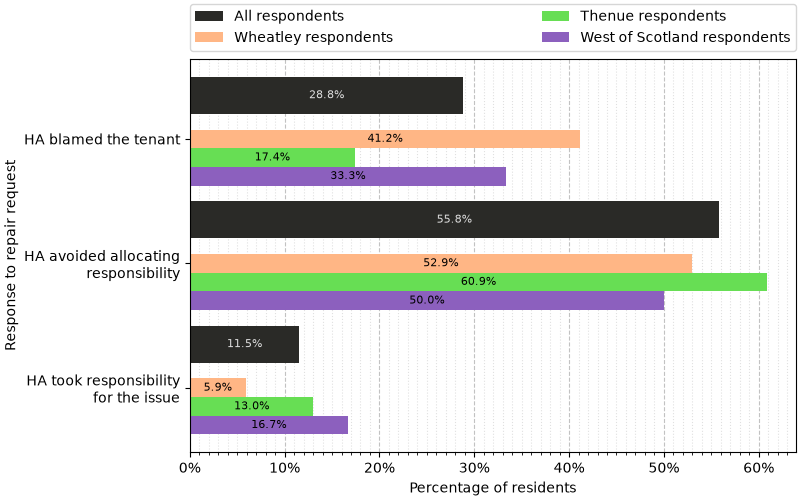
- Almost a third (28.8 per cent) of social housing tenants reported that their housing association had blamed them for the housing problems they were experiencing.
- By comparison, only 11.5 per cent reported that their housing association had accepted responsibility for the issues raised, while 55.8 per cent reported that responsibility had never been clearly assigned.
- This was particularly common among Wheatley Homes Glasgow tenants, 41.2 per cent of whom reported being blamed for housing problems, compared to 33.3 per cent of West of Scotland Housing Association tenants and 17.4 per cent of Thenue Housing Association tenants.
Victim blaming is the process by which institutions seek to displace accountability onto the very people they have failed. What emerges from the testimonies below is not a series of isolated incidents, but a recurring pattern in which responsibility moves away from defective homes and onto the people forced to live in them.
James Stewart captures this pattern in its simplest form:
Every time you phone up its,
Interview with James Stewart (Thenue Housing Association Tenant) by James Ferns and Isla Wallace (02.03.2026)oh are you sure it’s not you that’s doing this, or you that’s doing that. Every single time.
‘Every single time’ presents victim blaming not as a mistake, nor a failure in communication, but as the default response residents came to expect when they asked for help. Eileen Gallagher described a familiar script being deployed for damp and mould. The focus was not the condition of the property, but the conduct of the resident: wipe the walls, wipe the shower, open the windows, move items from the radiators. If the problems persisted, the implication was obvious – the tenant must be doing something wrong.
You’ve got to wipe your walls down after you cook, apparently. I’ve never heard of that in my life. Every time you go into the shower, you’ve got to wipe the shower down… There’s been a multitude of things that they’ve told us…
Interview with Eileen Gallagher (Wheatley Homes Glasgow Tenant) by James Ferns and Bohdan Starosta (10.03.2026)you’re doing something wrong to cause all this to happen, when it’s not the case at all… There’s been no evidence to prove that it’s anybody’s fault, bar the people that built the houses, and obviously the housing associations that have ignored it. There’s been a lot of blame placed on us. It’swipe your walls down”, “don’t have anything on your radiators,make sure you’re opening your windows.
This is the language of institutional evasion dressed up as lifestyle advice that allows responsibility to migrate steadily away from the condition of the property and towards the conduct of the tenant. In Eileen’s case, insinuation eventually gives way to accusation:
The first flood we had it took them a year to replace a sink; which never got replaced anyway. It took them another year to get the bathroom working; but the bathroom is not working because it’s still leaking water. It’s taken a lot of arguing, a lot of fighting, a lot of phone calls… You’re constantly told that there’s nothing wrong. I’ve had housing officers sit here and tell me,
Interview with Eileen Gallagher (Wheatley Homes Glasgow Tenant) by James Ferns and Bohdan Starosta (10.03.2026)You must be causing it somehow. How? Explain it to me, because I don’t live differently from you. So, explain it to me – what am I doing?
‘You must be causing it somehow’ is victim blaming stripped to its essentials. No evidence, explanation or attempt to establish causation was provided. The resident was simply made responsible because the alternative would be to accept that responsibility lay elsewhere.
The same logic appears throughout Maria Rossi’s testimony. Rather than investigating the causes of damp and mould, responsibility was again redirected towards the resident:
They said it was this, it was that, it was the other… it was because I was drying washing in my house… you want to kind of investigate a wee bit yourself, but you can’t just in case you go and do something and they try to blame you for doing that and they don’t fix it. So, you’re kind of like – held over a barrel kind of thing.
Interview with Maria Rossi (Wheatley Homes Glasgow Tenant) by James Ferns and Frances Galt (26.02.2026)
Her phrasing – ‘held over a barrel’ – captures the power imbalance at the centre of this relationship. Victim blaming does not merely redirect responsibility; it creates a situation in which residents risk being blamed regardless of what they do. Maria later recalled being told that the pervasive damp and mould in her home were caused by her clothes horse:
I had a clothes horse – like everybody has in their households. Had a clothes horse in my kitchen. My window was open, and that’s what the [repair] specialist [said]… he said,
Interview with Maria Rossi (Wheatley Homes Glasgow Tenant) by James Ferns and Frances Galt (26.02.2026)that’s because I was drying clothes in my house. And I’m like,What?I said,Everybody does that.
Drying clothes indoors is an ordinary feature of everyday life. To present a clothes horse as the explanation for pervasive housing defects is not a serious attempt to understand the problem.
Claire Sullivan’s testimony is striking for how quickly suspicion can be directed towards the resident. After reporting serious problems with her downstairs bathroom, she described being accused almost immediately of causing the problem:
I had moved into the Village I think roughly in 2015… the problems kind of arose quite quickly… you would contact the people, they would come out, and they would start accusing you almost immediately of maybe putting things down the drains, baby wipes, different things.
Interview with Claire Sullivan (West of Scotland Housing Association Tenant) by James Ferns and Frances Galt (30.01.2026)
The same pattern intensified after Claire returned from a typical school run and found her home in a state of chaos, with water coming through the walls and flooding the ground floor. Although housing staff were unable to establish what had caused the flood, suspicion very easily settled upon Claire herself:
I had gone to take the kids out to school this morning, and I’d come back and the ground floor was like puddles; water coming out the walls… I’d phoned the emergency housing line for the workers… they had come out and they couldn’t exactly determine what they thought was the cause of it at the time… but then that quickly changed and almost immediately [they] pointed the fingers at me and said,
Interview with Claire Sullivan (West of Scotland Housing Association Tenant) by James Ferns and Frances Galt (30.01.2026)I must have known about this because of the extent of the damage at the timeand basically said to me,You’ve known about it, but you’ve just not reported it. That has been thrown in my face quite a few times, not just with the first one, but also the second one. Almost kind of blaming me.
The accusations did not end there. The same pattern resurfaced after yet another flood, but this time the focus of suspicion extended beyond Claire and onto her daughter:
Fast forward to my next [flood]… I contacted the housing and explained the situation… the full ceiling and the kitchen, the living room, they were coming through… the water was literally gushing, and I mean gushing through the ceilings… they were like,
Interview with Claire Sullivan (West of Scotland Housing Association Tenant) by James Ferns and Frances Galt (30.01.2026)Oh, your daughter must have left the shower on.
For all the uncertainty surrounding recurring leaks, mould, and flooding, the question commanding the greatest intrigue was whether Claire’s daughter was closing the shower door properly:
I had quite bad mould upstairs in the shower, because it kept flooding and stuff upstairs. That was the one that was coming through my ceilings, and they were saying my daughter must be leaving the shower door opened… they basically accused us of taking a seal off, the bottom seal.
Interview with Claire Sullivan (West of Scotland Housing Association Tenant) by James Ferns and Frances Galt (30.01.2026)
It is generally safe to assume that residents do not spend their time dismantling shower fittings and engineering floods within their own homes. Yet according to Claire’s testimony, such explanations appear to have been treated more seriously than the recurring defects she had reported.
Victim blaming often relies upon explanations that collapse under even the most basic scrutiny. Throughout this research, residents described being presented with theories so implausible that they would be difficult to take seriously were the consequences not so significant. Maria Rossi recalled being told that damp developing around the pipework beneath her kitchen sink was not the result of any defect, but because cupboard doors were being closed:
My pipes under my sink kept… going all damp, like green… [the repair specialist said],
Interview with Maria Rossi (Wheatley Homes Glasgow Tenant) by James Ferns and Frances Galt (26.02.2026)that’s because of the cupboard doors [are being] shut.
Most residents would reasonably assume that cupboard doors can be closed without serious consequence, but according to Maria’s account, the matter was not so straightforward. Other residents encountered similarly implausible theories. Subsidence is ordinarily associated with drainage failures, ground conditions, or construction defects. According to one survey respondent, however, the investigation appears to have ventured into less conventional territory:
I have had major issues with subsidence with the back garden. I reported it to Wheatley Homes over four years ago but there has been no resolution. They tried to blame on me letting my two dachshunds in the garden.
Survey Participant 72 (Wheatley Homes Glasgow Tenant)
Our report is not in a position to comment on the alleged geological capabilities of dachshunds. But it is sufficient to note that four years after the issue was reported, the subsidence remained unresolved.
There is a serious point beneath this absurdity. Victim blaming does not depend upon convincing explanations; it depends upon explanations that move scrutiny away from the institution and onto the resident. Sometimes, however, even that is not enough, and victim blaming takes an even uglier form and slips into gaslighting, with residents’ describing their experience of reality being denied, dismissed, or rewritten altogether. Eileen Gallagher recalled an inspector attending her home and informing her that there were no issues with the property. When Eileen disagreed, she was told that the problem might exist only in her imagination:
I had one inspector come out because of the floods… and the guy came in and said:
Interview with Eileen Gallagher (Wheatley Homes Glasgow Tenant) by James Ferns and Bohdan Starosta (10.03.2026)Oh this is all fine, there’s no issues. I said:No, it’s fine because I’ve treated everything myself. But there’s obviously a deeper issue because the stuff keeps coming through – the mould spores keep coming through, the dampness keeps showing, I can smell it. And he says:Maybe you’re imagining it. And then he proceeded to ask me if I dohomers… Are you kidding? You’re here to fix my house and you’re asking me to fix yours?
‘Maybe you’re imagining it’ is not a repair strategy. It is a refusal to take a resident’s lived experience seriously. Claire Sullivan recalled an encounter that could be described as gaslighting after raising concerns that damp and mould within her home could be affecting her son’s breathing. According to Claire, two repair workers acknowledged that this was entirely possible. When she relayed that conversation to a senior member of staff at West of Scotland Housing Association, the discussion allegedly took a very different turn:
Nine times out of ten I would always be in the house by myself with the children, and my partner would be at work because that’s the way our work schedule would be… what had happened was two of the staff members had come out to the house… my son wasn’t well… and I had basically [said],
Interview with Claire Sullivan (West of Scotland Housing Association Tenant) by James Ferns and Frances Galt (30.01.2026)Listen to my wee boy… these guys sounded different and compassionate, and I thought,Right ok, so listen, listen. My wee boy, the way he’s breathing… and the guy had turned around, and he says,Oh yeah, [the mould and damp] could definitely be the cause of it… I had gone back to [a senior staff member within the housing association] and I was like,Your staff are agreeing with me… the [senior staff member] wasn’t happy about it. He had then gone back to the staff. Supposedly they denied it, made me look out to be as if I was lying, and I ended up with a warning against my name… I got a formal warning.
There is something deeply contemptible in the sequence of events described here. According to Claire, a conversation that appeared to validate concerns about her son’s health was subsequently turned against her, with the effect of portraying her as dishonest and undermining her own account of reality.
Survey responses reinforce the pattern of blame established throughout interview testimony – residents across different housing associations described the same tendency to redirect responsibility away from defects and onto those living with them:
Had to replace flooring due to flooding twice. The sewage from bottom bathroom is disgusting. The floorboards were full of black mould. The repair men said I put wipes down [the toilet] and I never.
Survey Participant 23 (Thenue Housing Association Tenant)
Issues going on for multiple years, big impact on both finances and mental health, housing association manager tried to blame us for the faults, meanwhile we still didn’t get our house fixed.
Survey Participant 26 (Wheatley Homes Glasgow Tenant)
When I moved in here there was a problem with the bathroom, the workers tried to blame me for the problem, but the issues only kept getting worse… I’m still waiting for the bathroom to get fixed.
Survey Participant 77 (Wheatley Homes Glasgow Tenant)
Accountability is the main issue… also for them to address the fact they always blame the tenants for the issues when it isn’t any fault of our own.
Survey Participant 90 (Wheatley Homes Glasgow Tenant)
Victim blaming appears in these oral testimonies and survey responses not as an isolated incident but as a recurring feature of residents’ interactions with their housing providers. The consequences become even more concerning when health is involved:
I experienced pneumonia, I have been blamed and my partner has been blamed. I feel as if my and my family’s safety is in constant danger.
Survey Participant 40 (West of Scotland Housing Association Tenant)
Getting support from a social worker, tried to deal with pick up of broken furniture from collapse. Called up housing association on tenant’s behalf. Been waiting for too many months. Constantly put blame on tenant. Suffered severe mental health issues.
Survey Participant 66 (West of Scotland Housing Association Tenant)
The most grotesque allegation documented during this research comes from Survey Participant 76, a mother whose family was already living with damp and mould serious enough to raise concerns about her children’s health. The situation had become sufficiently severe that their GP supported requests for decanting. Within this context, one might reasonably expect concern for the welfare of the children involved; according to the resident, what followed was nothing short of obscene:
They tried to blame my two daughters for issues with the shower (extensive black mould, pipe blockages), they said that it was their body fat blocking the pipes and causing the mould to appear on the walls. We tried to get a complaint in about the housing officer as she ignored us, the same housing officer responded and said
Survey Participant 76 (Wheatley Homes Glasgow Tenant)they won’t be taking it any further.
This allegation is victim blaming at its most deranged. Body fat does not cause mould to appear on walls; the claim is scientifically absurd. Yet the absurdity is not the most troubling aspect of this testimony. What makes the allegation so odious is the willingness to place responsibility for serious damp and mould onto children whose health was potentially already being affected by those conditions.
Victim blaming does not simply distort the truth. It protects institutions from accountability. If defects can be attributed to tenants’ behaviour, then defective homes cease to be institutional failures and become personal failings. Across these testimonies, victim blaming begins to resemble a kind of institutional catechism. The individual allegations differ, but responsibility is repeatedly redirected away from housing providers and onto the people forced to live with the consequences of their failures.
Re-Traumatisation of Domestic Abuse Survivors
There are few institutional failures more serious than behaviour that re-traumatises domestic abuse survivors. When domestic abuse is disclosed to a housing provider one would expect it to change the terms of every decision that follows. It should alter how risk is assessed, how residents are treated, and how decisions are made. The testimonies examined in this section concern situations in which disclosures of past abuse and ongoing fears for personal safety appear to have carried far less weight than they deserved, and in which housing conditions and institutional responses reignited past trauma.
Eileen Gallagher
For Eileen Gallagher, recurring flooding did not simply represent another housing problem. It revived memories of a previous period of domestic abuse that had also unfolded within a flooded property. The effects were severe enough that Eileen’s Community Psychiatric Nurse stated that the experience had triggered Complex Post-Traumatic Stress Disorder:
I was in a house prior to this, and I was going through a domestic abuse situation… and my house had a flood of water… it just kind of brought back loads of stuff if I’m being honest, and I’ve been to see a psychiatrist and I’ve got a CPN [Community Psychiatric Nurse] and the CPN said basically it’s triggered CPTSD [Complex Post-Traumatic Stress Disorder] from all the stuff that’s happened.
Interview with Eileen Gallagher (Wheatley Homes Glasgow Tenant) by James Ferns and Bohdan Starosta (10.03.2026)
Even allegations that recurring flooding had triggered Complex Post-Traumatic Stress Disorder appear to have done little to interrupt the familiar pattern of dismissal and victim blaming described elsewhere in this report. According to Eileen, responsibility continued to be directed towards the tenant rather than the conditions that had caused the harm:
Dismissive, very dismissive. They can’t do that for you and not do it for everybody else, kind of attitude. And their attitude is, if I’m being completely honest, you’re getting blamed for things. They’re telling me:
Interview with Eileen Gallagher (Wheatley Homes Glasgow Tenant) by James Ferns and Bohdan Starosta (10.03.2026)oh, but you need to not have anything on your radiators; you need to not do this… it’s never their fault. It’s never the house. It’s always,what are you doing to cause this… They’re fully aware of the situation that we were in when we moved here. So, at least I had expected them to make the house safe, but that’s never happened.
There is a profound moral failure described here. Eileen’s expectation was not an unreasonable one. Having escaped domestic abuse, she expected the home she was offered to be safe. Instead, she describes housing conditions that revived past trauma and an organisation that continued to search for faults in the resident rather than confront the consequences of its own failures. Some allegations in this report concern poor repairs. This allegation concerns something far more serious. When a survivor of domestic abuse tells a housing provider that conditions within their home have triggered Complex Post-Traumatic Stress Disorder and the response remains one of dismissal, deflection, and blame, the issue has ceased to be one of housing management. It has become a profound failure of care.
Claire Wilson
Claire Wilson no longer felt safe in her own home. Pregnant and living with the aftermath of domestic abuse, she wanted to leave an area where her former partner continued to threaten her family. The circumstances she described demanded empathy and support; according to her testimony, it was met with indifference:
We did want to move away from here and that was only because I’d been in a very abusive relationship and the boy was actually coming to this house and causing havoc for my family… it did kind of scare me – I was only a young girl. I had just fell pregnant with her. I was like no, I want to move out of here and [the housing officer] was like,
there’s nowhere you can go, there’s nowhere we can send you, there’s nothing we can do for you… I was about to have a baby, and I’d just been in this horrible relationship, and the fact that [my housing officer] stood in front of me and said to me,There’s nothing we can do for you, was like somebody slapping me in the face.I was just like,
Interview with Charlotte Wilson and Claire Wilson (Wheatley Homes Glasgow Tenant) by Bohdan Starosta and Alan Sproull (03.02.2026)hold on a minute, I’ve just been through serious trauma, I’m just about to bring a new baby into this world, and you’re saying to me,It’s alright for you to stay there, it’s alright for him to come to your door.Oh, all you need to do is phone up and get a restraining order. What?! That’s not going to stop somebody from coming to your house.
Claire’s testimony leaves little room for misunderstanding. ‘I’ve just been through serious trauma’ and ‘I’m just about to bring a new baby into this world’ are statements that demand immediate care, support, and protection; the phrase ‘somebody slapping me in the face’ captures the emotional force of Claire’s reaction to what she experienced as a profound absence of all three. Although the immediate threat was removed following her former partner’s imprisonment, his continued connection to the Village meant that her sense of safety was never fully restored:
Since he’s got a new girlfriend, it’s kind of died down a lot and now that he’s in prison. But it is a big concern, whether he is going to come back, because his new girlfriend has now moved round about here… I don’t feel comfortable and it’s like, still to this day… when I’m walking about these streets with my children, I’m like looking over my shoulder, just to make sure that he’s not anywhere near me or that there’s nobody following me.
Interview with Charlotte Wilson and Claire Wilson (Wheatley Homes Glasgow Tenant) by Bohdan Starosta and Alan Sproull (03.02.2026)
Claire described the ongoing effects of domestic abuse, a persistent fear for her own safety, and the prospect of raising her children in an environment where she no longer felt secure. Yet according to her account, these disclosures were met with a level of indifference that is difficult to reconcile with even the most basic duty of care that should be expected in such circumstances:
I sat in front of my housing officer and explained to her that I’ve just been through a traumatic relationship, and I had to go through court and things like that for it. And she stood here and was like,
Interview with Charlotte Wilson and Claire Wilson (Wheatley Homes Glasgow Tenant) by Bohdan Starosta and Alan Sproull (03.02.2026)There’s nothing I can do for you really. It just kind of made me feel like,is there anybody out there that’s willing to help me?Am I going to need to take my children to Woman’s Aid to get away from this? And then it’s like I’m going to need to leave my family dealing with the trauma and the stress of him still coming to the door.
Claire’s simple question – ‘is there anybody out there that’s willing to help me?’ – should be impossible to read without a sense of profound unease. Few institutional failures are more morally indefensible than leaving a survivor of domestic abuse unsupported.
Claire Sullivan
Claire Sullivan’s testimony concerns a situation in which warnings about personal safety appear to have been treated with remarkable disregard. According to Claire, she explained that she could not be decanted to another property within the Village while her home underwent repairs because doing so would place herself and her children at risk. She described being pushed into disclosing deeply personal experiences of domestic abuse because every other attempt to protect herself and her family had failed. Even then, her testimony suggests that she faced a prolonged struggle to make her housing provider comprehend the seriousness of her concerns:
I was also going through another trauma… it was quite private… I didn’t want the housing to know about it. But I almost felt pushed, I had no reason, [but] I had to tell them what was going on because they pushed me into a corner… Almost like, if I didn’t accept this decant, then they were going to – they were threatening me with courts basically to get me out…
Interview with Claire Sullivan (West of Scotland Housing Association Tenant) by James Ferns and Frances Galt (30.01.2026)please do not put me in the Village. Please.… they were like:no, no, you have to take this property… I spoke to them on many occasions, I had phoned them, I had went obviously to the level of going to the school, getting the letter, getting supports put in place, so that the housing would listen. They didn’t listen to any of them… they were still willing to put us down there. They were still forcing us to go.
Following a lengthy struggle, and with support from organisations including her children’s school, Claire was eventually placed in temporary accommodation outside of the Village. The immediate dispute over location may have been resolved, but according to Claire’s testimony, the hardship that followed merely replaced one form of trauma with another:
They put me in the hotel with four children. At that time, I was surviving on benefits. Two of my children have disabilities. One had mobility issues, which he still has. The other one had, obviously, mental disabilities – like ADHD, learning disabilities. They put us in a hotel. We didn’t drive and the school was quite a distance… there were no buses neither… so I was now using my own money – because at the time they also hadn’t provided any money for living expenses. They didn’t give me any money for travel. They gave me nothing basically. To the point I was using money to get taxis there and back for my children… taking my children to school, having to get a taxi to go back to a hotel, to then get another taxi to go back to the school at pick up time, to then get a taxi to go back…
That only lasted I think until the middle of the first week. Then my money ran out. And I was genuinely embarrassed. I was like,
What are we going to do?… I remember we were living out the McDonald’s. The first night I think we’d eaten out, not realising how pricey the restaurant was… I had a baby at the time as well… I was solely relying on making bottles, so I didn’t have any of those facilities. My son has ADHD, he required to have a room of his own… that was taken away from us… we were stuck.We had no way… midway through the week, I was absolutely heartbroken. I went down to the housing. I’ll never forget it. We walked from the hotel after school. I think it was maybe about four o’clock or whatever, we walked from the hotel to West of Scotland. I think we just made it before closing. Went in, and begged them for money. And they handed me fifty pounds. There was a Pizza Hut behind it, and I remember the kids were so hungry. We’d gone to Pizza Hut. We spent the entire money. There was no money left now to get home. We had to walk. That was the position that this housing then put me in.
I was constantly fighting back and forth while my children were at school. Begging them,
Interview with Claire Sullivan (West of Scotland Housing Association Tenant) by James Ferns and Frances Galt (30.01.2026)this place that you put us in just was not a good fit for us. They were just explaining they,didn’t have any decants at that time… they weren’t even helping me. I was just left with a wee baby. I think my daughter at the time must have just been twelve or thirteen months… it was stressful.
The most shocking aspect of this testimony is not the hotel itself, but the level of abandonment that accompanied it. The image of a mother walking to a housing office to beg for money, because she and her family had been left in circumstances so precarious she could not afford food, is difficult to reconcile with any meaningful conception of care or support. The hardship described above was not confined to the hotel placement. According to Claire, the accommodation that followed brought a new set of difficulties for both her and her children:
Then they put us in a two bedroom decant property… and even that… we weren’t provided a cot… [we only had] a set of bunkbeds, a single bed, and another bedroom with a double bed, which had to be given to my son. So, I was now put in a single bed with the baby and my other two children. So, there were four of us in that bedroom. And my son was in the other bedroom… everything that was going on, you know this was having an impact on all of us. I mean, things were breaking down at the time in school. The kids were all up and down. I mean it was massive… I was back and forth with the housing… they were basically stringing me along.
Interview with Claire Sullivan (West of Scotland Housing Association Tenant) by James Ferns and Frances Galt (30.01.2026)
After almost a decade of recurring floods, ceiling collapses, and prolonged battles to have her circumstances taken seriously, Claire eventually left the Village behind. Claire’s final reflection cuts to the heart of her testimony. Despite repeatedly explaining herself and fighting to be heard, she was left with the impression that every setback, disagreement, and complication had ultimately been placed back onto her:
Even though I said to them at the very beginning,
Interview with Claire Sullivan (West of Scotland Housing Association Tenant) by James Ferns and Frances Galt (30.01.2026)You know I can’t take this location for certain reasons. They were using this against me. But everything was basicallymy faultduring that whole process. Even right up until I was given this house.
Claire’s testimony describes the cumulative effect of moving from one crisis to the next without any meaningful sense of resolution. At every stage of her account, vulnerability appears to have been met not with understanding but with indifference. Few responsibilities should weigh more heavily upon a housing provider than protecting the safety and wellbeing of a survivor of domestic abuse and her children.
Patterns, Not Exceptions
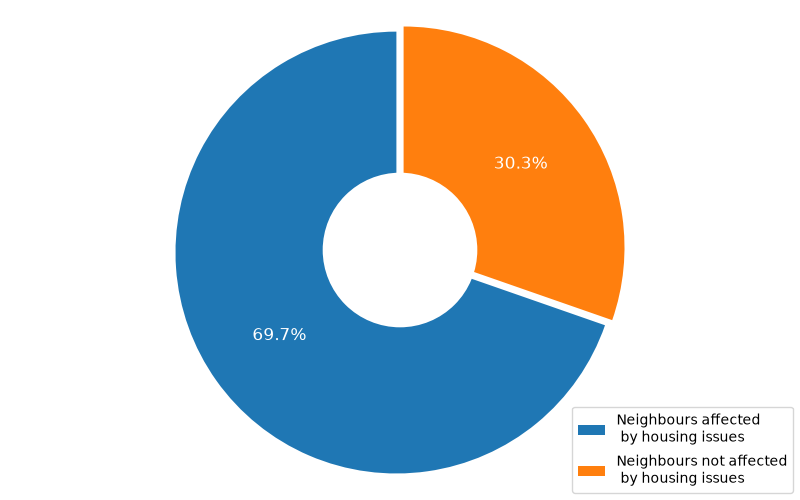
- 69.7% of respondents reported that their neighbours faced similar housing issues.
Shared Experiences
There comes a point at which repetition of the same failures throughout the same community can no longer be dismissed as a series of unrelated incidents. That point was reached long ago in Dalmarnock Village. The conditions documented throughout this report were not isolated cases, unfortunate exceptions, or individual misfortunes. They were the product of institutions that repeatedly failed residents and undermined the basic expectation that homes should be competently built, maintained, and repaired.
One of the most striking features of the oral testimony is the extent to which residents themselves recognised that the problems they were experiencing were not confined to their own homes. Residents continually situated their experiences within a wider pattern of housing problems affecting neighbours, friends, and entire streets. Far from describing isolated defects, residents repeatedly spoke of widespread failures that appeared throughout the Village. Helen Taylor was unequivocal when discussing the drainage problems affecting her street:
All our neighbours have got the same. Every one of them… The whole lot. Everyone in my street has got the same problems.
Interview with Helen Taylor (Thenue Housing Association Tenant) by James Ferns and Isla Wallace (03.02.2026)
Reflecting on housing conditions more generally, James Stewart stated:
Everyone I talk to here is always saying there’s problems with the houses, everyone. It’s not like one or two.
Interview with James Stewart (Thenue Housing Association Tenant) by James Ferns and Isla Wallace (02.03.2026)
Residents did not simply assert that problems were widespread, they supported these observations with examples drawn from the experiences of neighbours and friends. James described how similar issues appeared repeatedly among nearby households:
Next door… had mould, mushrooms and everything growing up his walls… My [other] neighbour as well… that’s a disabled house as well, and they’re having the exact same issues I’m having here as well – all frozen all the time, holes under the sink, the lot, everything… I think my neighbour over there, it’s another disabled house – it’s pretty much all disabled houses are having issues – and my neighbour next door, his ceiling has collapsed, twice.
Interview with James Stewart (Thenue Housing Association Tenant) by James Ferns and Isla Wallace (02.03.2026)
Eileen Gallagher’s testimony points towards an even wider pattern. Reflecting upon conversations with other residents, she described repeated reports of flooding, sewage problems, and ventilation failures across the Village:
Nearly all of them, if I’m being honest… they’ve all had floods, some of them have had sewage coming up through their toilets… I know one that had sewage coming through her washing machine, and it flooded the whole bottom floor of her house… I had somebody else that I spoke to whose ventilation system… went on fire when they were in the house, again because the filters weren’t changed.
Interview with Eileen Gallagher (Wheatley Homes Glasgow Tenant) by James Ferns and Bohdan Starosta (10.03.2026)
Comparable observations emerged elsewhere. Claire Wilson described neighbours experiencing severe rot, mould, and structural deterioration:
There’s a neighbour up there that’s had [a contractor] in her house multiple times and she’s got rot, mould, everything, behind her bathroom walls and they’re not doing anything about it… a lady at the very top, her washing machine… fell right through her floor. It was that bad, the floor was all rotting and stuff like that.
Interview with Charlotte Wilson and Claire Wilson (Wheatley Homes Glasgow Tenant) by Bohdan Starosta and Alan Sproull (03.02.2026)
Charlotte Wilson similarly pointed towards serious plumbing failures affecting nearby households:
The lassie that stays there, she had [raw sewage] all coming up through her toilet and it went all the way up.
Interview with Charlotte Wilson and Claire Wilson (Wheatley Homes Glasgow Tenant) by Bohdan Starosta and Alan Sproull (03.02.2026)
The same theme emerged when residents reflected upon the apparent futility of repeatedly reporting defects. Discussing recurring mould and repairs, Charlotte remarked:
It’s just swings and roundabouts. That’s what we feel, we feel [that although] everybody complains in this street, [it] just doesn’t get nothing done.
Interview with Charlotte Wilson and Claire Wilson (Wheatley Homes Glasgow Tenant) by Bohdan Starosta and Alan Sproull (03.02.2026)
Residents also recognised the impact these problems were having on one another. Elizabeth and Will Rutherford described how housing issues had become a visible source of stress within the wider community:
[Will Rutherford:] You can see the stress in other people as well. You can see what they’re going through.
Interview with Elizabeth and Will Rutherford (Owner-Occupiers) by James Ferns and Gary Wong (11.03.2026)
[Elizabeth Rutherford:] One of our friends who lived at the bottom of the Village – his kitchen had fell apart so bad, that he replaced his kitchen in a timeframe that he couldn’t financially sustain. So he had to sell… thankfully he’s come out of it ok and it’s been fine, but again that was about two years of him having insomnia and worrying… had to sell, at a time which was really crucial for his youngest at school and again, he’s out the equation now, he won’t go back, he won’t. I think he’s got trauma from it. He doesn’t want to talk, he just does not want to talk about it. It’s like:I’m done, I’m in my new house, I’m fine, the boys are fine, we’re ok.
Taken together, these testimonies expose the scale of the failure described throughout this report. These conditions were not confined to a small number of households, nor can they credibly be explained as a series of unrelated incidents. Residents repeatedly identified the same failures appearing in neighbouring properties, throughout their streets, and across the wider Village. What they describe is not coincidence; it is a pattern. The question is no longer whether these problems were widespread, but how such widespread failures were permitted to persist for so long.
Systemic Failure and Collective Realisation
The sheer scale and commonality of the problems documented throughout Dalmarnock Village shatters the credibility of one of the most common explanations offered to residents. Flooding, mould, structural deterioration, ventilation failures, sewage problems, and defective repairs cannot simultaneously be the fault of dozens of different households. The evidence instead points towards failures embedded within the construction, maintenance, and management of housing across the Village. The extent of those failures is simply too great to be dismissed as coincidence:
I’m not a builder, but to be honest with you, no ten-year-old house should be failing like this. It shouldn’t be failing this quickly or this badly. There’s been so many issues and so many people have the same issues that they can’t just blame people for it. It’s obviously coming from something else.
Interview with Eileen Gallagher (Wheatley Homes Glasgow Tenant) by James Ferns and Bohdan Starosta (10.03.2026)
[Will Rutherford:] When you look at every one of our neighbours: solar panel issues, window issues, dampness issues. You kind of go, there’s something happening here.
Interview with Elizabeth and Will Rutherford (Owner-Occupiers) by James Ferns and Gary Wong (11.03.2026)
[Elizabeth Rutherford:] It’s in every house.
Responsibility also cannot be confined to a single housing association. Wheatley Homes Glasgow, Thenue Housing Association, and West of Scotland Housing Association each feature prominently in accounts of defective housing, inadequate repairs, and dismissive treatment of residents. The failures documented throughout this report cross organisational boundaries:
I mean it’s not just our housing [association] that’s slacking in this area – all the housings are slacking.3
Interview with Charlotte Wilson and Claire Wilson (Wheatley Homes Glasgow Tenant) by Bohdan Starosta and Alan Sproull (03.02.2026)
Everybody thinks it’s Wheatley Homes, it’s not. West of Scotland are the same and so is Thenue. It’s not just one, it’s them all. And I think there has to be some sort of investigation into why they’re not carrying the repairs out to a decent standard.
Interview with Maria Rossi (Wheatley Homes Glasgow Tenant) by James Ferns and Frances Galt (26.02.2026)
The consistency documented throughout this report extended beyond the housing conditions themselves. Regardless of tenure, residents repeatedly describe institutions finding ways to avoid meaningful accountability. The mechanisms differed, but the outcome was often the same. For owner-occupiers, accountability was buried beneath years of delay; for tenants, it was buried beneath years of blame, as Will Rutherford explains:
[For us] it was not the blame game… it’s different… so housing associations, it seems to be a different thing. Whereas with us, it was like,
Interview with Elizabeth and Will Rutherford (Owner-Occupiers) by James Ferns and Gary Wong (11.03.2026)as long as we can keep them kind of on the hook, until the end, we’ll be good. That’s what it seemed like.
One of the most effective ways to obscure a systemic problem is to present it as a collection of individual ones. Residents were often left to navigate failures alone, initially without any clear understanding of how many others were experiencing the same conditions. Claire Sullivan described what happened when those boundaries began to break down:
Your story kind of gets louder in the Village, because you start kind of talking to your neighbours about all the stress that you’re enduring. Before you know it, your neighbours are also enduring these things and you’re like,
Interview with Claire Sullivan (West of Scotland Housing Association Tenant) by James Ferns and Frances Galt (30.01.2026)Hold on a minute, so you’re going through what I’m going through?And then they’re telling other people, so before you know it, the issue’s getting bigger and you’re like,Is this something that West of Scotland is aware of? And maybe they’re trying to hush it up, and actually this isn’t our problem?… when I had gone to the papers, people started messaging me through Facebook and that’s when my eyes opened and I knew I wasn’t alone. And I knew that, hold on a minute: these floods are actually happening all within the house, with the same issue… Any time I did bring this to West of Scotland they would never go into detail with any of it… they just wouldn’t, you know, acknowledge anything… they wouldn’t give anything away if it was true or not true. I got nothing. They just made it out as if,no, no, this is a complete isolated case and we’re only dealing with yours.
The individualisation of systemic failures only works for as long as residents remain isolated from one another. Locked into an institutional habit of treating systemic failures as individual cases, West of Scotland Housing Association was reluctant to acknowledge the wider pattern Claire was describing. But once Claire learned she was not alone, the authority of that response began to evaporate.
The breakdown of isolation did more than expose the scale of the problems affecting Dalmarnock Village. It also brought residents together around a shared determination to have those problems acknowledged and addressed. Maria Rossi recalled neighbours supporting one another through problems that many had come to recognise as shared:
It’s lucky we’ve got good supportive neighbours… that’s suffered the same kind of thing… The bit that we’re in is absolutely amazing… I love the bit of [the Village] that we’re in.
Interview with Maria Rossi (Wheatley Homes Glasgow Tenant) by James Ferns and Frances Galt (26.02.2026)
That sense of solidarity has increasingly been accompanied by a desire for collective action. Maria spoke not only about the need to come forward, but about the need to come forward together:
There’s hundreds of people, and I don’t know why they won’t come forward, because it is their right to repair. It is their right to live in a mould free, damp free home that is habitable… There’s hundreds of them in that Village. Hundreds of people suffering the same problem… A lot of people now need to come forward.
Something needs to be done… there’s so many people that are suffering problems who just will not come forward, and that’s what I want to do: I want to get people to speak up and come forward.
Interview with Maria Rossi (Wheatley Homes Glasgow Tenant) by James Ferns and Frances Galt (26.02.2026)
Once residents realised they were confronting the same failures, the conversation could no longer end with diagnosis alone. Attention increasingly turned towards what should happen next:
There’s a load of us now going like,
Interview with Kirsty Sinclair (Thenue Housing Association Tenant) by James Ferns and Frances Galt (27.11.2025)right, where do we go from here?
The same relationships that enabled residents to recognise these problems collectively also help to explain why so many remain committed to the Village itself. Across the interviews, residents distinguished between dissatisfaction with their housing conditions and their attachment to the communities they had built around them:
I don’t want to move. I want to stay here, I have very nice neighbours, it’s a nice place.
Interview with Susan Robertson (Owner-Occupier) by Isla Wallace and Bohdan Starosta (26.03.2026)
I don’t want to leave this house because we’ve built a community round about us.
Interview with Eileen Gallagher (Wheatley Homes Glasgow Tenant) by James Ferns and Bohdan Starosta (10.03.2026)
Elizabeth Rutherford’s testimony draws together the themes that run through the preceding accounts – the desire for a decent home, attachment to community, and a determination to fight for both:
This was our forever home, we were never moving, we are never moving, we are never selling… I want to fight this… and I don’t want somebody else to find that fucking home and then have to walk away from it because they’re fucking broke by a house; not by somebody dying, not by things life throws at you… I love this house, I love this community, and we’re all fighting the same thing.
Interview with Elizabeth and Will Rutherford (Owner-Occupiers) by James Ferns and Gary Wong (11.03.2026)
Elizabeth’s final observation – ‘we’re all fighting the same thing’ – captures a reality that emerges repeatedly throughout this report. Although often isolated by their housing providers, residents were not confronted by a succession of individual problems, but rather a set of institutional failures reproduced across an entire community. Patterns of neglect and disrepair appeared with such relentless consistency, scale, and persistence – across so many households and tenure types – that they were unmistakably systemic in nature. Once residents realised they were all fighting the same thing, the fiction of isolated failure became impossible to sustain.
Footnotes
- ‘Partial or temporary repair’ refers to issues that tenants do not consider resolved, but which Housing Associations regard as having been addressed. ‘Ongoing / no resolution’ refers to repair work that has not yet been completed. ↩︎
- Interview with Maria Rossi (Wheatley Homes Glasgow Tenant) by James Ferns and Frances Galt (26.02.2026) ↩︎
- Interview with Helen Taylor (Thenue Housing Association Tenant) by James Ferns and Isla Wallace (03.02.2026) ↩︎
- Interview with Elizabeth and Will Rutherford (Owner-Occupiers) by James Ferns and Gary Wong (11.03.2026) ↩︎
- Interview with Eileen Gallagher (Wheatley Homes Glasgow Tenant) by James Ferns and Bohdan Starosta (10.03.2026) ↩︎
- Interview with James Stewart (Thenue Housing Association Tenant) by James Ferns and Isla Wallace (02.03.2026) ↩︎