The findings presented in this section move beyond housing defects themselves to examine what it meant to live with them. The evidence that follows demonstrates that prolonged housing failure was not simply a matter of defective buildings, but rather sustained harm to the people living within them.1 Residents described the consequences of these conditions extending into almost every aspect of everyday life. The sections that follow examine how homes that should have provided comfort, security, and refuge instead became sources of sustained psychological harm, declining health, and the constant disruption of everyday life.
Housing Conditions as Psychological Harm
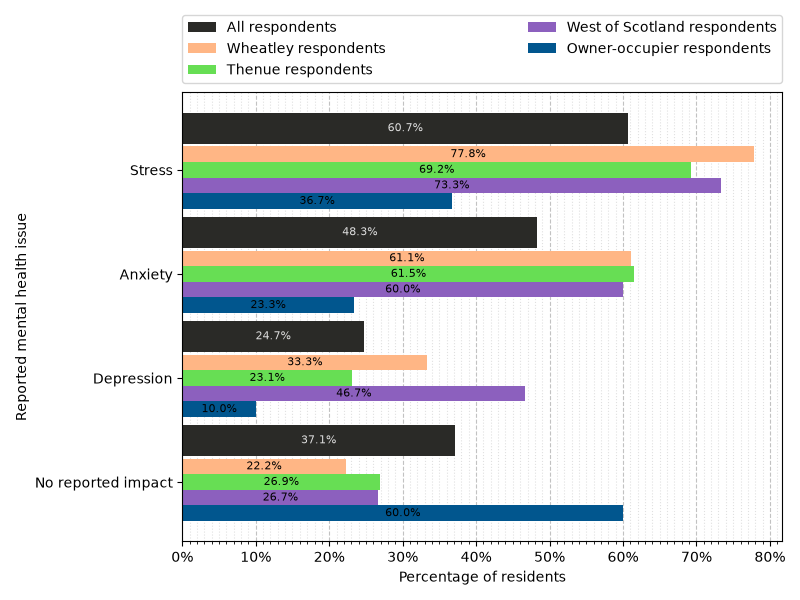
Figure 10: Impact on Mental Health by Housing Association.
- The impact of housing problems upon mental health was substantial. Almost two thirds of respondents (62.9 per cent) reported a deterioration in their mental health as a result of housing problems.
- Heightened stress was reported by 60.7 per cent of respondents, while 48.3 per cent reported increased anxiety and 24.7 per cent reported experiencing worsened depression. Notably, 24.7 per cent of respondents reported a worsening of all three conditions simultaneously.
Psychological and Physical Distress
The effects of poor housing conditions extended well beyond the fabric of residents’ homes, becoming a source of chronic stress, anxiety, fear, frustration, and emotional exhaustion that formed part of residents’ everyday lives. The evidence presented here demonstrates that poor housing conditions themselves constitute a form of psychological harm. These were not isolated reactions to unconnected incidents. Rather, they were the cumulative consequences of living for years with unresolved housing problems, recurring failures, and the constant uncertainty of not knowing what would go wrong next.
Kirsty Sinclair explained that the stress associated with her housing conditions had contributed to her beginning antidepressant medication:
The stress. Obviously, I care for my dad as well two days a week. So I don’t need the added stress as well as working, caring for my dad, and obviously all this… I’m now on anti-depressants… it’s just constant stress.
Interview with Kirsty Sinclair (Thenue Housing Association Tenant) by James Ferns and Frances Galt (27.11.2025)
Eileen Gallagher’s testimony illustrates how prolonged housing problems rob people of their sense of normality. Reflecting on years of flooding and disrepair, she described both the life she had lost, and the constant fear created by never knowing when the next flood might occur:
I used to go to the gym every day. I had a job. I had a normal life. And now I don’t leave my house. And I know that sounds dramatic, but I don’t really leave my house, I can’t breathe. I can’t walk very far. I can’t do the normal things that I should be able to do with my kids… I can’t do these things because – it’s just limited everything. To be honest with you, the mental impact, and I know it sounds crazy, but if I leave my house for any longer than a couple of hours, I need to turn the water off at the mains in case the house floods when I’m not there, because you don’t know what you’re coming back to… there’s loads and loads of stuff that’s happened and every time you hear water, you just panic because you think that the house is flooding. You shouldn’t have to live like that.
Interview with Eileen Gallagher (Wheatley Homes Glasgow Tenant) by James Ferns and Bohdan Starosta (10.03.2026)
Repeated attempts to secure repairs left Charlotte Wilson feeling abandoned. Unable to obtain meaningful action from her housing provider, she described feeling as though she was ‘going insane’; that she was ‘screaming inside’:
My mental health, I just feel as if I’m going insane. I feel as if I’m actually going insane. Because I can’t get a hold of my housing officer. They won’t come out and do the job properly… you just don’t feel as if you’re getting anywhere. I feel as if I’m just – like I’m screaming inside. I’m trying to hold it together for my family.
Interview with Charlotte Wilson and Claire Wilson (Wheatley Homes Glasgow Tenant) by Bohdan Starosta and Alan Sproull (03.02.2026)
The distress caused by poor housing conditions was compounded by a belief that those responsible for addressing the problems simply did not care. Claire Sullivan expressed this bluntly:
The housing, they say they’ve got a duty of care, but they don’t – they don’t have that valid approach like when it comes to people’s lives. How it actually affects them mentally.
Interview with Claire Sullivan (West of Scotland Housing Association Tenant) by James Ferns and Frances Galt (30.01.2026)
Maria Rossi provided one of the starkest descriptions of psychological harm encountered during the research. Left ‘one step away from insanity’, she saw little evidence that those responsible cared about anything beyond collecting rent:
As long as they’re getting rent from that property, they couldn’t care about the repairs that get carried out. Or anybody’s mental health. Or what they’re suffering. Or their family members… it gets you. I was one step away from insanity and that’s the truth… it takes its toll.
Interview with Maria Rossi (Wheatley Homes Glasgow Tenant) by James Ferns and Frances Galt (26.02.2026)
Elsewhere in the interview, Maria explained that the conditions within her home had not only caused significant distress, but had exacerbated an existing diagnosis of Obsessive Compulsive Disorder (OCD), making her symptoms ‘ten times worse’:
It was depressing. Let me put it that way. Very depressing… it got me to the stage where my child didn’t even want to be round me. Neither did my grandchild, because I was constantly on my hands and knees scrubbing. Because I’ve got OCD as well. Medically diagnosed with it… I’m trying to tell [Wheatley]… they didn’t budge… it made it ten times worse… that has been my anxiety’s anxiety. I was constantly walking about cleaning everything… It’s just not nice when you’ve got OCD.
Interview with Maria Rossi (Wheatley Homes Glasgow Tenant) by James Ferns and Frances Galt (26.02.2026)
Poor housing conditions took a physical toll as well as a psychological one. Residents described insomnia, significant weight loss, prescribed medication, hospitalisation, and other physical symptoms. The stress of living with prolonged housing problems was not simply felt – it was carried by the body. After returning home to find another flood had brought her ceilings down, Kirsty Sinclair was hospitalised with stress-related Bell’s Palsy:
You’re just constantly stressed… I was flooded about more than a month ago there, that was the washer that they fixed on the top toilet had went again… [and when I] got home from my dad’s, all my ceilings were in. I ended up in the hospital, like my face all drooped, my arm… I’ve got nerve pain in my arm, and it turns out I had Bell’s Palsy through stress.
Interview with Kirsty Sinclair (Thenue Housing Association Tenant) by James Ferns and Frances Galt (27.11.2025)
Every storm became a source of anxiety that the rotted windows of her home would collapse for Elizabeth Rutherford. The repetition in her testimony is particularly telling – she could not sleep:
It’s been the last, I would say six months, that I’m getting really – I can’t sleep because every time there’s a wind… I’m like this will be the storm that takes everything out. This will be the storm where windows fall out… I stress out when I talk about this house… I never slept last night… I’m terrified, [if the window] comes down, does somersaults and ends up in the path or on the road… I can’t sleep.
Interview with Elizabeth and Will Rutherford (Owner-Occupiers) by James Ferns and Gary Wong (11.03.2026)
The stress associated with prolonged housing problems left a profound physical mark on Maria Rossi. She described insomnia, significant weight loss, prescribed medication, and a gradual deterioration in her health:
The stress and anxiety… I’m surprised I’ve never had a mental breakdown to be honest. But I stopped eating. I stopped sleeping. Ended up with insomnia. I lost four stone in weight… they weren’t listening to me. You don’t get the stress and anxiety this is causing the person, the tenant.
Interview with Maria Rossi (Wheatley Homes Glasgow Tenant) by James Ferns and Frances Galt (26.02.2026)
The testimonies presented here should give pause to anyone seeking to minimise the consequences of poor housing conditions. No resident should be driven to antidepressants, left feeling abandoned, or pushed to the point of describing themselves as ‘going insane’ or ‘one step away from insanity’ because of the condition of their home. These are not the experiences of people involved in routine repair disputes. They are accounts of profound psychological distress. If residents are being driven to describe their lives in such terms, then something has gone seriously wrong.
Caregiver Stress and Protective Anxiety
For many residents, the psychological burden of poor housing conditions extended beyond concerns for their own wellbeing. They feared that the people they cared about most would be harmed by the conditions they were living in. These accounts reveal a form of protective anxiety rooted in the responsibility of keeping loved ones safe.
Eileen Gallagher recalled the distress of seeing the safety and security she wanted for her children placed at risk by ongoing housing problems:
To be completely honest, the impact that it has had… I couldn’t begin to describe it… When you feel as if you’re constantly trying to do better for your kids, [to] better their life and give them a house that’s basically a safe place that they can come to, and that’s under threat? It’s, it’s, it’s not fair – it’s not – it’s no fair at all.
Interview with Eileen Gallagher (Wheatley Homes Glasgow Tenant) by James Ferns and Bohdan Starosta (10.03.2026)
Elsewhere in the interview, Eileen described the dread that repeated flooding had instilled in her eldest son:
I’ve already got two autistic people in the house and my son who’s eighteen, and we’ve all got our own issues. It just shouldn’t be happening… My oldest has been impacted quite badly by it. A lot of his stuff has been ruined… he’s so paranoid every time you go anywhere that he thinks that the house is going to flood.
Interview with Eileen Gallagher (Wheatley Homes Glasgow Tenant) by James Ferns and Bohdan Starosta (10.03.2026)
Claire Sullivan similarly described the stress of living with housing problems whilst caring for children with additional needs. She felt that the impact upon vulnerable children was met with indifference:
We are still struggling to this day given that we have four children in this home with autism and different things. They don’t take into consideration… how these situations impact the children, especially ones that do have a disability. It just goes above their head. And nobody cares.
Interview with Claire Sullivan (West of Scotland Housing Association Tenant) by James Ferns and Frances Galt (30.01.2026)
Kirsty Sinclair described the fear of inadvertently putting her father’s health at risk. As a carer for her father, who has Chronic Obstructive Pulmonary Disease (COPD) and emphysema, she worried that each visit might carry harmful conditions from her home into his. At the same time, she felt unable to welcome him into her own home because she believed it was no longer safe for him:
My dad’s got COPD… I’m going down sometimes, like, down to that terrified.
Interview with Kirsty Sinclair (Thenue Housing Association Tenant) by James Ferns and Frances Galt (27.11.2025)Am I carrying anything? Am I taking any [mould], like into him?Like when he can’t afford to have anything like that… I wouldn’t even dare take my dad near my house… he’s got emphysema and COPD, so my dad can never come and visit me because I wouldn’t take the risk.
The fear that housing conditions could harm loved ones was also evident in Claire Wilson’s testimony. Already coping with severe postnatal depression, she described the overwhelming fear of raising a toddler in a home she did not believe was safe:
I am constantly worried about my children, and then with all this happening and all in the house, it doesn’t help matters… I mean and I’ve got severe postnatal depression and I, I’ve no, I’ve not been offered help for it yet, and I’m not – I try so hard just to, just to support them and try and stop them from getting unwell and things like that. I try and do things… but it, it does, it does worry, it does worry me, I, I, I feel stressed out daily knowing that I’ve got draughts coming through my windows and mould in my bathroom… knowing that this house isn’t adequate for my children, because it’s not adequate.
Interview with Charlotte Wilson and Claire Wilson (Wheatley Homes Glasgow Tenant) by Bohdan Starosta and Alan Sproull (03.02.2026)
No resident should be left fearing that the condition of their home could harm their child, parent, or other loved one. When housing conditions become a source of fear for the safety and wellbeing of loved ones, one of the most fundamental purposes of a home has been lost.
Dislocation and Alienation in the Home
When housing problems persist for years, the consequences can extend beyond physical conditions and psychological distress. The home itself can become alienating. Rather than places of comfort, safety, and belonging, homes became associated with stress, dread, and avoidance. Kirsty Sinclair’s testimony encapsulates this sense of dislocation. Reflecting on years of unresolved housing problems, she described reaching a point where home no longer felt like a place of comfort or refuge, but somewhere she did not want to return to:
You’re scared to go home because you don’t know if something else is burst when you get in… it deteriorates your mental health so much when you know every day you’re going home from work to a mouldy house, you know? You’re going to need to go in and try scrub with more bleach to take the horrible smell away… You don’t want to go home sometimes – because like,
Interview with Kirsty Sinclair (Thenue Housing Association Tenant) by James Ferns and Frances Galt (27.11.2025)going home to this tip again– because, and it’s nothing to do with not being clean… it’s just constant damp, mould, whatever… All I want is a house… just a home that I’m comfortable in and can live in and I’m happy to go home to.
Kirsty’s testimony reveals a profound rupture in the relationship between resident and home. Her repeated references to being ‘scared to go home’ and returning each day to ‘a mouldy house’ illustrate a deep sense of dislocation. In this sense, her account describes a form of alienation within the home itself: she had not lost her house, but she had lost the sense of safety and belonging that gives a house meaning as a home. Perhaps the most striking aspect of Kirsty’s testimony is the simplicity of what she ultimately wanted. After years of housing problems, her aspiration was not ambitious or extraordinary. She simply wanted a home she was ‘happy to go home to’.
The gulf between the idea of home, and residents’ lived experience, was also evident in Claire Sullivan’s testimony:
It’s depressing when you’re having to go home to your life – I mean – that is your home. And yeah, these houses look great from the outside. But they’re absolutely disgusting on the inside.
Interview with Claire Sullivan (West of Scotland Housing Association Tenant) by James Ferns and Frances Galt (30.01.2026)
Alienation from the home was also evident in the loss of pride and attachment residents once felt towards their homes. As housing problems persisted, many residents gradually lost the desire to invest time, care, and emotional energy in the places they lived. Elizabeth Rutherford described a profound loss of attachment to a home she had once been proud of:
I’m a bit house proud. Everything’s getting tired because I’ve lost my sense of faith in this house. I don’t want to paint. I don’t want to get new flooring. I don’t want to do anything. Because I’ve got a forty grand bill hanging over my head… my whole house is tired because I’m fucking worrying about issues that other people have gave me… I’m 54, this is the first time I’ve ever lost interest in any house I’ve ever stayed in.
Interview with Elizabeth and Will Rutherford (Owner-Occupiers) by James Ferns and Gary Wong (11.03.2026)
Elsewhere in the interview, Elizabeth contrasted her excitement when first purchasing the house with the feelings it now evoked:
My house was the thing. I couldn’t believe we bought this house. I couldn’t believe that where we sit, where our view is, how close it was to the school, how close it was to the train station… We were so excited about this. And now I’d cheerfully put a bomb to it and try and build something else, because it’s just shocking, it’s shocking how wrong everything is.
Interview with Elizabeth and Will Rutherford (Owner-Occupiers) by James Ferns and Gary Wong (11.03.2026)
A similar sense of disillusionment was evident in Maria Rossi’s testimony. Recalling her first impressions of the property, she described the excitement residents felt when they moved in, before years of unresolved problems gradually eroded that attachment:
I was one of the first ones to move in… you thought you’d won a Rolex… when you first moved in, they were amazing. They really were amazing. It’s just after a couple of years… that’s when the problems started to occur. And they’ve still not fixed them.
Interview with Maria Rossi (Wheatley Homes Glasgow Tenant) by James Ferns and Frances Galt (26.02.2026)
As that attachment diminished, residents increasingly questioned the value of investing time and effort in their homes. Maria Rossi, Charlotte Wilson, and Kirsty Sinclair each described reaching a point where decorating and maintaining the home no longer felt worthwhile:
When you’re decorating and it just falls apart round about you. So, you get to the stage you say to yourself:
Interview with Maria Rossi (Wheatley Homes Glasgow Tenant) by James Ferns and Frances Galt (26.02.2026)What’s the point?.
I don’t even want to do anything to this house. I want to decorate, but I don’t.
Interview with Charlotte Wilson and Claire Wilson (Wheatley Homes Glasgow Tenant) by Bohdan Starosta and Alan Sproull (03.02.2026)
I’ve just wallpapered as well, and all the wallpaper is just falling off the wall.
Interview with Kirsty Sinclair (Thenue Housing Association Tenant) by James Ferns and Frances Galt (27.11.2025)
For some residents, this process culminated in a complete loss of attachment to the home itself. As Maria Rossi bluntly put it:
I don’t even want to live there anymore.
Interview with Maria Rossi (Wheatley Homes Glasgow Tenant) by James Ferns and Frances Galt (26.02.2026)
A home is more than a physical structure. It is a place to which people become attached, invest care and effort, and expect to find comfort and security. The testimonies presented here reveal what happens when that relationship is broken. The progression from pride, to disillusionment, to withdrawal, and ultimately to rejection illustrates how prolonged housing problems can erode the very meaning of home.
Erosion of Comfort, Security and Dignity
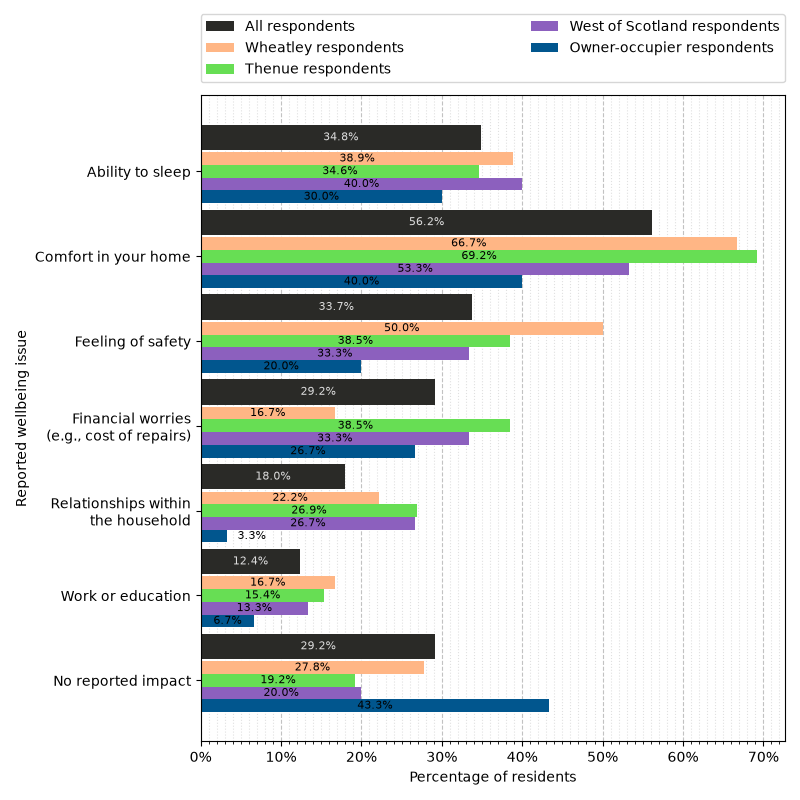
- The survey identified a significant impact upon wellbeing, with respondents reporting a 70.8 per cent decline.
- More than a third of respondents (34.8 per cent) reported that housing problems had negatively affected their ability to sleep, while 12.4 per cent reported disruptions to work or education.
- Loss of comfort within the home was reported by 56.2 per cent of respondents. Among this group, 60 per cent reported mould, 72 per cent reported damp, and 74 per cent reported plumbing problems. These findings suggest a strong relationship between deteriorating housing conditions and residents’ ability to feel comfortable within their own homes.
- A diminished sense of safety was reported by 33.7 per cent of respondents. Within this group, two thirds (66.7 per cent) reported structural problems affecting windows and doors, while more than half (56.7 per cent) reported structural problems affecting walls, floors, or ceilings. Concerns regarding safety were not limited to structural defects. 70 per cent of respondents within this cohort also reported mould, alongside leaks and flooding that frequently resulted in dampness and, in some cases, fears regarding the condition of the property itself.
- 18 per cent of respondents reported a deterioration in relationships within the household as a consequence of housing problems. Among this group, 75 per cent reported mould, 93.8 per cent poor plumbing, and 87.5 per cent leaks and flooding. These figures highlight the strain that persistent and unresolved housing problems can place upon family life, particularly where residents face longstanding difficulties securing effective repairs.
Comfort and Dignity
Comfort is one of the most basic expectations people have of home. Yet residents described living conditions that undermined their ability to feel settled, relaxed, and at ease within their own homes. In many cases, the effects extended beyond the physical fabric of the property and into the personal spaces, possessions, and routines through which people create a sense of home. Eileen Gallagher described discovering mould growing behind a framed picture in her son’s bedroom, illustrating how housing problems could intrude into the most personal aspects of domestic life:
One day, I went into my son’s room… and I was wiping one of the pictures and I saw mould spores coming out of the picture. So when I lifted the picture off the wall, there was a massive patch of mould on the wall.
Interview with Eileen Gallagher (Wheatley Homes Glasgow Tenant) by James Ferns and Bohdan Starosta (10.03.2026)
Claire Sullivan reflected on the destruction of the possessions and personal touches through which people create comfort and belonging:
This is heartbreaking that this is actually happening to people’s homes… it’s the things that people put into their homes to make it a home, now destroyed.
Interview with Claire Sullivan (West of Scotland Housing Association Tenant) by James Ferns and Frances Galt (30.01.2026)
Maria Rossi contrasted her current circumstances with what she felt a home should provide. At a stage in life when she wanted peace, stability, and comfort, she instead found herself living under constant uncertainty and vigilance:
Honestly, I want to move out, because it’s just – it’s a whole lot of stress you don’t need in life. I’m fifty, I don’t need that. My life’s coming to where I just want to be able to sit in my nice, warm, cosy house… when you hear a noise, you’re [not] like
Interview with Maria Rossi (Wheatley Homes Glasgow Tenant) by James Ferns and Frances Galt (26.02.2026)Oh my god, what’s that?.
Kirsty Sinclair expressed a similarly modest aspiration. After years of housing problems, all she wanted was a home in which she felt comfortable and happy to return:
All I want is a house… just a home that I’m comfortable in and can live in and I’m happy to go home to.
Interview with Kirsty Sinclair (Thenue Housing Association Tenant) by James Ferns and Frances Galt (27.11.2025)
For many residents, however, comfort was undermined not only by stress and uncertainty, but by the everyday sensory realities of the homes in which they lived. The odour of dampness, drains, and raw sewage became a routine part of everyday life for some households. Helen Taylor spoke of living with the smell of raw sewage entering her home through the drainage system:
The smell is coming up through the shower, and it is absolutely rank.
Interview with Helen Taylor (Thenue Housing Association Tenant) by James Ferns and Isla Wallace (03.02.2026)
At times, she described it as physically overwhelming:
Because if you go to use that toilet first thing in the morning, you actually feel sick… it’s that bad some mornings.
Interview with Helen Taylor (Thenue Housing Association Tenant) by James Ferns and Isla Wallace (03.02.2026)
Claire Sullivan similarly described the smell within her home as ‘revolting’.3 Reflecting on the aftermath of repeated flooding and dampness, she explained how persistent odours had become so normalised that they were no longer immediately noticeable:
During the most recent flood… we could smell obviously how bad the dampness and everything was. But we really didn’t actually smell it to the extent until we had gone on a holiday and actually come back, and smelled how bad it actually was. I mean, because you start to get immune to it.
Interview with Claire Sullivan (West of Scotland Housing Association Tenant) by James Ferns and Frances Galt (30.01.2026)
Living under these conditions for years fundamentally reshaped Claire’s sense of what was normal. Only after leaving the Village did she appreciate the extent to which she had adapted to the smell:
Another thing as well, like we’ve both noticed, our smells have come back! And I mean I’m not joking when I say this – it’s like you could actually now smell things to the point you questioned yourself: “Was I walking out the door stinky?”… all of a sudden we can now smell different things that we couldn’t previously.
Interview with Claire Sullivan (West of Scotland Housing Association Tenant) by James Ferns and Frances Galt (30.01.2026)
Residents also reported the presence of rats, mice, insects, and other pests within their homes. Beyond the distress they caused, infestations disrupted residents’ sense of comfort, security, and control within the home. Maria Rossi recalled repeated problems with pests entering her home, including ants, beetles, and insects emerging through the property’s drainage system:
I had beetles coming in my house, I had ants… infested with ants… big things coming out of my sink. Don’t know if it was woodworm or damp or whatever it was. But I had these big things coming out of my sink… I had ants just covering, like, my full worktops, my living room.
Interview with Maria Rossi (Wheatley Homes Glasgow Tenant) by James Ferns and Frances Galt (26.02.2026)
Infestations were particularly distressing where they occurred despite residents’ efforts to maintain clean and well-kept homes. One survey participant reflected:
A lot of insects, [they were on] the wall[s], the edges of the floor, the bed, inspectors came in eventually, and it was found that the insects came in because of the leaks and dampness related to the toilet… [I] felt that this was disgusting, because I keep a clean house.
Survey Participant 86 (Wheatley Homes Glasgow Tenant)
Persistent infestations also remained unresolved despite repeated complaints:
There’s a persistent mice infestation, and nothing has been done about it.
Survey Participant 91 (Wheatley Homes Glasgow Tenant)
The consequences extended beyond discomfort and disgust. Claire Wilson spoke of living in an area she believed to be heavily affected by rats, and the anxiety this created for her family:
This street is infested with rats – infested with rats! The only reason we don’t get them in this household is because we have two dogs… a rat actually came [into a neighbour’s] house and ate her budgie… I mean what if that happens to your children, they come in, they bite your children, it, it, it’s a big fear for me.
Interview with Charlotte Wilson and Claire Wilson (Wheatley Homes Glasgow Tenant) by Bohdan Starosta and Alan Sproull (03.02.2026)
In some cases, the cumulative impact of these problems fundamentally altered residents’ experience of the home. As one survey participant put it:
I’ve not been able to enjoy my tenancy due to rats and other issues in my house.
Survey Participant 54 (Wheatley Homes Glasgow Tenant)
A home should be a place where people can relax, feel at ease, and enjoy everyday life. The experiences described above illustrate what happens when those ordinary comforts are gradually stripped away. Yet for some residents, the consequences extended beyond discomfort alone. Housing failures intruded into some of the most private aspects of daily life and, in some cases, the responses offered by housing providers required residents to compromise basic expectations of privacy and dignity. Several residents reported being advised to leave bathroom doors open whilst showering in order to compensate for defective ventilation and persistent condensation problems. Eileen Gallagher explained why she regarded this advice as wholly inappropriate within a family home:
They’ve told us to leave the shower bathroom doors open while people are showering, and I’m not being funny – you can’t do that in a house full of people, you just can’t. You need privacy. That’s not a normal thing to do… especially with teenage boys and a wee lassie in the house, it’s not appropriate. Aye, they’ve asked us to do really weird things that I’ve never heard of anybody being asked to do before.
Interview with Eileen Gallagher (Wheatley Homes Glasgow Tenant) by James Ferns and Bohdan Starosta (10.03.2026)
Claire Sullivan recalled being given similar instructions as a means of managing persistent condensation and ventilation problems:
I was told to keep the ground floor toilet door opened to let the air in. To air it, because inside the toilet the vent up on the ceiling was broken, there wasn’t a window in the toilet neither for anything to go out… when you were having a shower and you’ve got all that condensation, it’s not evaporating.
Interview with Claire Sullivan (West of Scotland Housing Association Tenant) by James Ferns and Frances Galt (30.01.2026)
For some residents, these intrusions were not limited to inappropriate advice, but fundamentally altered the most intimate aspects of everyday life. Because his housing association failed to properly repair a collapsed bathroom floor, James Stewart was left with no choice but to assist his disabled mother whilst she showered, despite his concern for her privacy and dignity:
She can barely move – she’s got a Zimmer frame – and it’s very, very dangerous for her to get in and out the shower. And you can imagine, I don’t want to stand – I’m a boy, I don’t want to stand there with my mother in the shower – but I have to do it to make sure she’s safe.
Interview with James Stewart (Thenue Housing Association Tenant) by James Ferns and Isla Wallace (02.03.2026)
The ability to wash, dress, and attend to personal needs in private is among the most basic expectations of human dignity. The accounts presented here demonstrate how housing failures, and the response of housing associations to those failures, undermined that dignity by forcing residents to sacrifice privacy in order to live safely within their own homes. In doing so, they illustrate how the erosion of comfort within the home can ultimately extend into some of the most private and fundamental aspects of everyday life.
Social Withdrawal
Feelings of shame and embarrassment emerged repeatedly throughout residents’ testimonies. As housing conditions deteriorated, some residents became reluctant to invite friends and family into their homes, whilst others described withdrawing from social activities and contact with others. Claire Sullivan summed up the experience succinctly, describing it as ‘an embarrassing way of living’.4 Reflecting on the revolting smell of drains and sewage that permeated her home, she explained how embarrassment became so severe that she stopped inviting people into her home altogether:
When you would use the toilet, you would smell the drains… it was embarrassing because, if you had family or if you had friends over… even if you shut the bathroom door. The smell was – it was revolting, it’s the only way I could explain it. It would make you sick… I stopped. I stopped. I didn’t bring anybody into my house. The only person that was allowed to come was my mum… I mean I’m not even exaggerating when I say this, it was so embarrassing.
Interview with Claire Sullivan (West of Scotland Housing Association Tenant) by James Ferns and Frances Galt (30.01.2026)
Claire’s experience was not unique. Other residents similarly reflected on the embarrassment of welcoming visitors into homes permeated by the smell of sewage:
That’s embarrassing. Totally embarrassing… because it’s smelling.
Interview with Helen Taylor (Thenue Housing Association Tenant) by James Ferns and Isla Wallace (03.02.2026)
Many neighbours complain of the same toilet issues and sewage smell issues to the point sometimes you can’t sit downstairs in living room as it smells so bad, and it’s embarrassing if you have guests and your house smells like sewage!
Survey Participant 15 (Thenue Housing Association Tenant)
Housing conditions could also become a source of shame for other members of the household. Kirsty Sinclair described how her children no longer wanted to bring friends or partners into a home marred by dampness, mould, and disrepair:
My two sons still lived in the house at that time. The two of them’s now moved out because they don’t want to be staying in that, bringing their friends home, their girlfriends home, whatever… [my daughter] doesn’t want to bring her friends in the house either, so it’s a wee bit impacting her mental health and her social life because she doesn’t want to bring somebody in whenever my floors cut up and it’s all black mould… she’s embarrassed, she’s embarrassed when obviously that’s sitting there like that.
Interview with Kirsty Sinclair (Thenue Housing Association Tenant) by James Ferns and Frances Galt (27.11.2025)
Elsewhere in the interview, Kirsty reflected on the broader impact that this had upon both her own life and that of her daughter:
It does upset you… and it’s nothing to do with not being clean… it’s just constant damp, mould, whatever, you’re constantly going about with bleach… that’s just what you’re constantly doing trying to, because it’s embarrassing when people come in and you’re like “oh I’ve got another leak there”, do you know what I mean?… It’s having a big impact, like on my life, on my daily life, on my child’s life.
Interview with Kirsty Sinclair (Thenue Housing Association Tenant) by James Ferns and Frances Galt (27.11.2025)
Even residents who had spent considerable sums replacing defective fixtures and fittings described similar experiences. Reflecting on the only toilet in her home that had not been replaced since the original build, Elizabeth Rutherford stated:
People think we live in absolute luxury and it’s, it’s, it’s horrendous what you need to make people do when they come in the house.
Interview with Elizabeth and Will Rutherford (Owner-Occupiers) by James Ferns and Gary Wong (11.03.2026)Can you go to the toilet we put in because that one doesn’t work?
For some residents, the emotional toll of housing problems began to affect relationships with those closest to them. Maria Rossi reflected on how constant stress and anxiety strained her relationship with her children and grandchildren:
[I was] constantly on edge… it was chaos. My kids were always around about me, and they did not want to be… because I was unbearable… I was always on edge, and I just wasn’t nice to be around, like, with my grandkids… the stress and anxiety.
Interview with Maria Rossi (Wheatley Homes Glasgow Tenant) by James Ferns and Frances Galt (26.02.2026)
In the most severe cases, residents described withdrawing from social life altogether. Eileen Gallagher’s earlier reflection also captures the extent to which prolonged housing problems transformed her relationship with everyday life:
I used to go to the gym every day. I had a job. I had a normal life. And now I don’t leave my house.
Interview with Eileen Gallagher (Wheatley Homes Glasgow Tenant) by James Ferns and Bohdan Starosta (10.03.2026)
The testimonies presented here reveal the social cost of poor housing conditions. Residents described feeling unable to invite friends into their homes, embarrassed when visitors crossed the threshold, and ashamed of conditions that were beyond their control. Homes that should have been places of warmth, hospitality, and family life instead became places to hide, avoid, and apologise for. In this way, housing problems did not merely damage the home itself; they eroded the social relationships and human connections that give a home much of its meaning.
Safety
Safety is one of the most fundamental purposes of housing. No resident should fear that their home could injure them, harm their children, or place the lives of loved ones at risk. Nevertheless, a recurring theme throughout residents’ testimonies was the belief that their homes posed a threat to their safety and wellbeing. Eileen Gallagher described the psychological burden of living in a home she did not regard as safe:
You’re not safe in your own house. This is the issue, you’re actually not safe here. You don’t know what’s going to happen. I’ve heard of people whose roofs have collapsed… see when you’ve already got mental health issues, and you’ve got that kind of worry on top of these things… you automatically think that’s going to happen to you, so you don’t – you don’t live normally. You’ve no quality of life because you’re worried more about what’s going on in the house. And, it just – it feels constant. It’s never ending.
Interview with Eileen Gallagher (Wheatley Homes Glasgow Tenant) by James Ferns and Bohdan Starosta (10.03.2026)
Concerns for the safety of children emerged repeatedly throughout residents’ testimonies. Reflecting on the potential consequences of an unresolved leak within his home, Tesfay Kiros explained:
I have kids, you know. And if something happens… that’s very bad, you know… I have five kids, so it’s a worry. I don’t know… maybe it’s going [to get] bigger and someday something bad [will] happen… I have kids, you know. Maybe some places it might gush out some day.
Interview with Tesfay Kiros (Wheatley Homes Glasgow Tenant) by James Ferns and Isla Wallace (25.02.2026)
Safety concerns were not confined to social tenants. Elizabeth Rutherford described an overriding fear that a rotting window could fall from her property and strike a child or passer-by below:
I’m stressed out my box right now because the worst window is in our bedroom, and it’s above the two cars that normally sit there, and it’s a pathway. So now when that comes out, is it just going to be two cars that get hit? Is it going to be nothing that gets hit because we’re at work? Or is it going to be a child? And I’m getting to the point where I’m actually going to have to fix this so it’s not killing anybody…
Interview with Elizabeth and Will Rutherford (Owner-Occupiers) by James Ferns and Gary Wong (11.03.2026)
Other residents described unsafe conditions within the home itself, including damaged flooring that created significant trip hazards:
They just ripped a bit of floor up… I nearly lost my ankle, that was how dodgy they put the floor down. When my daughters were chasing me around my kitchen, I stood on one bit of floor because of the big gap, my ankle went down the other bit, and I just pulled it out in time or my ankle would have been caught. My granddaughter nearly broke her ankle with slipping on the floor. I was left like that for nineteen months, with no flooring, no nothing… just a big damp floor. And they kept saying
Interview with Maria Rossi (Wheatley Homes Glasgow Tenant) by James Ferns and Frances Galt (26.02.2026)Oh, we don’t know.
I’ve struggled to get a response and I don’t feel safe walking around on my floor, I’ve tripped on my floor a few times due to mould causing my flooring to be removed and I’ve been left waiting on my housing association to fix it.
Survey Participant 62 (West of Scotland Housing Association Tenant)
For some residents, these concerns culminated in a broader sense that their family’s safety was under constant threat:
I feel as if my and my family’s safety is in constant danger.
Survey Participant 40 (West of Scotland Housing Association Tenant)
For some households, concerns about housing safety were inseparable from concerns about the survival of vulnerable relatives. James Stewart described the conditions within his disabled mother’s bedroom:
The kitchen and the disabled bedroom were really cold… absolutely like ice… it’s frozen… I’ve had to buy electric blankets, halogen heaters, everything, just to keep my mother alive pretty much.
Interview with James Stewart (Thenue Housing Association Tenant) by James Ferns and Isla Wallace (02.03.2026)
Elsewhere in the interview, James reflected on how the severe cold within his home left his father’s bedroom uninhabitable. Unable to sleep in his bedroom, his father – a wheelchair user and double amputee – slept on a couch instead. James went on to describe the tragic sequence of events that followed:
Because of the house – my dad wouldn’t sleep in that room, so he would sleep on this couch. And because of that, he fell off the couch… my dad was an amputee. He lost his feet first, through diabetes, then it was up to both his knees… he was sitting in here with his legs, or what was left of his legs, on the wheelchair – and one day he went to get up and he broke his femur… which led to him getting put in hospital, which led to him [being] put under anaesthesia… he came out of anaesthesia and had a heart attack and died… Because he fell off this couch – because that room was too cold – my dad died… he just couldn’t sleep; it was too cold. And my dad was a big man so I couldn’t carry him up the stairs.
Interview with James Stewart (Thenue Housing Association Tenant) by James Ferns and Isla Wallace (02.03.2026)
Safety is not an optional feature of housing. It is its most fundamental obligation. The testimonies presented here describe residents who feared injury, feared for their children, feared for vulnerable relatives, and, in the most tragic case, connected the death of a loved one to conditions within the home itself. This should never happen. No resident should be left questioning whether their home is safe. No family should lose a loved one in circumstances they believe arose because a home failed to provide basic protection from harm. Such conditions are not merely regrettable; they are unacceptable.
Living within Constant Chaos
Chaos permeates many of the testimonies gathered during this research. Housing problems were not described as isolated events but as an unending succession of defects, failures, and fresh crises. A sense of constant and all-encompassing disruption pervades many residents’ accounts, with everyday life increasingly consumed by the endless cycle of cleaning, repairing, replacing, and reporting. Eileen Gallagher’s testimony captures the overwhelming sense of chaos that housing problems can create – or, as she states, ‘it’s just pure panic every five minutes’.5 Reflecting on the cumulative impact of repeated flooding and water damage, she described a home consumed by an unending cycle of deterioration, cleaning, and damage limitation; a situation that, ‘feels constant… never ending’:
[The] whole floor [in the living room] is actually damaged… out on the hall, it’s pretty bad. The kitchen’s really bad. The back door’s bad. The carpet upstairs – this was a new carpet again, that was laid after the last flood – and that carpet’s all damaged because there’s still water coming out the shower. It’s all starting to go discoloured and it’s mouldy looking. And I’m bleaching it, and I’m bleaching it, and I’m bleaching it – because there’s not really anything else I can do at this point, because I can’t afford to replace it.
Interview with Eileen Gallagher (Wheatley Homes Glasgow Tenant) by James Ferns and Bohdan Starosta (10.03.2026)
A similar sense of disorder and upheaval permeates Maria Rossi’s testimony. Rather than recounting a single housing problem, she described an exhausting succession of disrepair:
My walls were falling in… it was uninhabitable… they come out, they said it was this, it was that, it was the other… it was because I was drying washing in my house… They come out and ripped my bottom toilet out three times, to the extent I’ve not got a shower in my bottom toilet at all… it’s the anxiety it caused me. I had no flooring. I had to have my grandkids in that. It was just the mould, the damp, and they didn’t replace it all, they just replaced wee bits here and there. Then they came out and said they were giving me a new kitchen… now that’s all falling off the wall… my kitchen ceiling’s caving in, my door’s walls are caving in.
Interview with Maria Rossi (Wheatley Homes Glasgow Tenant) by James Ferns and Frances Galt (26.02.2026)
Elsewhere in the interview, Maria distilled the experience into a simple phrase:
[I was] constantly on edge… it was chaos… the stress and anxiety.
Interview with Maria Rossi (Wheatley Homes Glasgow Tenant) by James Ferns and Frances Galt (26.02.2026)
Kirsty Sinclair similarly described housing problems as a relentless cycle from which there appeared to be no escape. Years of flooding, dampness, mould, cleaning, repairs, and damaged possessions created a sense of being trapped within conditions that continually reproduced themselves:
Loads of problems, like constant flooding, mould, dampness… mould everywhere, all over the ceilings… like wetness constantly. Like you’re just constantly trying to clean, because you feel dirty with having to live in it… it’s [since] 2018 and it’s not like it’s a year or two or a couple of months that this has been happening. It’s just constant and then every time you look up, there’s more damp somewhere else, do you know what I mean? We’re living in that… I’m now on anti-depressants… it’s just constant stress, constantly doing your house up, money worries trying to replace all the furniture that gets damaged, all the flooring that gets damaged. So you’re constantly chasing your own tail.
Interview with Kirsty Sinclair (Thenue Housing Association Tenant) by James Ferns and Frances Galt (27.11.2025)
Elsewhere in the interview, Kirsty reached for a metaphor that captured the futility of this endless cycle of labour and deterioration. Comparing her home to the Forth Rail Bridge – a byword for never-ending maintenance, where work is often said to resume almost as soon as it is completed – she explained:
I would like them to fix my house properly. So you can live in it like a home. Like it’s the Forth Rail Bridge right now, every time I finish decorating I need to start again because something else bursts, and that’s just the way I feel.
Interview with Kirsty Sinclair (Thenue Housing Association Tenant) by James Ferns and Frances Galt (27.11.2025)
Kirsty’s comparison recalls the work of Cathy McCormack, a pioneering Easterhouse housing activist whose campaigning work during the 1980s drew national attention to the effects of dampness, mould, and housing disrepair in Glasgow. Reflecting on her own experiences, McCormack famously wrote:
It was as if I’d been decorating the Forth Bridge to keep the fungus at bay. Now I couldn’t afford to be paintbrush Annie anymore and we had to live with the fungus staring back at us.
C. McCormack, The Wee Yellow Butterfly (Glendaruel: Argyll Publishing, 2009) p.46
The parallels with Kirsty’s testimony are striking. Despite being separated by four decades, both accounts describe the same exhausting cycle of labour without resolution. Both McCormack and Sinclair, working-class Glaswegian women, recount repeatedly cleaning, decorating, repairing, and maintaining homes affected by persistent defects. In both testimonies, the image of the Forth Bridge captures the futility of this process: no matter how much effort is invested, the work is never finished because the defects continually return.
The image of the Forth Bridge endures because it captures something fundamental about the experiences described here. The problem was never simply the existence of defects, but their persistence. Effort was expended, money was spent, repairs were attempted, yet the work was never finished because the underlying problems remained. In this sense, the chaos described throughout this section was not a temporary disruption but a way of life imposed by housing conditions that residents could neither resolve nor escape.
Housing Conditions and Declining Health
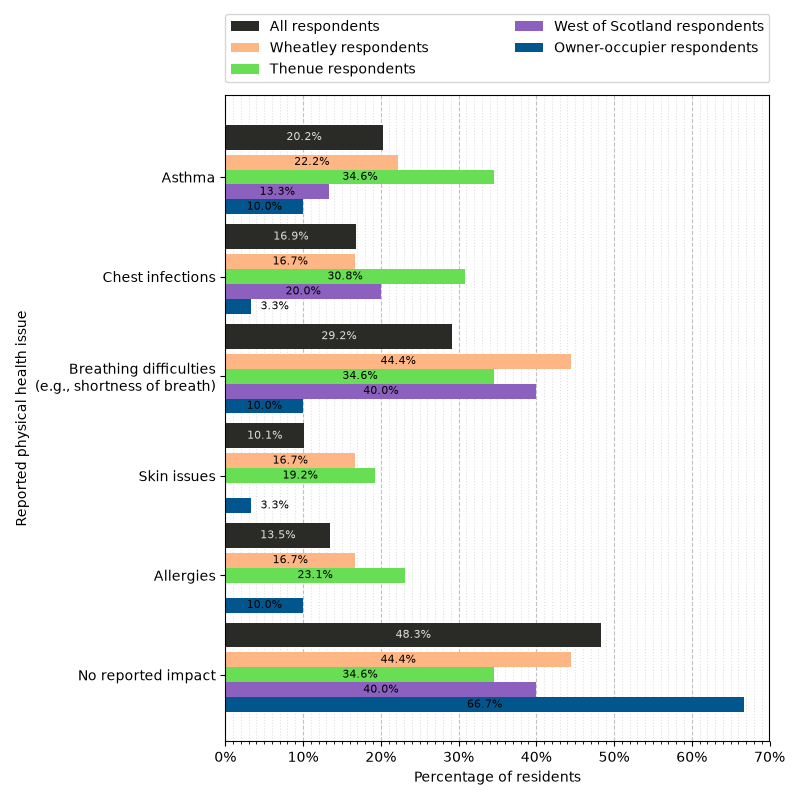
- More than half of survey respondents (51.7 per cent) reported that housing conditions had negatively affected the physical health of at least one member of their household.
- Among households containing at least one person with a disability, this figure rose to 61.9 per cent. This disparity is perhaps unsurprising given that disabled residents may spend more time within the home and are therefore likely to experience greater exposure to housing conditions and environmental hazards.
- Breathing difficulties were the most reported health issue, affecting 29.2 per cent of respondents, followed by asthma (20.2 per cent) and chest infections (16.9 per cent).
- One concerning finding relates to the fact that 15.7 per cent of respondents reported discussing housing-related issues with their GP; seeking medical advice is a significant step and typically reflects concerns that extend beyond everyday discomfort.
Adult Health
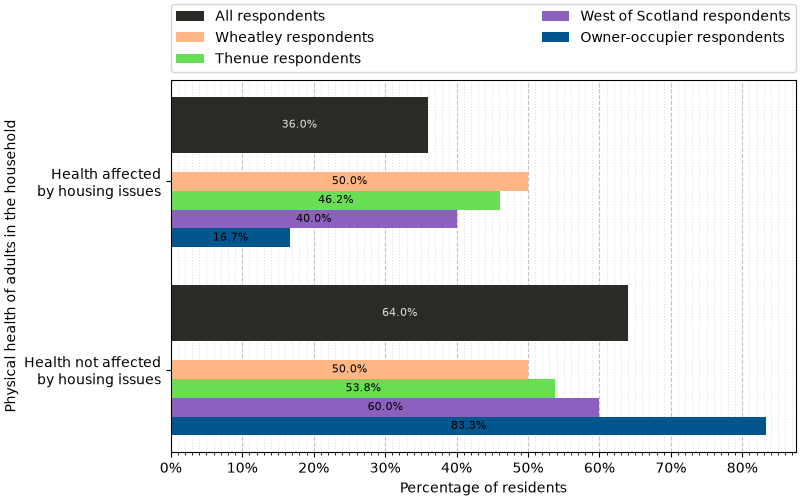
- More than a third (36 per cent) of survey respondents believed that housing conditions had negatively affected the health of adults within their household.
Physical health was a prominent concern across both interviews and survey responses. Dampness, mould, defective ventilation systems, and prolonged exposure to disrepair were repeatedly linked to deteriorating health, respiratory problems, and serious medical conditions. Whilst this research does not seek to establish clinical causation, it is clear that many residents believed their homes were harming their health and the health of those around them. Eileen Gallagher expressed concern that a defective ventilation system may have been distributing mould throughout her home:
There’s a good possibility that the filter system, because it hadn’t been changed that long and they had left it, that it’s been basically distributing mould throughout the rest of the house.
Interview with Eileen Gallagher (Wheatley Homes Glasgow Tenant) by James Ferns and Bohdan Starosta (10.03.2026)
Elsewhere in the interview, she directly linked housing conditions to deteriorating health within her household:
I’ve ended up not well. My kids have ended up not well. My daughter’s been basically unwell from 2021. There’s been recurring issues and I’ve got medical reports to say this. I’ve got a form of lung disease, I can’t breathe properly, it’s, it’s been horrendous if I’m being honest, I couldn’t even begin to tell you the extent of the amount of things that’s happened because there’s been that many incidents. And it’s taking me reading the subject access requests to realise how many things have actually happened that they have ignored.
Interview with Eileen Gallagher (Wheatley Homes Glasgow Tenant) by James Ferns and Bohdan Starosta (10.03.2026)
Maria Rossi similarly expressed concern about the impact of persistent dampness and mould upon respiratory health. Reflecting on her partner’s COPD and subsequent lung cancer diagnosis, she drew a connection between these conditions and the dampness within her home:
[My partner] was diagnosed with lung cancer, stage 1 lung cancer… But he’s got… COPD… emphysema… and I’ve still got mould and damp… it definitely had an impact… I think it was all building up and he couldn’t breathe, so he went to his doctor and that was when he was diagnosed with COPD.
Interview with Maria Rossi (Wheatley Homes Glasgow Tenant) by James Ferns and Frances Galt (26.02.2026)
Whilst this research cannot determine the role, if any, that housing conditions played in these diagnoses, Maria’s account nevertheless highlights a troubling reality: persistent dampness and mould remained unresolved within a household containing a resident living with COPD, emphysema, and lung cancer. Regardless of causation, few would regard a home affected by dampness and mould as an appropriate environment to manage such serious respiratory issues.
Not all residents’ health concerns centred upon respiratory illness. Kirsty Sinclair reflected on a series of health problems and repeated periods of hospitalisation that she believed may have been linked to the conditions within her home:
I’ve been in hospital a few times really, really sick and… they can’t ever get to the bottom why it is.
Interview with Kirsty Sinclair (Thenue Housing Association Tenant) by James Ferns and Frances Galt (27.11.2025)
Elsewhere in the interview, and as discussed previously in relation to the psychological impacts of housing conditions, Kirsty described a diagnosis of Bell’s Palsy that medical professionals attributed to severe stress:
I ended up in the hospital, like my face all drooped, my arm… I’ve got nerve pain in my arm, and it turns out I had Bell’s Palsy through stress.
Interview with Kirsty Sinclair (Thenue Housing Association Tenant) by James Ferns and Frances Galt (27.11.2025)
Concerns about housing-related health impacts were sufficiently serious that numerous survey participants reported discussing them with medical professionals. Residents described seeking advice from GPs regarding mould, dampness, ventilation systems, respiratory illness, and broader health concerns:
Doctor advised that I must address the issue with the housing association because mould is a silent killer.
Survey Participant 21 (Thenue Housing Association Tenant)
I spoke to my GP about if the issues with the mould in the faulty ventilation system could have made my COPD and severe asthma worse. They said it could have been a contributing factor.
Survey Participant 81 (Thenue Housing Association Tenant)
Received a support letter from [my] doctor regarding mould to send to Thenue.
Survey Participant 48 (Thenue Housing Association Tenant)
Survey participants also reported a range of ongoing health concerns that they associated with poor housing conditions:
I have experienced breathing problems, skin problems, health worries.
Survey Participant 90 (Wheatley Homes Glasgow Tenant)
I’m worried that the issues about with mould and damp will affect my asthma and COPD.
Survey Participant 69 (West of Scotland Housing Association Tenant)
I experienced pneumonia, I have been blamed and my partner has been blamed. I feel as if my and my family’s safety is in constant danger.
Survey Participant 40 (West of Scotland Housing Association Tenant)
We’re worried about the impact of all this on our physical health too, my partner has developed asthma and shadows on his lungs.
Survey Participant 26 (Wheatley Homes Glasgow Tenant)
The accounts presented here raise serious concerns about housing conditions that residents repeatedly associated with declining health and worsening medical conditions. Even where mould, dampness, and defective ventilation cannot be shown to have caused particular illnesses, few would regard them as acceptable conditions in which to manage chronic disease, recover from illness, or maintain good health.
Children’s Health
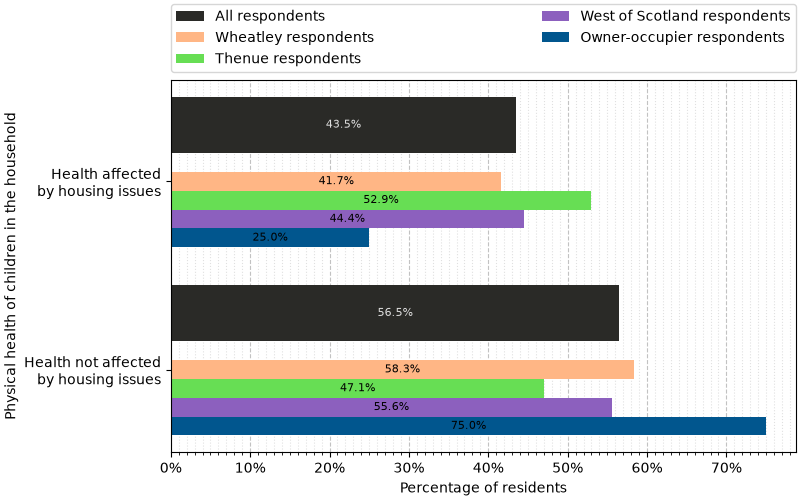
- Just over half of respondents (52 per cent) lived with children, of whom 43.5 per cent believed that their children’s health had also been affected by housing conditions.
Parents described living with the fear that housing conditions were harming their children. The accounts presented here are not simply accounts of housing disrepair, but of parents watching children become unwell and worrying that the homes in which they live may be responsible.
Eileen Gallagher described ongoing health problems affecting her children. Explaining that her daughter had been ‘basically unwell from 2021’, and that doctors had suggested housing conditions may have been contributing to her ill health, she reflected:
My wee girl’s been not well, my oldest son’s been not well – their chests are terrible. My wee lassie has been in and out of hospital from when she’s been wee and they couldn’t explain what was going on… she had scarlet fever apparently nearly every week. In my mind, that’s came from the house because there was no other reason for her to be that unwell. And even the doctors, the GPs have said the same thing to me basically. They’ve said:
Interview with Eileen Gallagher (Wheatley Homes Glasgow Tenant) by James Ferns and Bohdan Starosta (10.03.2026)We think it might be what’s going on in the house that’s causing it.
Claire Sullivan similarly linked persistent housing problems to recurring illness among her children. Reflecting on her son’s breathing difficulties and repeated hospital admissions, she described a period during which illness became a constant feature of family life:
One of my children was premature, who was born almost two months early and born with breathing machines and different things… [after he came home to the Village he] was now struggling with breathing, lots of chestiness. I mean he was one of the ones that was really, really, really struggling, and it was impacting obviously our everyday life… we’re a working family so we were having to take time off… I was having to leave my work to come home and obviously be with my son, take my son to hospitals, take them to doctors, and each and every time I was told that it was bronchiolitis. One of the times I was in the hospital and I think I had obviously broke down crying. Because it was constant. It was almost every week where the kids were unwell – genuinely unwell… I had recorded their breathing because I almost felt like the housing didn’t believe me. It was as if you were doing everything to prove this is what your kids are living in… when I was in the hospital, I did explain to the hospital our situation with dampness, floods and different things, and [the doctor] says,
Interview with Claire Sullivan (West of Scotland Housing Association Tenant) by James Ferns and Frances Galt (30.01.2026)obviously without seeing it, but it could be one of the big factors. Because it’s not normal for a child to have that many trips to the hospital, doctors, for bronchiolitis. Since we’ve moved [away from the Village], I kid you not, I think we’ve maybe been to the doctors once.
Particularly striking is Claire’s description of what happened after the family moved away from the Village. Reflecting on the dramatic improvement in her son’s health that followed, she explained:
My wee boy at the time was lying on the couch. I mean he was lethargic, he had no energy whatsoever… [now] my wee boy – I’ve off the top of my head not been to hospital this year… put it this way, if I had been to any doctors, it’s never been for bronchiolitis. It’s not been for a chest infection… they’re absolutely fine. Whereas when we were back in there, it was like – the breathing. It was definitely the breathing… his body could never take it.
Interview with Claire Sullivan (West of Scotland Housing Association Tenant) by James Ferns and Frances Galt (30.01.2026)
The anxiety evident in Claire Sullivan’s testimony was shared elsewhere in the research. Claire Wilson similarly described the fear of caring for a vulnerable child whilst housing problems remained unresolved. Reflecting on a young child with a heart condition living in a bedroom affected by severe draughts and defective windows, she explained:
So, she sleeps in the same bedroom as me… that full length window at the front… it’s got a few holes in it which is causing a draught to come through, and obviously the frame’s rotting on the outside. As well, the other window’s got a small draught coming through it as well, and I did explain to [the housing association] that obviously, she does have a condition, that she can’t really get severely unwell… it is kind of concerning that they’ve still not contacted us about it. I mean that was months ago they came out and looked at the windows, and they’ve still not came out to say this is what’s happening… Every night she was coming into my bed… she felt freezing, like frozen to the touch. And it was just kind of concerning me more than anything else and now she’s kind of ended up with a viral infection.
Her skin’s very dry, it’s all cracked, it bleeds sometimes… They don’t know [what’s causing it]… I’m still to see a dermatologist about it… she was absolutely fine when she was born and since obviously living here, it’s got worse… basically what they said to me… it could be because the dry air, and then I’m thinking to myself where’s the dry air coming from? The draughts in the windows is my only option.
Interview with Charlotte Wilson and Claire Wilson (Wheatley Homes Glasgow Tenant) by Bohdan Starosta and Alan Sproull (03.02.2026)
Concerns about children’s health were also reflected in survey responses, several of which described discussions with medical professionals regarding the impact of housing conditions:
My child had difficulty breathing and was in and out of hospital for eight months. I don’t know if this was because of my house.
Survey Participant 28 (West of Scotland Housing Association Tenant)
Concerned about the health of grandchildren. My lower bathrooms are unusable because of extreme mould. Asthma of grandchildren inflamed. Worried about health of family.
Survey Participant 21 (Thenue Housing Association Tenant)
The mould and damp has affected me and my family’s health, our GP has helped us ask the housing association for decanting, but it still took eighteen months to do so. We’re back now, but I didn’t want to move back on account of [mine] and my kids’ health being affected.
Survey Participant 76 (Wheatley Homes Glasgow Tenant)
The accounts presented here raise serious questions about the housing conditions that many parents regarded as harmful to their children’s health. Even where housing conditions cannot be shown to have caused particular illnesses, few would regard persistent dampness, mould, defective ventilation, or severe draughts as acceptable environments in which children should be expected to live and grow.
Footnotes
- Bridgeton CAB has not verified any medical information referred to by residents. ↩︎
- Wellbeing was defined as impacts upon: feeling of safety; work or education; relationships within the household; financial worries; comfort in own home; and ability to sleep. ↩︎
- Interview with Claire Sullivan (West of Scotland Housing Association Tenant) by James Ferns and Frances Galt (30.01.2026) ↩︎
- Interview with Claire Sullivan (West of Scotland Housing Association Tenant) by James Ferns and Frances Galt (30.01.2026) ↩︎
- Interview with Eileen Gallagher (Wheatley Homes Glasgow Tenant) by James Ferns and Bohdan Starosta (10.03.2026) ↩︎