The evidence presented in this section establishes the physical reality of housing conditions in Dalmarnock Village. Residents described homes affected by recurring floods, defective plumbing and drainage, persistent damp and mould, structural deterioration, and ventilation systems that frequently failed to perform their most basic function.
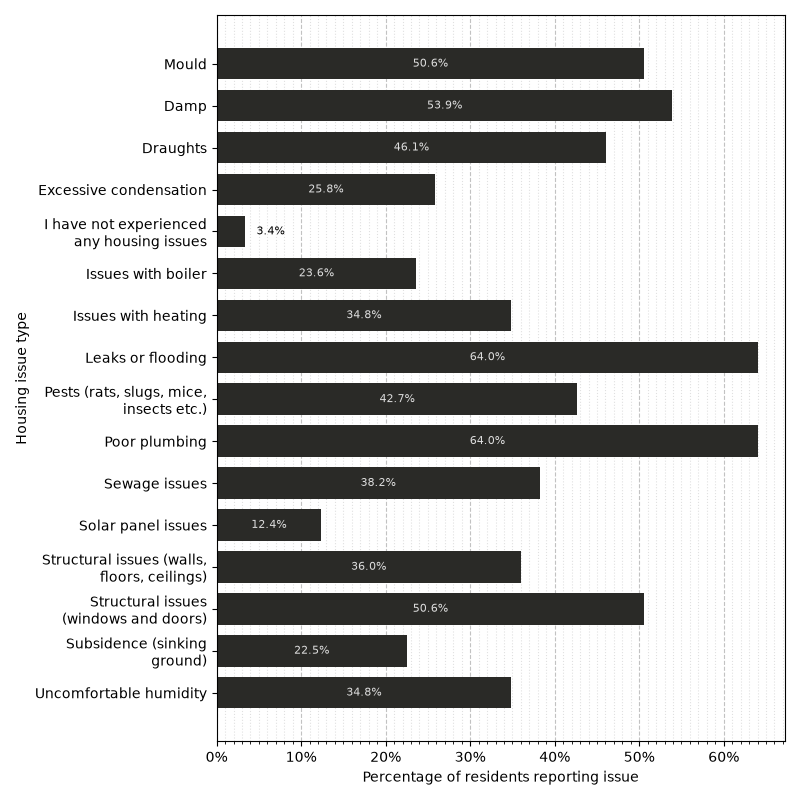
- Survey results delivered a stark figure: 96.6 per cent of respondents have dealt with one or more issues during their tenancy or since purchasing their home.
Systemic Plumbing and Drainage Failures
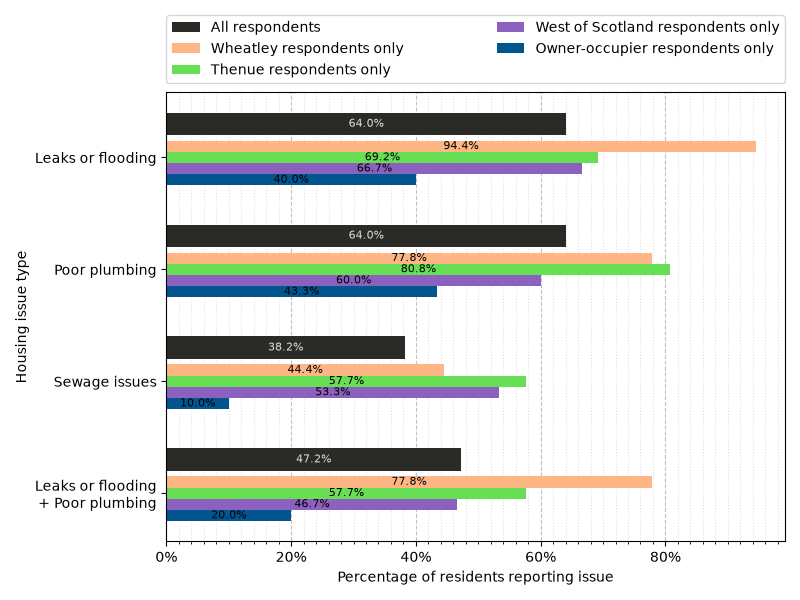
- Leaks and Flooding and Poor plumbing were two of the most commonly reported problems within the survey – both being reported by 64 per cent of respondents and a high degree of overlap between the two.
- Sewage issues emerged as a distinct but related category, with 38.2 per cent of respondents reporting problems relating to this.
- Housing association tenants generally reported these problems more frequently than owner-occupiers.
Leaks and Flooding
Plumbing issues and recurring leaks were among the most common and disruptive housing problems reported by residents. Far from representing isolated incidents, these experiences emerged across multiple households and often persisted for years. For example, Tesfay Kiros, a tenant of Wheatley Homes Glasgow, described an ongoing leak which has remained unresolved for ‘more than three years’.1 Taken together, these accounts point towards a recurring pattern of plumbing failure which has had significant consequences for residents’ homes and daily lives.
Eileen Gallagher, another Wheatley Homes Glasgow tenant, described a home repeatedly overwhelmed by floods, leaks, and plumbing failures:
I have had in the region of about ten floods I would say… there’s been loads of leaks, there’s been loads of issues with the plumbing itself. The drainage – basically the build quality of the whole house has just been terrible if I am being completely honest.
Interview with Eileen Gallagher (Wheatley Homes Glasgow Tenant) by James Ferns and Bohdan Starosta (10.03.2026)
Eileen’s account of a second major flood offers a stark illustration of what it means to live with recurring plumbing failures:
The second [flood] was probably the one that was the worst if I’m being honest. I’m lying in my bed, it’s about half past four in the morning and all I can hear is water, but we’ve got the VELUX windows on the roof, so I’m going:
Interview with Eileen Gallagher (Wheatley Homes Glasgow Tenant) by James Ferns and Bohdan Starosta (10.03.2026)Is that the rain?And obviously it’s not the rain. And by the time I got up, the whole floor – the whole floor is soaked. It’s ran all the way down to the second floor and it started to come down to the bottom floor… It was just a nightmare.
Recurring flooding emerged as a common feature of residents’ experiences. West of Scotland Housing Association tenant, Claire Sullivan, described multiple serious floods within her home:
My first flood – I had gone to take the kids out to school this morning, and I’d come back and the ground floor was like puddles; water coming out the walls… fast forward to my next one… the full ceiling and the kitchen, the living room, they were coming through… the water was literally gushing, and I mean gushing through the ceilings.
Interview with Claire Sullivan (West of Scotland Housing Association Tenant) by James Ferns and Frances Galt (30.01.2026)
No resident should have to create a chronology of floods in order to distinguish one from another. Yet Claire’s matter-of-fact phrase, ‘fast forward to my next one’, reveals how repeated flooding became normalised for some residents. The normalisation of repeated flooding was often accompanied by a wider cycle of recurring leaks, failed repairs, dampness, and damage. The relentless nature of these failures is clearly illustrated in the testimony of Kirsty Sinclair, a Thenue Housing Association tenant:
Loads of problems, like constant flooding, mould, dampness. Like I’ve had two toilets ripped out, I’ve had a toilet fixed, the washer in the toilet pan, that’s come through my ceiling. [The contractor] fixed it and then it’s bust again and it’s come through my ceilings again. I’ve had to replace umpteen bits of furniture, carpets, flooring, all of this kind of stuff… they replaced my full shower, my full toilet and now that toilet is leaking again, so now it’s my kitchen, flooring, everything is all damaged, all mould, all stained in black mould and dampness. Like I just feel as if my house is just a big ball of dampness to be honest. Everywhere, the windows, the toilets, everything.
Interview with Kirsty Sinclair (Thenue Housing Association Tenant) by James Ferns and Frances Galt (27.11.2025)
In the most serious cases, recurring plumbing failures resulted in structural damage that no resident should be expected to endure within their home. Kirsty described how the same plumbing defect caused the collapse of the same ceiling on two separate occasions within a matter of months:
Twice. Twice for the same issue. The washer and the toilet pan up in the top toilet. Same ceiling, same issue… wasn’t that long, I think it was last year it collapsed and it collapsed there in September.
Interview with Kirsty Sinclair (Thenue Housing Association Tenant) by James Ferns and Frances Galt (27.11.2025)
The significance of Kirsty’s testimony lies not simply in the severity of the incident, but in its repetition. Similar incidents were reported by other residents during the campaign. Far from representing isolated accidents, these accounts point towards recurring failures which repeatedly caused significant damage within residents’ homes. When ceilings collapse, housing disrepair ceases to be a matter of inconvenience or property damage. It becomes a potential threat to life.
Plumbing failures were not confined to social housing tenants alone, and similar issues were reported by owner-occupiers. One owner-occupier survey respondent stated, ‘I have had four leaks. One was caused by a pipe that was broken at the time of installation’.2 Not all owner-occupiers reported the same level of recurring leaks and flooding. Homeowners Elizabeth and Will Rutherford, for example, attributed their relative freedom from these problems to replacing a number of original fixtures and fittings early on:
[Will Rutherford:] A lot of the plumbing stuff that a lot of people are having problems with. We’ve not had it because we replaced a lot of it right at the start.
Interview with Elizabeth and Will Rutherford (Owner-Occupiers) by James Ferns and Gary Wong (11.03.2026)
[Elizabeth Rutherford:] I think we’ve taken a lot of the things out that could cause the problem, quite quick… I think after two years everybody started getting this flooding issue. We never got it. We changed the downstairs [toilet]; we changed the middle floor [toilet].
While some owner-occupiers could replace problematic fixtures and fittings themselves, social housing tenants remained dependent upon housing providers and repair contractors to address defects that often persisted despite repeated reports and repair attempts.
Drainage and Sewage
Leaks and flooding formed only part of a wider pattern of plumbing-related problems. Residents also reported widespread drainage failures, including persistent sewage smells, blocked drains, and systems that appeared unable to cope with normal household use. One survey respondent stated bluntly: ‘The sewage from bottom bathroom is disgusting’.3 Looking back, Claire Sullivan identified recurring sewage smells coming from the drains as one of the earliest indications that something was wrong within the home. She described the odour as ‘revolting’:
The problems kind of arose quite quickly. Not like physically as you could see them, but more so the smells. It started off with the drains, which were a problem right away, as soon as we moved in… the stench would get really, really bad… it would make you physically sick… it was revolting.
Interview with Claire Sullivan (West of Scotland Housing Association Tenant) by James Ferns and Frances Galt (30.01.2026)
Thenue Housing Association tenant, Helen Taylor, shared similar concerns, remarking, ‘I don’t think the drains were ever right’, before describing persistent foul smells and recurring drainage problems experienced by both her household and her neighbours:
The drains have been absolutely pathetic – they’ve been smelling constantly. The bottom shower room… when you open the shower door the smell is coming up through the shower, and it is absolutely rank. If it’s wet outside it seems to be worse. So as far as I’m aware, the pipes are all blocking – they’re all backing up or something… All our neighbours have got the same. Every one of them.
Interview with Helen Taylor (Thenue Housing Association Tenant) by James Ferns and Isla Wallace (03.02.2026)
Problems were not limited to smells and blockages. Several residents also reported toilets that struggled to function properly. One survey respondent stated:
Toilets have terrible flush system, very weak… None of the toilets flush well and it takes 3 or 4 attempts to get a small piece of toilet paper to flush away. Many neighbours complain of the same toilet issues and sewage smell issues.
Survey Participant 15 (Thenue Housing Association Tenant)
Similar concerns were reported by owner-occupiers. Elizabeth and Will Rutherford described how they discovered that the wrong system had been installed in their downstairs toilet:
[Elizabeth Rutherford:] We complained about the cistern in the bottom bathroom because you couldn’t flush toilet paper and I was like,
Interview with Elizabeth and Will Rutherford (Owner-Occupiers) by James Ferns and Gary Wong (11.03.2026)well it’s not functional… so they came out and they said,oh you’ve got the wrong– [Will Rutherford:]the wrong system for the wrong bowl.
Perhaps most significantly, multiple residents sought advice from independent plumbers who identified fundamental flaws within the Village’s drainage systems. Although these assessments were obtained independently of one another, they point towards strikingly similar concerns regarding the design and installation of drainage infrastructure within the Village. One survey participant commented:
A plumber who visited my gran’s house in Bridgeton told them [that for] the houses in the Village, the underground pipes/drainage linked to bathrooms and sewage were not built correctly, the pipes go up and over which causes plumbing problems and smells. The pipes were apparently put like this for quickness and cheaper costs when building the houses in a rush for the Commonwealth Games and the plumber said it’s a massive job and costly to try and rectify this now so it is left as it is, but the positioning of the pipes and sewage will forever cause blockages.
Survey Participant 15 (Thenue Housing Association Tenant)
Wheatley Homes Glasgow tenant, Maria Rossi, reported receiving a similar assessment from an independent plumber, who attributed her problems to drainage systems that were allegedly installed ‘back to front’:
[I hired] an independent plumber… he told me the drains are back to front, but [Wheatley] won’t admit it. They just won’t admit it. It’s a drainage problem… my own [plumber]… he said,
Interview with Maria Rossi (Wheatley Homes Glasgow Tenant) by James Ferns and Frances Galt (26.02.2026)the pipes are back to front. The drainage is back to front. Some of the houses have too many toilets, so the drainage can’t cope.
Taken together, these testimonies raise serious questions about both the quality of construction and the effectiveness of subsequent repairs. Residents describe recurring problems which extend far beyond ordinary household maintenance and which, in many cases, have persisted for years. These are not the experiences of one household, one street, or one tenure. They are experiences repeated across the Village. The cumulative weight of this evidence points towards systemic failures rather than isolated defects. No resident should have to live with repeated floods, collapsing ceilings, sewage smells, defective drainage systems, or leaks that remain unresolved for years. Yet for many residents of Dalmarnock Village, these experiences have become an accepted part of daily life.
Persistent Damp and Mould
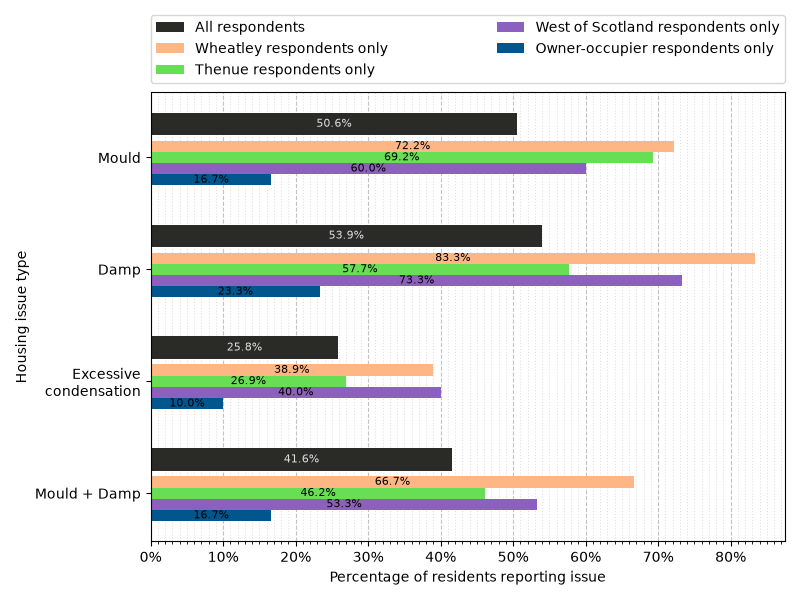
- Mould was reported by 50.6 per cent of respondents, while 53.9 per cent reported damp. As with the previous section, there was a high degree of correlation between these two responses per respondent.
- By contrast, excessive condensation was reported by only 25.8 per cent of respondents. This suggests that damp and mould within the Village are only partially related to condensation, and are instead a result of other underlying issues.
The leaks, floods, and plumbing failures described throughout the previous section carried consequences that extended far beyond the initial escape of water. Damp and mould emerged as some of the most widespread and persistent housing problems reported by residents. Across multiple households, residents described mould spreading through bedrooms, bathrooms, floors, furniture, and personal possessions, often persisting for years despite repeated complaints and repair attempts. Taken together, these accounts point towards a pattern of housing conditions that no resident should be expected to tolerate.
Eileen Gallagher’s testimony illustrates how mould had become intertwined with everyday life within the home. She recalled:
It was on bedding. It was on the floor… it was on a multitude of things. I had mould coming up through the flooring. I had mould on shoes. I had mould on bedding that was in the cupboard. I had mould on pictures… There’s been loads and loads of things that have just been ruined by it and can’t be replaced.
Interview with Eileen Gallagher (Wheatley Homes Glasgow Tenant) by James Ferns and Bohdan Starosta (10.03.2026)
The scale and overwhelming nature of the damp and mould described by Kirsty Sinclair is difficult to overstate:
Tiles started popping off the walls because it was that damp in the background. There was mould everywhere, all over the ceilings, round the shower tray, everything. Like it was just disgusting and to have to try and live in that. Like your floorboards are mouldy. Like wetness constantly. Like you’re just constantly trying to clean, because you feel dirty with having to live in it and it’s not good for your health, it’s not good for my child’s health.
Interview with Kirsty Sinclair (Thenue Housing Association Tenant) by James Ferns and Frances Galt (27.11.2025)
Kirsty later described her home as a ‘dampness trap’, a phrase which suggests that dampness had ceased to be an isolated problem and instead become a constant, inescapable feature of everyday living conditions.
Similar themes emerge in Maria Rossi’s testimony, which illustrates the far-reaching consequences of prolonged damp and mould within the home:
Living with [damp and mould] was horrendous, because I was always trying to clean it, always hanging the wee dehumidifier bags about… it was not nice at all, do you know what I mean? Especially when you’ve got grandkids coming in and out, and the smell’s horrendous… my floor was rotting away, my drawers were rotting away. The mould was that bad, my radiator caved my wall in, and they said that was
Interview with Maria Rossi (Wheatley Homes Glasgow Tenant) by James Ferns and Frances Galt (26.02.2026)condensation… I had mushrooms growing. My neighbour had slugs in hers. And my other neighbour had mushrooms in hers too. And rats too… I don’t even want to live there anymore.
Maria’s testimony demonstrates how prolonged damp and mould can fundamentally alter living conditions within the home. Rotting floors, damaged furniture, and mushrooms growing indoors are not the hallmarks of minor housing defects. They are indicative of conditions that have deteriorated to an unacceptable standard.
The consequences of persistent dampness were also visible in the physical condition of homes. Residents reported warped flooring, swollen doors, and corrosion affecting fixtures and fittings throughout their properties:
The floor has all started to warp quite badly, so there’s water coming from somewhere.
Interview with Eileen Gallagher (Wheatley Homes Glasgow Tenant) by James Ferns and Bohdan Starosta (10.03.2026)
The doors are starting to like – you couldn’t open and shut the doors because the floors had swollen so much.
Interview with Claire Sullivan (West of Scotland Housing Association Tenant) by James Ferns and Frances Galt (30.01.2026)
Some of my doors in my house [are] swollen up… just swollen out at the tops and stuff like that. All the handles are broken, every tap in my house is corroded. The silverness is corroded off it. And obviously I blame the dampness on that.
Interview with Kirsty Sinclair (Thenue Housing Association Tenant) by James Ferns and Frances Galt (27.11.2025)
While less dramatic than flooding or visible mould growth, these accounts illustrate the cumulative impact of persistent dampness on the condition of homes. Warped floors, swollen doors, and corroded fixtures point towards moisture becoming embedded within the fabric of the building and gradually degrading everyday living conditions.
The evidence presented here raises serious questions regarding the condition of homes throughout the Village. Residents describe damp and mould spreading through multiple areas of the home, damaging possessions, degrading living conditions, and persisting for years. These are not the experiences of one household, one street, or one housing provider. The cumulative weight of this evidence points towards housing conditions that extend far beyond ordinary wear and tear. No resident should have to live with mould on their bedding, rot within their home, or dampness so pervasive that their property becomes, in their own words, a ‘dampness trap’.
Structural Deterioration and Build Quality
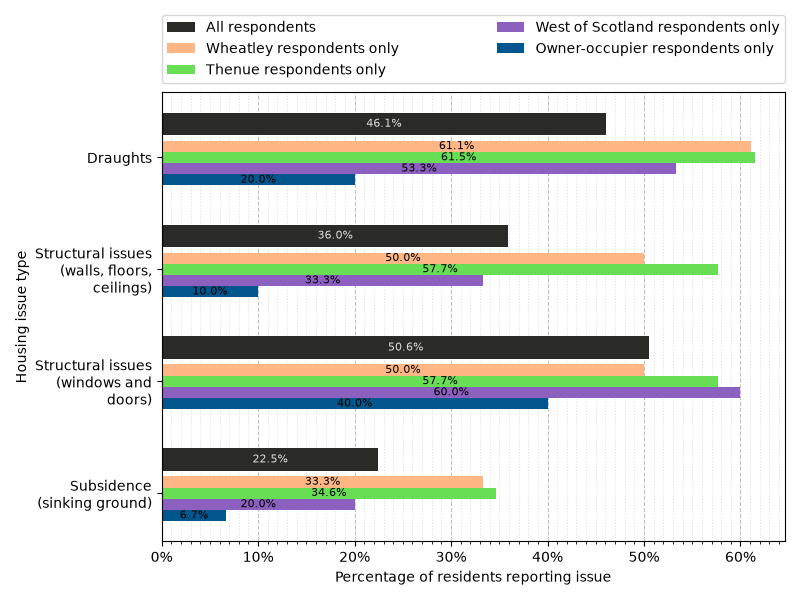
- Structural problems affecting windows and doors were among the most commonly reported housing problems, affecting 50.6 per cent of respondents.
- Issues with windows and doors was closely associated with reports of draughts, which affected 46.1 per cent of respondents, and pest infestations, reported by 42.7 per cent. These problems were unsurprisingly all highly correlated.
- Structural issues with walls, ceilings, and floors (reported by 36 per cent of respondents) were correlated. While some of these problems may be attributable to subsidence, residents also linked structural damage to flooding and water ingress.
- Almost a quarter of respondents (22.5 per cent) reported subsidence. This figure raises serious concerns regarding the long-term structural stability of the development.
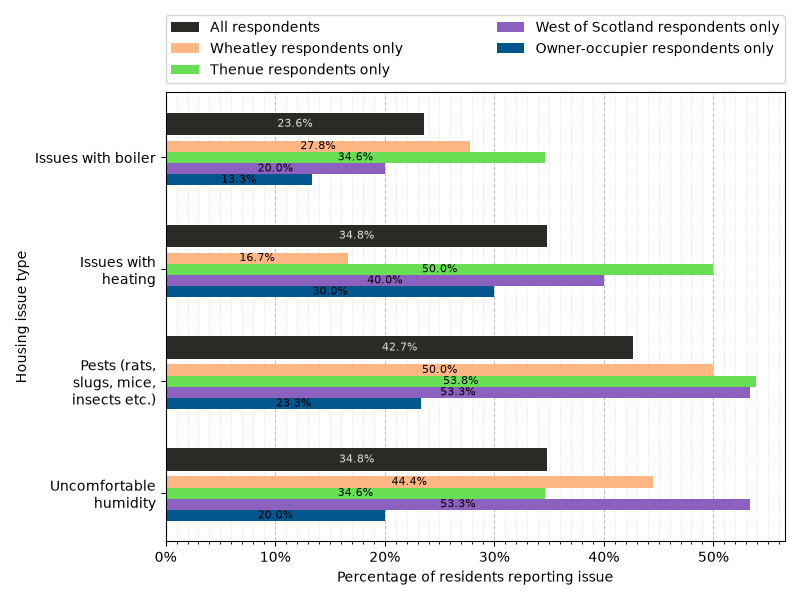
- Problems with heating and uncomfortable humidity were both reported by 34.8 per cent of respondents. Residents frequently described these issues as codependent, given that excessive humidity creates a need to ventilate properties, resulting in heat loss and exposing or exacerbating specific problems with heating systems.
Flooring Deterioration
Beneath the surface of residents homes lay further evidence of defective construction and prolonged deterioration. Thenue Housing Association tenant, James Stewart, recalled discovering multiple unsealed holes beneath the flooring of his home after repeatedly noticing his father’s wheelchair becoming caught in the carpet:
I found six or seven holes in the floor. We had a carpet when we first moved in, and my dad’s wheelchair kept getting caught in it all the time… I eventually lifted the carpets up and there were six or seven holes that were left in the floor. I believe it’s for access for the radiators, to piping, but they were never sealed up, no underlay, nothing. And my dad nearly toppled over in his wheelchair a few times.
Interview with James Stewart (Thenue Housing Association Tenant) by James Ferns and Isla Wallace (02.03.2026)
The significance of James’ testimony extends beyond the holes themselves. His account highlights the potential risks posed when construction defects remain unidentified or unresolved. Similar concerns were raised elsewhere. Wheatley Homes Glasgow tenant, Charlotte Wilson, described falling through a hole in the floor which she was later told was an access point:
I fell through a hole right here. I had two [walking] sticks, and I banged my head and [fell] down up to my arms… I phoned them out and they said:
Interview with Charlotte Wilson and Claire Wilson (Wheatley Homes Glasgow Tenant) by Bohdan Starosta and Alan Sproull (03.02.2026)It was an access hole, and my husband says:You don’t build an access hole like that with a bit of wood holding it up.
Maria Rossi reported discovering similar holes beneath her flooring, which she was told resulted from mistakes made during the installation of radiators:
You’ve got big holes in your floor when you take the flooring up, and I asked them why that was, and they said it was,
Interview with Maria Rossi (Wheatley Homes Glasgow Tenant) by James Ferns and Frances Galt (26.02.2026)because they made a mistake trying to put the radiators in.
The holes described by residents were not always the result of apparent construction defects. Residents also described how prolonged water ingress caused flooring to deteriorate, rot, and in some cases turn to ‘mush’, leaving significant holes within the home. Claire Sullivan recalled:
[The utility cupboard] floor had turned to mush and it completely disappeared, so there was now this big hole.
Interview with Claire Sullivan (West of Scotland Housing Association Tenant) by James Ferns and Frances Galt (30.01.2026)
Similarly, James Stewart described the collapse of flooring within a bathroom, stating:
The floor in the toilet has collapsed. Now, that’s the disabled bathroom – that’s collapsed, while my mother was in the shower.
Interview with James Stewart (Thenue Housing Association Tenant) by James Ferns and Isla Wallace (02.03.2026)
Floors should not collapse, they should not turn to ‘mush’, nor should they contain hidden unsealed holes capable of causing injury. Yet residents described all three. Whether linked to apparent construction defects or prolonged water ingress, these accounts point towards housing conditions that raise serious concerns regarding both safety and construction quality.
Windows and Doors
Problems relating to windows and doors emerged as another major concern throughout the Village. Residents described widespread rot, decay, and deterioration affecting wooden window frames, doors, and external surrounds. These problems were reported by both social housing tenants and owner-occupiers, although for owner-occupiers they often carried significant financial consequences, with some residents facing the prospect of replacing windows and doors throughout their homes.
The extent of the deterioration described by homeowner Susan Robertson is particularly striking. She explained:
My problems are all related to windows and doors. The wooden surrounds on the windows are all rotting away and left with large holes in the wooden external structure, to the point where I’ve had to take emergency measures and apply roof flashing to try and prevent water ingress… I have to replace the windows and doors in the entire house and I’ve been getting quotes for that.
Interview with Susan Robertson (Owner-Occupier) by Isla Wallace and Bohdan Starosta (26.03.2026)
When seeking quotations for replacement works, Susan also discussed the condition of the timber with a number of contractors:
I showed the photos to some of the experts I’ve been getting quotes from to see what they thought was going on, and they said – and this has come from a number of different people – that it looked as though [the] wood had just been applied without being treated, and then it had just been painted over.
Interview with Susan Robertson (Owner-Occupier) by Isla Wallace and Bohdan Starosta (26.03.2026)
Similar concerns were raised by Elizabeth and Will Rutherford, who also described serious deterioration affecting windows and doors throughout their property:
[Elizabeth Rutherford:] After five years, we started noticing on all the downstairs windows and doors, that the cracking was starting to happen.
Interview with Elizabeth and Will Rutherford (Owner-Occupiers) by James Ferns and Gary Wong (11.03.2026)
[Will Rutherford:] Dry rot. Every single window has got dry rot on it somewhere, which as a standard, shouldn’t happen.
Comparable problems were reported by social housing tenants. James Stewart stated:
If you look out the window there you can see those, like all the wood’s rotten… we’ve had ours painted, to protect the wood, but I’ve had to paint it all myself as well, multiple times, just to stop it from all rotting away… They just don’t come out and fix anything.
Interview with James Stewart (Thenue Housing Association Tenant) by James Ferns and Isla Wallace (02.03.2026)
The experiences described above were echoed across numerous interviews and survey responses:
The frames are rotting on the outside.
(Claire Wilson) Interview with Charlotte Wilson and Claire Wilson (Wheatley Homes Glasgow Tenant) by Bohdan Starosta and Alan Sproull (03.02.2026)
A few years ago… we noticed issues with decaying window frames.
Survey Participant 61 (Owner-Occupier)
I’ve had to change [the front door] locks twice and the frame is rotten.
Survey Participant 103 (Owner-Occupier)
My windows are absolutely rotting. There’s not even a window ledge on it, it’s just completely rotten away.
Interview with Maria Rossi (Wheatley Homes Glasgow Tenant) by James Ferns and Frances Galt (26.02.2026)
All my windows are rotting, I have been told they all need replacing. Recently spent £3k for short term fixes to prevent leaks.
Survey Participant 18 (Owner-Occupier)
All my wooden window frames are rotten away, there is no programme planned currently by my landlord to replace the windows that have been in the property since they were built in 2013/2014.
Survey Participant 34 (West of Scotland Housing Association Tenant)
Key issue for me is significant damage to wooden external windows, large holes have formed and I’ve had to carry out emergency repairs with roofing flashing tape to try and minimise further damage. I am discussing replacement of all windows/doors.
Survey Participant 100 (Owner-Occupier)
The cumulative weight of this evidence is difficult to ignore. Residents repeatedly described windows and doors rotting, cracking, and deteriorating to the point where extensive repairs or wholesale replacement became necessary. These concerns were raised by both owner-occupiers and social housing tenants, meaning that the problem extends beyond isolated defects affecting individual properties. For some, this has translated into significant financial costs; for others, it has meant living with deterioration that continues to worsen over time. The apparent scale of the deterioration in the evidence outlined above raises serious questions regarding the quality, durability, and long-term condition of windows and doors throughout parts of the Village.
Ground Stability and Subsidence
Concerns regarding subsidence were raised by a number of residents, particularly those living with long-term drainage problems. Several residents reported sinking ground and subsidence affecting their gardens:
They’ve told me the back garden’s sinking because of the drainage, so they knew about this and they refused to fix it.1
Interview with Eileen Gallagher (Wheatley Homes Glasgow Tenant) by James Ferns and Bohdan Starosta (10.03.2026)
The back garden is actually all sinking. It’s always damp and you can’t do anything with it because it’s… it’s always mucky… its right at the window, see its actually dipping – aye, its dipping badly… [my neighbours] gardens are the same. Theirs is all subsiding as well.
Interview with Helen Taylor (Thenue Housing Association Tenant) by James Ferns and Isla Wallace (03.02.2026)
I have had major issues with subsidence with the back garden. I reported it to Wheatley Homes over four years ago but there has been no resolution.
Survey Participant 72 (Wheatley Homes Glasgow Tenant)
Concerns regarding subsidence were not confined to individual gardens. Claire Wilson, a tenant of Wheatley Homes Glasgow, described similar problems affecting nearby buildings, including Riverside House Care Home, and raised wider questions about the preparation of the site before construction:
I mean that care home’s sinking, it’s actually sinking into the ground because the foundations under the ground… My neighbour up there, he pulled out all his grass up and there’s just chairs, all chairs and all tables and all that from all the old houses that used to be here. They’ve just threw rubble underneath the ground and build houses on that.
Interview with Charlotte Wilson and Claire Wilson (Wheatley Homes Glasgow Tenant) by Bohdan Starosta and Alan Sproull (03.02.2026)
Concerns regarding subsidence were not limited to outdoor spaces. Several residents reported cracks appearing within their homes, raising concerns about potential movement within the structure of the buildings themselves:
Also, there’s cracks… cracks that are constantly appearing up the sides of the walls, all the time… they’re constantly showing up.
Interview with James Stewart (Thenue Housing Association Tenant) by James Ferns and Isla Wallace (02.03.2026)
I have noticed movements in the walls as well as damp, mould and studs emerging from my walls. Causing a bad housing experience for myself. I’ve also noticed large cracks in my kitchen walls, which may be subsidence.
Survey Participant 81 (Thenue Housing Association Tenant)
While these accounts do not establish the precise cause of the problems described, they reveal a pattern of concerns extending beyond individual gardens or properties. Residents reported sinking ground, recurring cracks, and signs of apparent movement both inside and outside the home, raising wider questions regarding ground stability across the Village.
Insulation and Heat Retention
Concerns regarding draughts, heat retention, and insulation were reported by both owner-occupiers and social housing tenants. Residents described cold air entering homes through warped doors, damaged windows, and other defects. As Susan Robertson explained:
Well, there’s drafts. The doors are warped so there’s now drafts coming in around some of the doors, and windows. So, it is definitely colder… I’m sure that hasn’t been particularly healthy over the winter.
Interview with Susan Robertson (Owner-Occupier) by Isla Wallace and Bohdan Starosta (26.03.2026)
Claire Wilson similarly described cold air entering her home through damaged windows:
That full length window at the front… it’s got a few holes in it which is causing a draft to come through and obviously the frame’s rotting on the outside.
Interview with Charlotte Wilson and Claire Wilson (Wheatley Homes Glasgow Tenant) by Bohdan Starosta and Alan Sproull (03.02.2026)
For James Stewart, concerns regarding draughts and heat loss extended far beyond discomfort. Describing persistent cold affecting both his kitchen and his mother’s disabled bedroom, he recalled:
When we first moved in, we realised both the kitchen and the disabled bedroom were really cold… absolutely like ice… frozen. There’s a pipe that runs through my mother’s wardrobe, there’s a draft coming from that right now, I have to keep the wardrobe sealed all the time because it’s cold – it’s the exact same pipe as in the kitchen, draft there as well, and both the kitchen and the bedroom are frozen all the time. I’ve had to buy electric blankets, halogen heaters, everything, just to keep my mother alive pretty much.
Interview with James Stewart (Thenue Housing Association Tenant) by James Ferns and Isla Wallace (02.03.2026)
After repeatedly raising concerns regarding the cold affecting his home, an investigation eventually confirmed his suspicions:
Eventually… they came out… they lifted the windowsills in my mother’s room and the kitchen, and there was no insulation – at all – and the air that was coming through it was like a gale force wind.
Interview with James Stewart (Thenue Housing Association Tenant) by James Ferns and Isla Wallace (02.03.2026)
Residents should not be forced to endure freezing rooms, persistent draughts, and homes that cannot retain heat during winter. James Stewart’s testimony demonstrates how failures in insulation and heat retention can make parts of a home effectively unusable, particularly for residents with additional care needs. His account also raises serious questions about how such defects could remain unresolved despite repeated complaints.
Heat and Humidity
While concerns regarding cold homes were more frequently reported, some residents described the opposite problem of their homes becoming ‘unbearably hot’.4 Survey responses highlighted overheating and excessive humidity during summer months:
Excessive heat… Uncomfortable. Something needs to be done with the excessive heat in the summer, you could grow tomatoes in the living room.
Survey Participant 33 (West of Scotland Housing Association Tenant)
It is unfair that the design of the house is causing so much issues when it comes to the summer months it is unbearably hot. I have had to buy loads of fans to cool the house down and the house can regularly sit at 28 degrees and above even with fans on fully.
Survey Participant 37 (Owner-Occupier)
While the evidence presented above has largely focused on heat loss and inadequate insulation, these accounts demonstrate that temperature regulation problems can also manifest in the opposite direction. Ultimately, the issue extends beyond whether homes are too cold or too hot. Residents’ testimonies suggest that some properties are failing to provide the stable and comfortable living environment that homes should be expected to offer.
Defective Ventilation Systems
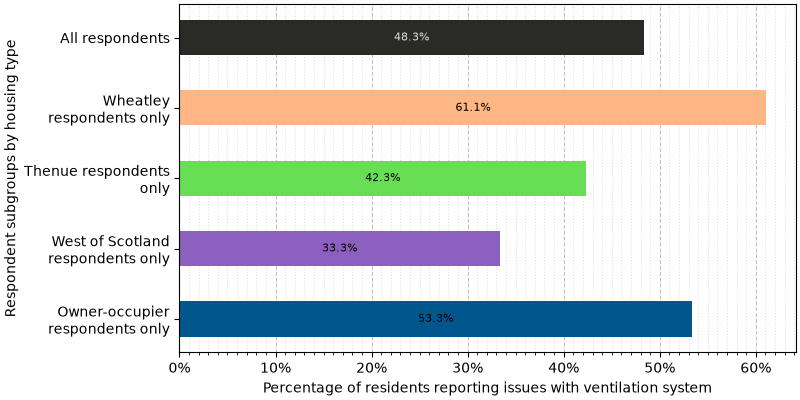
- Almost half of survey respondents (48.3 per cent) reported experiencing problems with their ventilation system at some point.
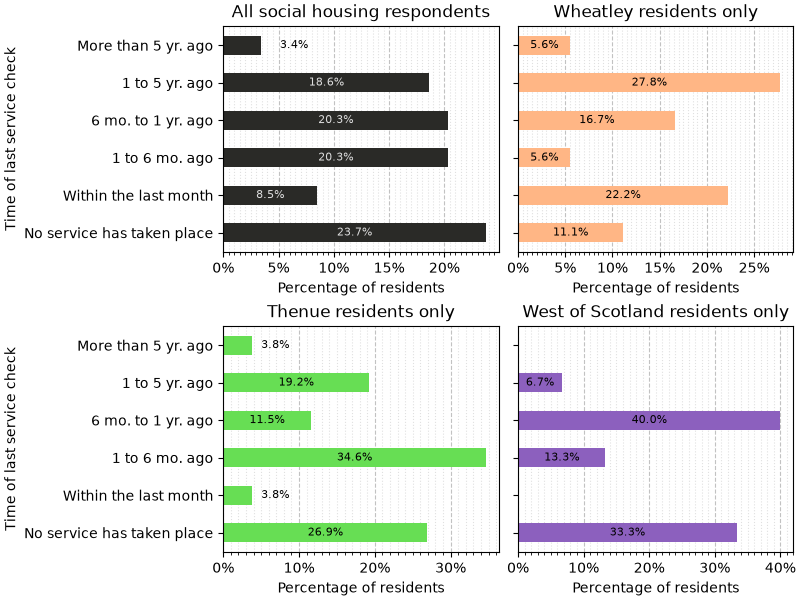
- Among social housing tenants, 49.1 per cent reported a ventilation service within the last year prior to completing the survey, while 22 per cent reported that a ventilation service had taken place more than one year ago (from the date of completing the survey).
- Notably, 23.7 per cent of social housing tenants reported that no ventilation servicing had taken place at all.
- There was a noticeable increase in reported servicing activity among social housing tenants during the period in which the survey was conducted. It is possible that this increase was prompted by the attention generated by the campaign.
- The survey also found that 22.5 per cent of respondents had incurred costs associated with the maintenance or repair of their ventilation systems. Of these respondents, 65 per cent were owner-occupiers, while 35 per cent were housing association tenants.
Mould and Contamination
Ventilation systems are intended to improve indoor air quality and help prevent problems such as damp and mould. Yet many residents described systems that appeared dirty, mouldy, clogged, or potentially circulating dust and contaminants throughout the home. In numerous accounts, systems intended to protect residents from dampness and poor air quality were instead associated with the very problems they were designed to prevent. The nature of these concerns is illustrated by the testimony of Will Rutherford, who described black deposits accumulating around the vents:
[The air vents] were disgusting and it is like a black soot, but if you actually had to test it, I’m guessing you’ll get spores off it.
Interview with Elizabeth and Will Rutherford (Owner-Occupiers) by James Ferns and Gary Wong (11.03.2026)
For Eileen Gallagher, the issue was not simply contamination within the ventilation system itself, but the possibility that it was distributing mould throughout her home:
There’s a good possibility that the filter system, because it hadn’t been changed that long and they had left it, that it’s been basically distributing mould throughout the rest of the house… so you’re basically just breathing in mould and there’s nothing you can do about it… they’ve told me basically that a lot of the filters weren’t cleaned or fixed properly.
Interview with Eileen Gallagher (Wheatley Homes Glasgow Tenant) by James Ferns and Bohdan Starosta (10.03.2026)
The concerns described by Will Rutherford and Eileen Gallagher point towards a wider pattern. Across interviews and survey responses, residents repeatedly reported black dust, mould, leaking vents, and fears that ventilation systems were circulating contaminants throughout their homes. Rather than improving indoor air quality, many residents came to view the systems as a source of contamination and anxiety:
Black ring blew around vent.
Survey Participant 50 (Thenue Housing Association Tenant)
Black dust blowing around vents.
Survey Participant 47 (Thenue Housing Association Tenant)
Possible black mould circulating through vents.
Survey Participant 54 (Wheatley Homes Glasgow Tenant)
The ventilation system has leaked a yellow liquid.
Survey Participant 72 (Wheatley Homes Glasgow Tenant)
Very noisy, clogged with flies, and malfunctioning. After the first year we switched it off and have never used it again.
Survey Participant 10 (Owner-Occupier)
Our ventilation system is also covered with a layer of mould, but I can’t get the housing association to deal with it.
Survey Participant 82 (Thenue Housing Association Tenant)
Black mould is all over the vents which is extremely concerning. I’m worried that the issues about with mould and damp will affect my asthma and COPD.
Survey Participant 69 (West of Scotland Housing Association Tenant)
The vents are blowing black dust everywhere. They are possibly mouldy due to flooding & potentially spreading mould when ventilation system is on. They are not fit for purpose.
Survey Participant 90 (Wheatley Homes Glasgow Tenant)
Residents should be able to trust that systems installed to improve indoor air quality are working in their interests. Instead, many described ventilation systems as a source of contamination, anxiety, and concern. While the precise nature of the material described cannot be established through resident testimony alone, the consistency of these accounts raises important questions regarding the condition, maintenance, and operation of ventilation systems throughout parts of the Village.
Servicing and Maintenance
Residents frequently questioned whether ventilation systems were being adequately cleaned and maintained. Several described systems that appeared heavily clogged with dirt and debris despite receiving periodic servicing visits. Claire Wilson explained:
They’re pure clogged up to the back. They’ve got years’ worth of dirt in them, that they’ve never came out and cleaned… they service the vents every so often… they don’t take them out and clean inside them or anything like that, or blast it through to make sure it’s all clean. They don’t do any of that. They just come up the stairs, put new filters in the loft and then leave.
Interview with Charlotte Wilson and Claire Wilson (Wheatley Homes Glasgow Tenant) by Bohdan Starosta and Alan Sproull (03.02.2026)
Other residents questioned how frequently ventilation systems were being serviced. Maria Rossi stated:
I don’t use mine to be honest, and I’ll tell you why I don’t use it: because it does cause mould… [the filters are] black, it’s absolutely black, and that’s damp and mould… [They’ve came to clean them] once in ten years. Once in ten years… I’ve never refused them or anything… it’s just, green, black – like mushrooms growing out it… but they don’t come out and do it every year at all… I’ve not used mine in nearly, what, four years? There’s no mould in mine. Go and look at my daughter’s and my neighbours and it’s a different story.
Interview with Maria Rossi (Wheatley Homes Glasgow Tenant) by James Ferns and Frances Galt (26.02.2026)
Maria Rossi’s account suggests a level of neglect difficult to reconcile with the purpose of a system intended to improve air quality and reduce dampness within the home.
Residents’ concerns extended beyond the condition of the systems themselves. Several interviewees also described difficulties obtaining servicing visits and repairs, with appointments allegedly missed and maintenance issues left unresolved for extended periods. Eileen Gallagher recalled:
[It was serviced] recently, but before that: never. The ventilation experts are the people that are supposed to be contracted to come out and fix all this, and I had one letter through the door one day to tell me it was August the 18th… and I waited in all day – nobody came, and then I got a wee leaflet through the door saying contact us, and I contacted them again and they said, “we’ll get somebody back out”. Never heard from anybody.
Interview with Eileen Gallagher (Wheatley Homes Glasgow Tenant) by James Ferns and Bohdan Starosta (10.03.2026)
Similar experiences were reported elsewhere:
The vents have never been cleaned and are filthy.
Survey Participant 59 (Thenue Housing Association Tenant)
Repairs need to replace the ventilation system when I moved in but after two years nothing has been done.
Survey Participant 82 (Thenue Housing Association Tenant)
When the ventilation service company comes to perform repairs, they don’t let me choose the time. I have anxiety and a disability, I need to prepare properly for the visit. My daughter needs to help me, and I can’t even give her proper notice.
Survey Participant 77 (Wheatley Homes Glasgow Tenant)
Residents should not be left living with ventilation systems clogged with years of accumulated dirt and debris, nor should they have to wait years for maintenance issues to be addressed. Yet this is precisely what many residents described. The evidence presented here suggests that concerns regarding ventilation systems were often compounded by concerns regarding the adequacy of their upkeep and maintenance.
Installation and Functionality
Concerns regarding ventilation systems were not limited to maintenance and cleanliness. Residents repeatedly questioned whether the systems had been properly installed, or commissioned. In several cases, the defects described were so fundamental that they called into question whether the systems were capable of performing their intended purpose at all. Eileen Gallagher was informed by repair crews that some ventilation systems had been installed backwards:
They’ve done some of them backwards… it’s not been installed properly.
Interview with Eileen Gallagher (Wheatley Homes Glasgow Tenant) by James Ferns and Bohdan Starosta (10.03.2026)
A ventilation system installed ‘backwards’ is not a routine maintenance problem; it is a fundamental failure in installation. Concerns regarding the effectiveness of the systems themselves were raised elsewhere. Kirsty Sinclair recalled being told by maintenance staff that the ventilation systems were ‘useless anyway’ – an extraordinary admission in and of itself. Her testimony is marked by a repeated question: if the systems were known to be ineffective, why had they not been repaired, replaced, or removed?
A person from [a contractor] and the maintenance manager came out… and the builders [said],
Interview with Kirsty Sinclair (Thenue Housing Association Tenant) by James Ferns and Frances Galt (27.11.2025)They’re useless anyway. That was his words to me. So what are they in the houses for? Why are we running the electricity with those things if they are useless?… That was the [contractor] workers. That was what he says to me… he said they’re not worth having anyway… why is there a ventilation system in your house that doesn’t work properly or doesn’t work to their satisfaction as far as they’re concerned? Why are they in the house? Why have they not changed them? Why?
Some of the most extraordinary accounts came from residents who questioned whether parts of their ventilation systems were capable of functioning at all. One survey respondent stated:
It doesn’t exist, the extractor in the kitchen is for show.
Survey Participant 51 (Owner-Occupier)
While another reported:
The extractor wasn’t connected to the ventilation system!
Survey Participant 101 (Owner-Occupier)
If accurate, these accounts point towards a level of incompetence that extends far beyond routine defects or maintenance failures. A ventilation system that exists only for appearance, or an extractor fan that is not connected to the ventilation system it is supposed to serve, cannot perform the function for which it was installed. Other residents reported similar fundamental issues with their ventilation:
My housing association repair team told me that the vent system was installed
Survey Participant 81 (Thenue Housing Association Tenant)backwards.
It’s poor, does not do the job properly.
Survey Participant 97 (Owner-Occupier)
Vents stopped working completely and I had to make a stage two complaint.
Survey Participant 76 (Wheatley Homes Glasgow Tenant)
I went in one day because I used to hoover out the filters… I switched it off… switched it back on, nothing. My brother came and tested it, who is an electrician and he went:
Interview with Elizabeth and Will Rutherford (Owner-Occupiers) by James Ferns and Gary Wong (11.03.2026)There’s power going to it. He says:I’ve looked at a unit. It’s around about four grand, to replace the unit. And I’m going:I am not replacing a four grand air system.
Nuaire fans not available anymore, need a whole new unit when the fans go. It was out of action for one year as no one could be found to attend for it.
Survey Participant 55 (Owner-Occupier)
It wasn’t commissioned properly and I have never received a certificate or proof it’s ever been commissioned properly. System also failed within first two years. The system has also been installed on an internal wall completely against manufacturer recommendations. This causes extra noise/vibration from the unit.
Survey Participant 60 (Owner-Occupier)
The evidence presented here extends far beyond routine maintenance problems or isolated equipment failures. Residents repeatedly questioned whether ventilation systems had ever functioned as intended in the first place. Reports of systems installed backwards, equipment described as ‘useless anyway’, and concerns regarding commissioning and reliability suggest problems that originate not simply in maintenance, but in the installation and design of the systems themselves. Ventilation systems are intended to remove moisture, improve air quality, and help prevent damp and mould. Yet many residents were left questioning whether the systems installed within their homes were capable of performing these functions at all. The problems described raise fundamental questions regarding installation, quality control, and oversight.