Executive Summary
Why this Report Matters
- Dalmarnock Village was promoted as the legacy of the 2014 Commonwealth Games. Today, it stands as a legacy of institutional failure and avoidable human suffering.
- This report presents evidence gathered through a resident-driven housing campaign, combining door-to-door surveys and oral history interviews.
- It identifies a profound disconnect between the positive picture presented by housing providers and the reality documented inside residents’ homes.
Material Housing Conditions
- Residents described persistent problems including flooding, damp, mould, defective ventilation, rotten windows and doors, and subsidence.
- Defects remained unresolved for years despite repeated reports to housing providers.
Human Impact
- Residents linked ongoing disrepair to worsening physical and mental health.
- Residents described living with constant stress, anxiety and uncertainty while attempting to manage homes that were often unsafe or only partially usable.
- Financial costs were routinely transferred onto residents through damaged possessions, replacement furnishings and self-funded repairs.
Institutional Failure
- The evidence documents repeated failures in diagnosis, repair quality, communication and complaint handling.
- Confidence in housing providers collapsed after years of unsuccessful interventions and broken assurances.
Patterns, Not Exceptions
- The consistency of experiences across the village demonstrates that the problems cannot credibly be understood as isolated incidents.
- Dalmarnock Village reveals systemic weaknesses in how housing conditions are identified, monitored and addressed.
Key Survey Findings
- More than half (50.6%) of respondents reported mould, while 53.9% reported damp.
- 60.7% of respondents reported heightened stress; 48.3% increased anxiety; and 24.7% worsened depression because of their housing conditions.
- 70.8% of respondents reported that their overall wellbeing had declined because of housing problems. Loss of comfort within the home was reported by 56.2% of respondents; 33.7% felt less safe; and 34.8% experienced disrupted sleep.
- 77.8% of Wheatley Homes Glasgow tenants, 50% of Thenue Housing Association tenants, and 46.7% of West of Scotland Housing Association tenants, reported housing issues lasting more than five years.
- More than two thirds of social housing tenants (67.3%) reported having to make repeated calls before maintenance was scheduled.
- Across all social housing tenants, only 21.2% were satisfied with their housing associations’ attempts to resolve their housing problems.
A Snapshot of Residents’ Experience
All my ceilings were in. I ended up in the hospital, like my face all drooped… I’ve got nerve pain in my arm, and it turns out I had Bell’s Palsy through stress.
Interview with Kirsty Sinclair (Thenue Housing Association Tenant) by James Ferns and Frances Galt (27.11.2025)
My first flood… the ground floor was like puddles; water coming out the walls… fast forward to my next one… the full ceiling and the kitchen, the living room… the water was literally gushing, and I mean gushing through the ceilings.
Interview with Claire Sullivan (West of Scotland Housing Association Tenant) by James Ferns and Frances Galt (30.01.2026)
The kitchen and the disabled bedroom were really cold… absolutely like ice… it’s frozen… I’ve had to buy electric blankets, halogen heaters, everything, just to keep my mother alive.
Interview with James Stewart (Thenue Housing Association Tenant) by James Ferns and Isla Wallace (02.03.2026)
I just feel as if I’m going insane. I feel as if I’m actually going insane… They won’t come out and do the job properly… you just don’t feel as if you’re getting anywhere. I feel as if I’m just – like I’m screaming inside.
Interview with Charlotte Wilson and Claire Wilson (Wheatley Homes Glasgow Tenant) by Bohdan Starosta and Alan Sproull (03.02.2026)
They tried to blame my two daughters for issues with the shower (extensive black mould, pipe blockages), they said that it was their body fat blocking the pipes and causing the mould to appear on the walls.
Survey Participant 76 (Wheatley Homes Glasgow Tenant)
I’m surprised I’ve never had a mental breakdown to be honest. But I stopped eating. I stopped sleeping. Ended up with insomnia. I lost four stone in weight… they weren’t listening to me.
Interview with Maria Rossi (Wheatley Homes Glasgow Tenant) by James Ferns and Frances Galt (26.02.2026)
I used to go to the gym every day. I had a job. I had a normal life. And now I don’t leave my house… I know it sounds crazy, but if I leave my house for any longer than a couple of hours, I need to turn the water off at the mains in case the house floods when I’m not there.
Interview with Eileen Gallagher (Wheatley Homes Glasgow Tenant) by James Ferns and Bohdan Starosta (10.03.2026)
All our neighbours have got the same. Every one of them… The whole lot. Everyone in my street has got the same problems.
Interview with Helen Taylor (Thenue Housing Association Tenant) by James Ferns and Isla Wallace (03.02.2026)
This was our forever home, we were never moving, we are never moving, we are never selling… I want to fight this… I love this house, I love this community, and we’re all fighting the same thing.
Interview with Elizabeth and Will Rutherford (Owner-Occupiers) by James Ferns and Gary Wong (11.03.2026)
A Need for Change
- Immediate action is required to make homes safe and compensate residents.
- Reform of existing repair, complaints and regulatory systems is essential if similar failures are to be prevented elsewhere.
- The evidence exposes a fundamental democratic deficit at the heart of Scotland’s social housing system.
Acknowledgments
This report belongs first and foremost to the residents of Dalmarnock Village. It exists because they chose to speak openly about experiences that were often deeply personal, painful, and, at times, traumatic. Their willingness to share their stories, open their homes, document housing conditions, and place their trust in this campaign made this work possible. We are profoundly grateful to every resident who contributed to the survey, oral history project, photography, community meetings, and wider campaign. Their courage, determination, and refusal to accept poor housing conditions have shaped every page that follows.
We also wish to acknowledge the staff, volunteers, and the Board of Bridgeton Citizens Advice Bureau, whose longstanding commitment to Dalmarnock Village laid the foundations for this campaign. For many years they have supported residents through advice, advocacy, and representation while documenting the recurring housing problems that ultimately gave rise to this research. Their professionalism, persistence, and unwavering commitment to the communities they serve demonstrate the vital role that community-based advice services play not only in supporting individuals, but in exposing and challenging systemic injustice.
We also acknowledge Citizens Advice Scotland for their engagement with the project.
Finally, our thanks go to Levy & McRae, particularly Olivia Robertson and David McKie, for their thoroughness and support.
Report: Dr James Patrick Ferns.
Survey data analysis: Bohdan Starosta.
Survey fieldwork: Dr James Patrick Ferns, Bohdan Starosta, Gary Wong, Dr Alan Sproull, Brandon Docherty, Adrian Cheung, Lonjezo Ngalande, Zoe McTavish, Frank Mosson, Barry Martin, Anna Marie Campbell, Mhairi Ann Campbell, Gabriel Lazar.
Oral history data analysis: Dr James Patrick Ferns, Dr Frances Galt, Isla Wallace.
Oral history interviewers: Dr James Patrick Ferns, Dr Frances Galt, Isla Wallace, Bohdan Starosta, Dr Alan Sproull, Gary Wong.
Interview transcription: Gary Wong, Isla Wallace, Bohdan Starosta.
Report proofreading: Dr Frances Galt, Frank Mosson, Dr Kate Wilson, Bohdan Starosta, Gary Wong, Dr Iain Paterson, Dr Fearghus Roulston.
A Note from the Author
I am going to break with tradition at the outset of this report, because there is one experience from this campaign that sits too heavily over everything that follows to be confined to an acknowledgement or footnote.
One of the residents who participated in this research had endured some of the worst housing conditions encountered during the campaign. When our team visited his home in October 2025, we found a property that had been devastated by flooding following a ceiling collapse. Furniture had been destroyed and much of what remained was damp, rotting, and covered in mould. He told us that he had spent a long time trying to get assistance from his housing association, but felt that they neither cared about what he was living through nor intended to do anything about it.
In the week before the Citizens Advice Bureau closed for Christmas, my colleague Bohdan Starosta and I were finishing the last few housing surveys of the year. After months spent knocking on doors across Dalmarnock Village through some thoroughly miserable weather, it was an unusually bright and pleasant day. As we were leaving the Village, we happened to meet this resident again by chance. He was visibly distressed.
We stopped to speak with him, and he shook my hand while telling us that since we had last spoken nothing had changed. At some point I realised that our initial handshake had never actually ended and that I was still holding his hand. During our conversation he said something that has never left me. He told me that he no longer felt like a human being. Still holding his hand, I promised him that we would not stop until something changed. After making sure he had contacted family members and would not be left alone, we said goodbye and I let go of his hand.
When I returned to work after the Christmas break, I was told that he had killed himself sometime during the holidays.
I do not know all of the circumstances that led to his death, but I do know that I will never be able to honour the promise I made to this man. The best I can do now is ensure that the conditions he was forced to endure are exposed for what they were. The testimonies that follow describe damp, mould, flooding, and disrepair, but these are symptoms of a much deeper rot. This report is not ultimately about damaged buildings. It is about what happens to people when neglect becomes normalised and suffering is allowed to persist for years without remedy.
The most damning testimony I encountered during this campaign did not concern physical disrepair – it was a resident telling me that he no longer felt like a human being.
His housing provider should not be able to read those words without shame.
James Patrick Ferns
Introduction
In Dalmarnock Village, damp and mould are merely the visible symptoms of a much deeper rot. The problems documented throughout this report extend far beyond the physical condition of individual homes and into the systems responsible for constructing, maintaining, and repairing them. This report argues that the conditions described by residents cannot be understood as isolated defects, but rather as evidence of wider patterns of neglect, evasion of accountability, and institutional failure.
Drawing upon survey responses, oral history interviews, photographic evidence, and wider community engagement, this report documents the experiences of residents living across Dalmarnock Village more than a decade after the development was presented as a flagship regeneration project and a lasting legacy of the 2014 Commonwealth Games.
Residents describe recurring floods, defective drainage systems, persistent damp and mould, structural deterioration, failed repairs, and years spent struggling to secure recognition of those problems. The significance of these experiences lies not simply in their severity, but in their consistency. Similar problems emerge across different households, streets, tenures, and housing associations with a regularity that is impossible to dismiss as coincidence. The experiences documented throughout this report span homes managed by Wheatley Homes Glasgow, Thenue Housing Association, and West of Scotland Housing Association, as well as owner-occupied properties. Taken together, residents’ accounts reveal patterns of failure that extend far beyond individual properties and point towards systemic problems embedded within the construction, maintenance, repair, and management of housing throughout the Village.
This report is therefore concerned with more than housing conditions alone. It examines the consequences of those conditions for the people forced to live with them. It explores the financial costs imposed upon residents, the effects on physical and mental health, the strain placed upon families and relationships, and the gradual erosion of trust that occurs when serious problems remain unresolved year after year. Above all, it documents the experiences of a community that has spent too long being told that systemic problems are individual ones.
The Making of Dalmarnock Village
For much of its history, Dalmarnock was a working-class community shaped by industrial work. Like many of Glasgow’s communities, it experienced the profound economic and social dislocation associated with deindustrialisation during the late twentieth century. By the beginning of the twenty-first century, large parts of the area had become the focus of ambitious regeneration programmes intended to reverse decades of decline and attract new investment.
The awarding of the 2014 Commonwealth Games to Glasgow accelerated these processes dramatically. Dalmarnock became the physical centrepiece of the Games’ regeneration strategy and the Athletes’ Village was constructed following extensive demolition, land clearance, and redevelopment. These processes have become the subject of significant controversy and wider debates regarding displacement, regeneration, and gentrification in Dalmarnock.
A detailed examination of these issues lies beyond the scope of this report. But they do provide important context for understanding the significance of Dalmarnock Village itself. The Village occupied a distinctive position within the wider regeneration of Glasgow’s East End. Constructed as the Athletes’ Village for the 2014 Commonwealth Games, the development was subsequently converted for permanent residential use and transferred into a mixed-tenure community comprising social housing and privately owned homes. Its development therefore encompassed several distinct stages, from the original design and construction of the Athletes’ Village through its post-Games conversion and transfer into permanent residential use. The housing associations referred to in this report were not responsible for the construction work carried out to convert the Athletes’ Village into residential accommodation. Dalmarnock Village was intended to stand as one of the most visible and enduring legacies of the Commonwealth Games. The homes built within the Village were marketed as high-quality housing and presented as evidence that the Games had delivered a transformed future for the area. Crucially, this promise extended beyond private ownership. The development was also intended to demonstrate that regeneration could deliver high-quality social housing and lasting improvements in living standards for residents of Glasgow’s East End.
Housing Standards in Scotland
The homes constructed in Dalmarnock Village sit within an established framework of housing standards in Scotland. The Tolerable Standard, set out in the Housing (Scotland) Act 1987, establishes the minimum standard a home must meet. It is a ‘condemnatory’ standard, meaning that a house falling below it is considered unacceptable for people to live in. Among its requirements, a home must be structurally stable, substantially free from rising or penetrating damp, have satisfactory provision for ventilation and heating, satisfactory thermal insulation, and an effective system for the drainage and disposal of foul and surface water. Social housing is additionally subject to the Scottish Housing Quality Standard (SHQS), which requires homes to meet the Tolerable Standard, be free from serious disrepair, be energy efficient, have modern facilities and services, and be healthy, safe and secure.1
A Decade of Deterioration
The reality of life in Dalmarnock Village soon departed from the vision that had been used to sell it. Within only a few years of completion, residents were reporting housing defects, failed repairs, damp, mould, flooding, drainage problems, and structural deterioration. What were initially treated as isolated incidents would, over time, accumulate into something far more difficult to dismiss.
Throughout this period, Bridgeton Citizens Advice Bureau (CAB) worked with residents experiencing housing problems within the Village. Individual cases appeared at first to concern specific defects affecting individual households. Over time, however, recurring themes became impossible to ignore. Residents described remarkably similar problems, often involving the same types of defects, the same difficulties securing effective repairs, and the same frustrations when attempting to obtain accountability from housing providers. As similar complaints continued to emerge across different streets, tenures, and housing associations, concerns grew that residents were not simply experiencing individual housing problems, but symptoms of a wider deterioration affecting the Village itself.
Dalmarnock Village Housing Campaign
The Dalmarnock Village Housing Campaign was launched by Bridgeton CAB and the Glasgow Social Policy Project in response to growing concerns regarding housing conditions within the Village. While Bridgeton CAB continued to support residents experiencing housing problems on an individual basis, the scale and consistency of the issues being reported made it increasingly clear that a broader investigation was required. Individual casework could help residents navigate immediate problems, but it could not by itself establish the extent of the issues affecting the Village as a whole. The campaign was therefore established to document housing conditions across Dalmarnock Village, investigate whether residents were experiencing wider patterns of neglect and disrepair, and advocate for meaningful change where necessary.
The campaign was developed as a partnership between residents and Bridgeton CAB, combining research, advocacy, and community organising from its outset. A Residents’ Coordinating Group helped guide the work of the campaign, shape its priorities, and ensure that residents remained central to decisions affecting its direction. Extensive door-to-door engagement was undertaken throughout the Village, with campaign teams systematically chapping doors, speaking directly with residents, gathering survey responses, and identifying households affected by housing problems. Reflecting on this approach, resident Tesfay Kiros remarked:
No one is going to come to your house and check [if] there’s a problem – you are coming to the ground, you know. You are asking people, the real people, you know.
Interview with Tesfay Kiros (Wheatley Homes Glasgow Tenant) by James Ferns and Isla Wallace (25.02.2026)
Where residents required advice or assistance, they were connected with Bridgeton CAB to ensure that immediate support was provided alongside the campaign’s longer-term research and advocacy work. Campaign leaflets, posters, and online resources were developed in partnership with residents and distributed throughout the Village, including local businesses and community organisations. A dedicated campaign website acted as both an online information hub and the platform that hosted the survey. Alongside evidence gathering, the campaign facilitated regular residents’ meetings, feedback sessions, and coordinating group meetings, as well as a housing rights workshop at Riverbank Primary School and a public meeting at which survey findings were presented and discussed. Many of these discussions took place not in formal settings but in residents’ homes, where neighbours gathered to share experiences, discuss common concerns, and identify priorities for action. These meetings frequently grew beyond their initial participants, with residents encouraging neighbours to attend and contribute their own experiences. As the campaign developed, these activities strengthened relationships between residents, supported the recruitment of new volunteers into Bridgeton CAB’s social policy work, and helped build a substantial body of evidence regarding housing conditions within the Village.
As part of the research, we also sought to engage directly with the housing associations operating in Dalmarnock Village. We met with Wheatley Homes Glasgow in October 2025, alongside a resident who discussed their experiences, and outlined the campaign’s emerging findings. Wheatley indicated that they would investigate the issues further and encouraged us, where possible, to refer residents experiencing problems directly to them so that they could intervene. In January 2026, we met with West of Scotland Housing Association, presented case studies illustrating residents’ housing experiences and, at their request, identified specific streets for further investigation. They similarly encouraged us to bring individual cases to their attention where possible. Their subsequent investigations identified little to no evidence of the wider issues raised. In August 2026, we met with Thenue Housing Association, discussed the emerging report and provided examples of tenants’ experiences; Thenue indicated that they would investigate these issues further.
The findings presented throughout this report emerged from the campaign’s research and community engagement. Together, they provide a detailed account of housing conditions within Dalmarnock Village and the experiences of those living there. More importantly, they make it possible to move beyond individual stories and isolated complaints to identify wider patterns of neglect, disrepair, and institutional failure affecting the community as a whole.
Methodology
Bridgeton CAB’s longstanding work with residents experiencing housing problems within Dalmarnock Village played an important role in shaping the research methodology. Through casework and ongoing engagement with residents, recurring concerns relating to housing conditions, repairs, and accountability had become increasingly apparent. A central objective of the survey was therefore to establish whether these experiences reflected wider patterns across the Village. The survey was designed to identify common issues and generate quantitative evidence regarding the extent and distribution of housing problems. Quantitative data alone, however, could reveal relatively little about the experience of living with these conditions or the challenges residents faced when attempting to secure recognition and resolution of them. For this reason, the survey formed one component of a broader mixed-methods approach. While the survey was used to identify patterns and trends across the Village, oral history interviews were conducted to explore residents’ experiences in greater depth. Together, these methods allowed the project to document both the scale of housing problems and the consequences for those living with them.
Survey
Methodology
Dalmarnock Village comprises approximately 700 households. Of these, 89 households completed the survey, producing a response rate of 12.7 per cent. The sampling strategy was geographically based, with all households treated as eligible for inclusion and selected according to their address rather than any demographic or household characteristics. The survey had a margin of error of 9.7 per cent.
Survey data was gathered primarily through door-to-door canvassing, which accounted for 93 per cent of validated responses, with the remaining responses submitted through the campaign website. Respondents were asked to provide their names and addresses to enable validation checks and ensure that only one response was recorded per household. This also allowed responses to be mapped geographically for internal purposes.
The survey was organised into five sections covering respondent demographics, housing tenure, housing conditions, experiences of repairs and landlord responses, and the wider impact of housing issues on residents’ lives. The questionnaire was informed by recurring issues identified through Bridgeton Citizens Advice Bureau casework and preliminary conversations with residents during the early stages of the campaign. The survey combined closed questions to generate quantitative data with open-ended questions that enabled respondents to describe their experiences in their own words.
Door-to-door canvassing created opportunities for residents to share photographic evidence of housing conditions and express interest in participating in oral history interviews. Overall, 26 per cent of respondents submitted photographic evidence documenting housing conditions within their homes, while 57.3 per cent indicated a willingness to participate in an oral history interview.
Demographics
Demographic information was collected for both respondents and members of their households. In most cases, respondents were also the individuals primarily responsible for communicating with housing associations and other institutions regarding repairs and housing conditions. The largest proportion of respondents fell within the 35-44 age group (39.3 per cent), followed by those aged 45-54 (27 per cent). A majority of respondents (51.7 per cent) reported living in households with children.
Most respondents identified as women (78.7 per cent) and as White Scottish (70.8 per cent). A further 14.8 per cent identified as belonging to Black, Asian, or other minority ethnic backgrounds. Levels of disability among respondents were notably high. Almost half (47.2 per cent) reported a long-term disability affecting their daily lives. Of these respondents, 66.7 per cent (31.4 per cent of all respondents) reported a mobility impairment, while 35.7 per cent (16.8 per cent of all respondents) reported mobility impairments affecting movement both within and beyond the home.
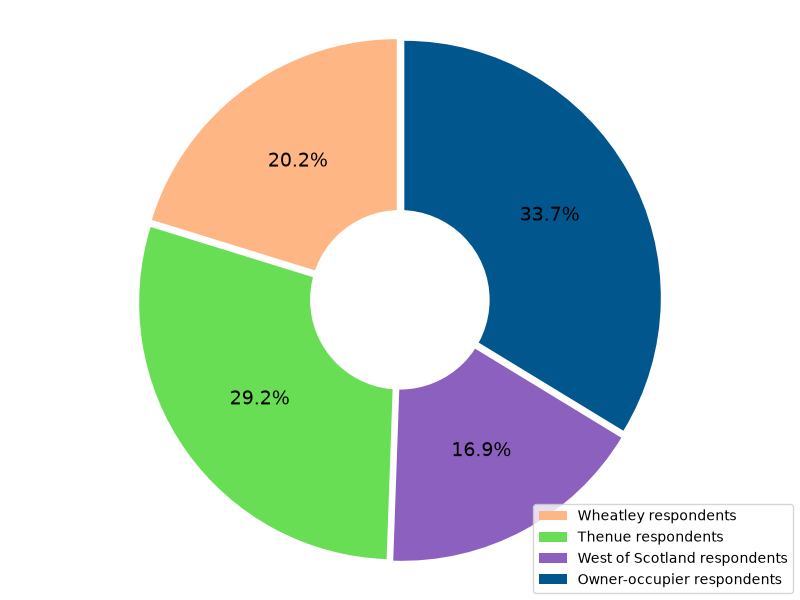
Dalmarnock Village comprises approximately 700 homes, around 400 of which are operated by housing associations and approximately 300 of which are owner-occupied. Owner-occupiers accounted for 33.7 per cent of respondents, while the remaining 66.3 per cent were social housing tenants. The distribution of housing association tenants broadly reflected the composition of social housing within the Village, with Thenue Housing Association tenants accounting for 29.2 per cent of respondents, Wheatley Homes Glasgow tenants 20.2 per cent, and West of Scotland Housing Association tenants 16.9 per cent.
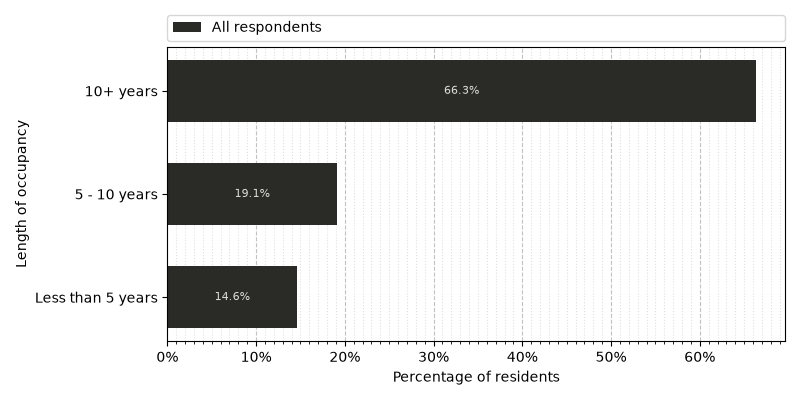
Two thirds of respondents (66.3 per cent) had lived in the Village since properties were first occupied by residents. By contrast, only 14.6 per cent reported having lived in their homes for less than five years. As a result, a substantial proportion of respondents were able to reflect upon housing conditions across much of the Village’s history.
Oral History
Oral History Theory
Oral history was chosen as a central component of the research methodology because of its ability to recover marginalised narratives and illuminate the emotional and experiential dimensions of wider social problems.3 While housing providers generate extensive documentation through repairs processes and inspection reports, these records often reveal relatively little about what it means to live with housing problems over extended periods of time. Residents’ experiences are therefore often mediated through institutional records that prioritise repairs, inspections, and administrative processes over lived experience.
This project adopts a reconstructive approach, utilising oral history as a form of recovery history in order to better understand residents’ housing experiences. According to Abrams, oral history as recovery history is defined as:
The practice of interviewing people to provide evidence about past events which could not be retrieved from conventional historical sources… or to uncover the hidden histories of individuals or groups which had gone unremarked upon in mainstream accounts.
L. Abrams, Oral History Theory (New York: Routledge, 2010) p.5
This approach is particularly relevant in the context of housing because it enables experiences that are only partially captured within institutional records to be recovered and understood from the perspective of residents themselves. Summerfield has drawn attention to the power of dominant discourses in shaping which experiences are prioritised, remembered, or silenced, and states that while oral history cannot ‘solve all the problems of cultural silence’, it does offer ‘legitimation […] to memories of experiences that have not been legendized, or that run counter to public discourse’.4 The oral history testimony within the report served not only as evidence, but as a method of recovering perspectives that might otherwise have remained obscured.
Oral history was therefore utilised for its ability to challenge hegemonic understandings of housing conditions as well as its capacity to prioritise the lived experience of working-class people and contest their marginalisation. Discussions of poor-quality housing have commonly been framed within narratives that emphasise individual behaviour, personal responsibility, and tenant failure, while obscuring the role of institutional neglect and structural conditions. This report challenges the mythology of working-class irresponsibility, with the testimonies of residents themselves offering a radically different interpretation of both the causes of housing problems and the experience of living with them.
Interview Design and Participants
The oral history interviews followed a semi-structured format. Interviewers worked from a common questionnaire to ensure that key themes were explored consistently across interviews while retaining sufficient flexibility for interviewees to focus on the issues most significant to them. The interviews began with a small number of background questions relating to participants’ housing tenure and length of residence within Dalmarnock Village before exploring the history of housing problems in their homes, including when issues first emerged, how they evolved over time, and the ways in which they affected everyday life. Particular attention was given to the physical, emotional, financial, and community impacts of housing conditions, alongside residents’ experiences of engaging with housing providers and navigating repair processes. Interviews concluded by inviting participants to reflect upon any additional experiences they considered important and the changes they wished to see. This approach created space for experiences and perspectives to emerge that may not have been captured through more structured methods of data collection.
All interviews were audio recorded and subsequently transcribed. Interviewees were provided with a Participant Information Sheet prior to the interview and completed an Informed Consent Form before participation. Following the interview, interviewees completed a Recording Agreement Form specifying how their interview material could be used and archived. To protect interviewees’ anonymity, all residents quoted or referred to in this report have been assigned pseudonyms. The names used throughout the report are therefore not their real names. Interviewees were also given the option of removing identifying information from transcripts up to and including their voice (in which case the audio file was deleted and only the transcript remained). Interview data was stored securely by Bridgeton CAB and Archives and Special Collections at the University of Strathclyde in accordance with interviewees’ consent preferences and relevant data protection requirements.
Interviewees were recruited through a combination of community outreach, campaign engagement activities, existing relationships with Bridgeton CAB, and snowball sampling. Recruitment took place through community meetings, workshops, social media, door-to-door engagement, and partnerships with local organisations, including Riverbank Primary School. Bridgeton CAB’s longstanding presence within the community and existing relationships with residents proved particularly valuable in supporting recruitment and building trust throughout the research process. Interviews were conducted between November 2025 and March 2026. While most interviews involved a single interviewee, two were conducted jointly: one with a mother and daughter and another with a husband and wife. In total, the oral history component involved twelve interviewees across ten interviews. Nine participating households were current residents of Dalmarnock Village, while one interview was conducted with a former resident. The interviews captured experiences across a range of housing tenures and providers, including owner-occupiers and tenants of Wheatley Homes Glasgow, Thenue Housing Association, and West of Scotland Housing Association.
Eleven interviewees had lived in the Village for more than ten years and had been the only occupants of their homes since moving into them, providing an exceptional perspective on the development’s condition over time. Women constituted the majority of interviewees, with nine women and three men taking part. This reflects longer-standing historical patterns within housing struggles. Working-class women have often been the people pursuing repairs, managing the consequences of housing failures, and organising collectively when institutions fail to respond. The prominence of women’s voices within the interviews therefore reflects not only the composition of interviewees but also the wider social realities of housing activism itself.
Footnotes
- Housing (Scotland) Act 1987. (1987). Part IV, ss. 85–87, The Tolerable Standard https://www.legislation.gov.uk/ukpga/1987/26/part/IV/crossheading/the-tolerable-standard ↩︎
- The spread of respondents roughly reflects the housing composition in Dalmarnock Village, with a slight underrepresentation of owner-occupiers (approximately 40% of housing in the Village area). ↩︎
- A. Thomson, Anzac Memories: Living with the Legend (New York : Oxford University Press, 1994); A. Portelli, They Say in Harlan County: An Oral History (Oxford: Oxford University Press, 2012); L. Abrams, Oral History Theory (New York: Routledge, 2010) ↩︎
- P. Summerfield, ‘Culture and Composure: Creating Narratives of the Gendered Self in Oral History Interviews’, Cultural and Social History, 1:1 (2004) p.93 ↩︎